Before Emerson, Lake & Palmer made keyboard-led progressive rock an arena language, The Nice tested its grammar in clubs and theatres. Their arrangements pulled Sibelius, Bach, Bernstein, Brubeck and jazz improvisation into British psychedelia, often with more aggression than reverence.
Keith Emerson’s stagecraft attracted attention, but the band’s history is not a solo preface. Davy O’List’s guitar gives the debut quartet its psychedelic volatility; Lee Jackson’s bass and unvarnished vocals stop the later trio from sounding conservatory-smooth; Brian Davison’s jazz-aware drumming makes abrupt changes of scale possible. Across studio songs, live adaptations and commissioned orchestral work, The Nice document progressive rock while its conventions were still unsettled.
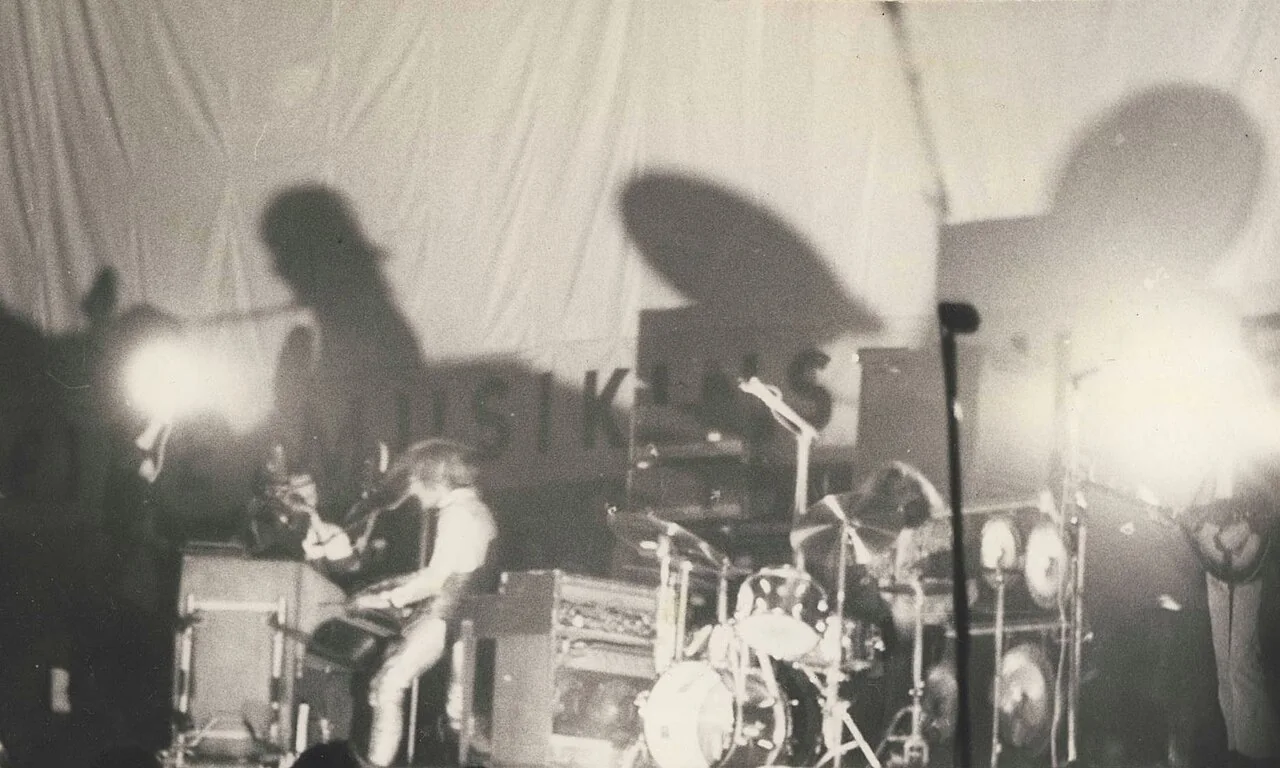
The Nice performing at the Ernst-Merck-Halle in Hamburg on 29 March 1970.Photo: Dr. Ronald Kunze / Wikimedia Commons · Licensed under CC BY 3.0. Converted to WebP for this page.
Formation & History
P. P. Arnold needed a backing group in 1967, and Keith Emerson assembled bassist Lee Jackson, guitarist Davy O’List and drummer Ian Hague. The musicians also played their own opening set. In October, after only a few months with Arnold, they became independent; Brian Davison replaced Hague, and the quartet continued as The Nice. O’List left in October 1968, leaving the organ-bass-drums trio heard across most of Ars Longa Vita Brevis, Nice and Five Bridges.
Their adaptation of Bernstein’s America joined a West Side Story melody to quotations, improvisation and confrontational performance, making Emerson’s rearrangement method visible beyond the albums. In 1969 he met King Crimson bassist and singer Greg Lake during a United States tour. Emerson announced his departure in early 1970 and formed ELP with Lake and Carl Palmer; The Nice completed its remaining commitments and ceased performing that year. Emerson, Jackson and Davison reunited for a four-date British tour in 2002 with members of the Keith Emerson Band; the Glasgow recording appeared as Vivacitas in 2003.
Sound & Style
Emerson treats Hammond distortion, feedback, percussive attack and organ registration as compositional resources rather than decoration. Jackson’s bass often works as both anchor and counterline, while Davison brings jazz accents and explosive transitions. Without a permanent guitarist after 1968, the trio makes the keyboard carry riff, harmony, noise and orchestral suggestion at once.
The repertoire matters as much as the instrumentation. Dave Brubeck’s Blue Rondo à la Turk, Sibelius’s Karelia Suite, Bach’s Brandenburg Concerto No. 3, Dylan songs and original pop material are not presented as museum pieces: they are cut apart, recombined and pushed through rock dynamics. The albums can feel unstable because songs, adaptations and large suites coexist, yet that instability is historically revealing: progressive rock is visibly forming rather than following established rules.
Essential Albums
1968
The Thoughts of Emerlist Davjack
Immediate · Original 1968 release
The Thoughts of Emerlist Davjack catches The Nice as a quartet and therefore contains colours absent from their later records. Davy O'List's guitar gives “Flower King of Flies” and “The Cry of Eugene” a distinctly psychedelic edge, while “Rondo” turns a jazz-derived theme into the platform for Emerson's aggressive organ language. The album still belongs to 1967 pop, with concise songs beside extended playing, but its collisions are the point. Rather than hearing an immature ELP, listen for four musicians discovering that arrangement, quotation and amplified improvisation could transform the shape of a rock album.
Key tracks: Flower King of Flies · Rondo · The Cry of Eugene
Ars Longa Vita Brevis makes The Nice's orchestral ambition explicit. Their treatment of Sibelius in “Intermezzo from the Karelia Suite” puts Hammond weight against a melody already carrying national and historical associations. The side-long title suite combines group sections, individual features and orchestra in a structure that is ambitious even when the joins remain audible. Davy O'List was leaving during the album's creation, so the music documents a band becoming a trio in public. Its imperfections are instructive: this is the progressive suite before the format became standardised.
Key tracks: Intermezzo from the Karelia Suite · Ars Longa Vita Brevis
Nice divides its attention between compact studio work and live performance. “Azrael Revisited” turns a familiar harmonic idea into a compressed keyboard attack, while Tim Hardin's “Hang on to a Dream” allows Emerson unusual restraint. The live “She Belongs to Me” expands Dylan through organ, rhythm and quotation, showing how radically the trio could remake outside material onstage. Jackson's voice remains an acquired taste, but its grain stops the quieter music from becoming sentimental. This is the clearest single record of The Nice as a functioning trio rather than a transitional project.
Key tracks: Azrael Revisited · Hang on to a Dream · She Belongs to Me
Five Bridges grew from a commission for the 1969 Newcastle Arts Festival. The suite connects Lee Jackson’s Newcastle imagery to Emerson’s writing for trio and orchestra; the album also places live orchestral material beside adaptations of Dylan, Tchaikovsky and Bach. It is the clearest evidence that The Nice had moved beyond inserting classical quotations into rock songs toward designing a complete concert work across several ensembles.
The post-breakup Elegy and the later BBC Sessions should be treated as archival extensions rather than additional studio chapters. They preserve alternate approaches to Dylan, Tchaikovsky and the core repertoire, while the documented BBC broadcasts from 1967 to 1970 show how frequently arrangements changed outside the album versions. The 2002 reunion belongs to a different context again: an Emerson–Jackson–Davison return supported by guitarist Dave Kilminster and the Keith Emerson Band.
The Nice made the keyboard trio imaginable as a major rock format and showed that classical material could be rearranged, distorted and argued with instead of respectfully reproduced. Their recordings also expose the risks of that method: the collision between Jackson’s rough voice, Emerson’s virtuosity, Davison’s rhythmic freedom and orchestral scale never becomes seamless, which is precisely why the music retains tension.
Their best work is not merely an ELP preface. It preserves a wilder psychedelic moment in which club improvisation, compact pop, commissioned concert music and provocation still occupied the same project. ELP would make some of these ideas more controlled and commercially durable; The Nice let listeners hear them being invented in public.
RetroForge Records publishes original music and independent editorial guides. This historical band guide is not affiliated with the artist, labels or rights holders. No unlicensed album artwork is reproduced.