
Overview
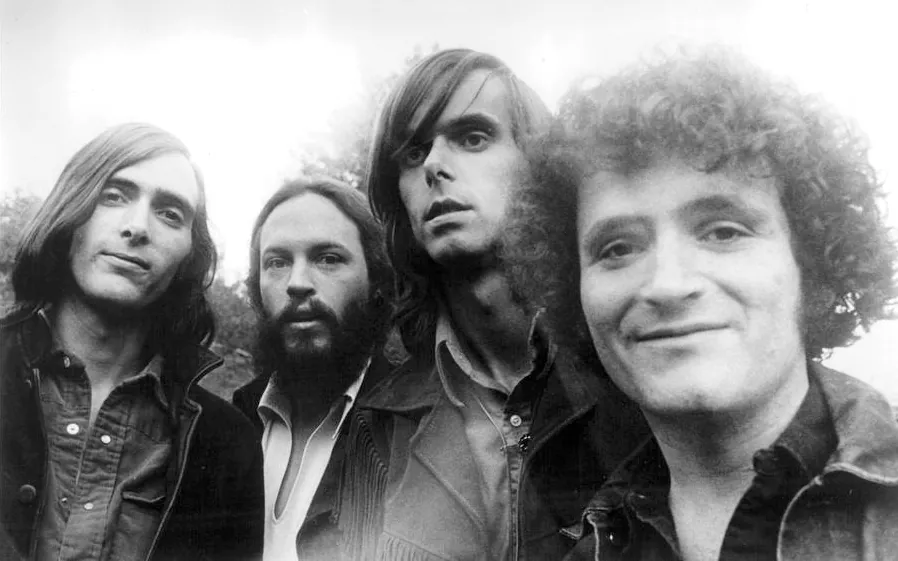
Quicksilver Messenger Service belonged to the first wave of San Francisco psychedelic groups alongside Jefferson Airplane and the Grateful Dead. Their most stable early recording lineup—John Cipollina and Gary Duncan on guitars, David Freiberg on bass and vocals, and Greg Elmore on drums—did not issue an album until 1968, after years of local performances. That delay meant the debut captured a working ensemble rather than a group assembled inside the studio.
The early catalogue moves between compact folk- and blues-derived songs and long instrumental development. Happy Trails makes the contrast explicit: a full side grows from Bo Diddley's “Who Do You Love”, while the second side passes through Duncan's “Mona” and “Maiden of the Cancer Moon” before Cipollina's “Calvary”. Later personnel changes brought Nicky Hopkins's piano and then Dino Valenti's more vocal- and song-led direction, making “the Quicksilver sound” a sequence of distinct phases rather than one fixed formula.
Formation & History
The group's beginnings are often compressed into a story about Dino Valenti, but the surviving accounts do not support calling him a performing member of the classic 1965–68 band. Valenti, who wrote “Get Together”, was connected to early plans with Cipollina before imprisonment removed him from the developing group. Cipollina, Duncan, Freiberg, Elmore and singer-harmonica player Jim Murray formed the first recognised lineup; Murray left in 1967 before the Capitol albums were recorded.
The quartet made Quicksilver Messenger Service and the largely live Happy Trails. Duncan then left, and Nicky Hopkins joined Cipollina, Freiberg and Elmore for Shady Grove. Duncan returned in 1970 together with Valenti, whose songs—often credited to his pseudonym Jesse Oris Farrow—dominate Just for Love and much of What About Me. Cipollina and Hopkins departed during this period, and Freiberg left in 1971. Further lineups recorded and toured through the 1970s, with a 1975 reunion album, Solid Silver, bringing Cipollina, Duncan, Freiberg, Elmore and Valenti back onto one record.
The original era ended in 1979, but the name did not. Duncan later led Quicksilver projects, and from 2006 he and Freiberg again performed under the full name. David Freiberg's Quicksilver Messenger Service subsequently continued with a later ensemble; its current official site distinguishes that group from the original Capitol-era lineups.
Sound & Style
Cipollina built his sound around rapid vibrato-bar movement, fingerpicking and a custom amplifier system that separated bass and treble pickup signals across Standel and Fender amplifiers with conventional speakers and Wurlitzer horns. The result could move from a thin, vocal-like cry to a hard metallic attack. Duncan generally supplied a rounder, more flowing line. On Happy Trails, the two do not stay in fixed lead and rhythm roles: phrases overlap, separate and regroup over Freiberg and Elmore's changing pulse.
The arrangements are equally important. “Gold and Silver” adapts the five-beat logic associated with Dave Brubeck's “Take Five” into a guitar instrumental; the “Who Do You Love” sequence distributes individual showcases across a continuous Bo Diddley frame. With Duncan absent, Shady Grove gives Hopkins's piano a structural role, especially on his instrumental “Edward, (The Mad Shirt Grinder)”. Valenti's return shifts the centre toward repeated vocal hooks, acoustic texture and countercultural lyrics. Those changes are audible evidence of different working lineups, not a simple progression from “pure” early work to inferior later music.
Essential Albums
Happy Trails
1969Happy Trails turns concert tapes into a deliberately shaped album. Side one frames individual episodes by Freiberg, Duncan, Elmore and Cipollina inside the “Who Do You Love” sequence, preserving the sense of musicians handing the centre to one another. Side two moves from Duncan's Bo Diddley adaptation “Mona” through the collective “Maiden of the Cancer Moon” into Cipollina's studio-completed “Calvary”, then closes with the brief Roy Rogers theme. The edits create an album argument about live interaction rather than pretending to reproduce one uninterrupted show.
Key tracks: Who Do You Love suite · Mona · Calvary
Open album guide → View on Amazon →Shady Grove
1969Shady Grove documents a different four-piece after Duncan's departure. Nicky Hopkins does not merely fill the missing guitar space: his piano redirects the arrangements, from the rolling title song and Freiberg's vocal writing to the long instrumental “Edward, (The Mad Shirt Grinder)”. Cipollina's sharply inflected guitar now works against piano rather than a second guitarist, while “Flute Song” brings Freiberg's viola and guest woodwind colour forward. It is best heard as a lineup-specific studio album, not as a failed continuation of Happy Trails.
Key tracks: Shady Grove · Holy Moly · Edward, (The Mad Shirt Grinder)
Open album guide → View on Amazon →The 1968 debut compresses the quartet's stage language into six studio tracks. Hamilton Camp's “Pride of Man” foregrounds Freiberg's voice and the band's dynamic control; Valenti's “Dino's Song” supplies a concise melodic contrast. “Gold and Silver” puts the guitars over an asymmetrical pulse, while the twelve-minute “The Fool” moves from sung material into sustained instrumental development. The production is more contained than the following live album, which makes the division of roles inside the quartet unusually clear.
Key tracks: Pride of Man · Gold and Silver · The Fool
Open album guide → View on Amazon →Affiliate note: Amazon links on this page may earn RetroForge Records a small commission, at no extra cost to you.
Deeper Cuts
Just for Love
1970Just for Love introduces Valenti as the dominant singer and writer while restoring Duncan to the lineup. Recorded during the group's Hawaii period and completed in California, it favours linked short pieces, acoustic guitars and recurring vocal phrases over the long concert architecture of Happy Trails. “Fresh Air” gives the expanded band its clearest compact groove; the title material appears in multiple parts, making repetition part of the album's design rather than simply a bid for accessibility.
Open album guide → View on Amazon →What About Me
1970What About Me draws on the same broad 1970 period but is less unified by one location or lineup. Valenti's title song and “Local Color” sit beside Duncan's “Subway”, Freiberg's “Baby Baby” and Hopkins's instrumental “Spindrifter”; Mark Naftalin appears on several tracks as the keyboard personnel changes. That patchwork quality is the point of interest: the record catches the Cipollina–Hopkins phase giving way to the leaner Valenti–Duncan group.
Open album guide → View on Amazon →Why They Still Matter
Quicksilver's lasting contribution is a practical model of collective guitar improvisation. Cipollina and Duncan could exchange foreground and support without reducing the music to alternating solos, while Freiberg and Elmore made metre and dynamics flexible enough for long pieces to change direction. Happy Trails preserves that method through editing as well as performance: its suite is constructed from live tapes but still feels governed by the musicians' responses in the moment.
The later records matter for a different reason. Hopkins demonstrates how the group could reorganise around piano, while Valenti's return tests the improvising identity against repeated songs and a stronger authorial voice. The band's history is messy, with overlapping revivals and contested origin stories, but the best records make those changes audible. Cipollina's preserved amplifier rig at the Rock & Roll Hall of Fame is a physical reminder that this language depended on designed equipment, touch and ensemble listening together.
Sources & Further Reading
Connected archive routes
Explore This Band
Continue through the RetroForge knowledge graph
Curated paths into the people, records, events and ideas that give this subject its wider musical context.