Pulse Supplies Coordinates
Repeating events help the listener measure otherwise abstract motion.

Krautrock & Electronic Family
Electronic music using synthesis, signal and long-form motion to make distance itself audible.
The Sound
Space electronic music is defined less by science-fiction titles than by the way it constructs scale. A small pulse can suggest orbital motion; a sustained chord can become a horizon; filter movement can make an apparently static field feel as though it is crossing enormous distance.
The route overlaps with Berlin School, ambient electronic and cosmic music. Space electronic usually keeps a stronger sense of journey, whether through sequencer movement, thematic return or gradual changes that imply departure and arrival.
Oxygen Cathedral is a cosmic psychedelic progressive album rather than a pure electronic release. It is included as the catalogue’s closest bridge because Moog, signal texture and deep-space atmosphere are central to its documented palette.
What You’ll Hear
How It Works
Space electronic music uses sequence, drone, noise and spatial depth to create the sense of departure, transit and remote arrival. Unlike rock-centred space music, propulsion can be produced entirely through electronic patterns and changes in timbre.
Listen for navigation. A pulse may function like a coordinate, a returning sound like a beacon and a harmonic field like the environment through which the piece moves. The journey becomes convincing when these elements establish distance and change, not merely atmosphere.
Useful distinction: Boundary line: electronic music with a space title is not necessarily space electronic. The composition must make scale and travel audible.
Repeating events help the listener measure otherwise abstract motion.
Texture gives the imagined space material resistance.
Recurring sounds provide orientation across long forms.
The ending reveals distance by sounding unlike the point of departure.
Historical Development
Space electronic music uses synthesizers, sequencers and studio processing to construct journeys defined by scale, transmission and imagined distance. It shares personnel and techniques with progressive electronic and Berlin School, but its identity is more explicitly spatial. The arrangement often behaves like travel: departure, acceleration, suspended drift and return.
The style became especially visible in the 1970s as electronic instruments acquired wider pitch stability, sequencing and multitrack control. Vangelis could perform cosmic drama in real time; Jean-Michel Jarre built precise layers; Tangerine Dream used repetition to turn duration into movement. Film, planetarium and science programming gave this sound a public visual vocabulary.
Celestial titles are not enough. A convincing space-electronic record creates depth through register, stereo placement, reverberation and the relationship between pulse and sustained tone. The listener should sense changing distance even when no narrative is stated.
The Real-World Foundations
Not a ranking: six useful doors into the style.
Sequenced movement, guitar and melodic clarity turn electronic abstraction into travel.
Astronomy, expressive synthesis and rhythmic drama create a richly physical cosmos.
Layered melody and spacious production make electronic distance immediately legible.
A continuous cycle refines movement between atmospheric drift and electronic pulse.
Slow melody, sustained tone and electronic landscape open a contemplative route.
Serge synthesizer and long harmonic arcs evoke space without relying on conventional rhythm.
Research Trail
Closest RetroForge Route
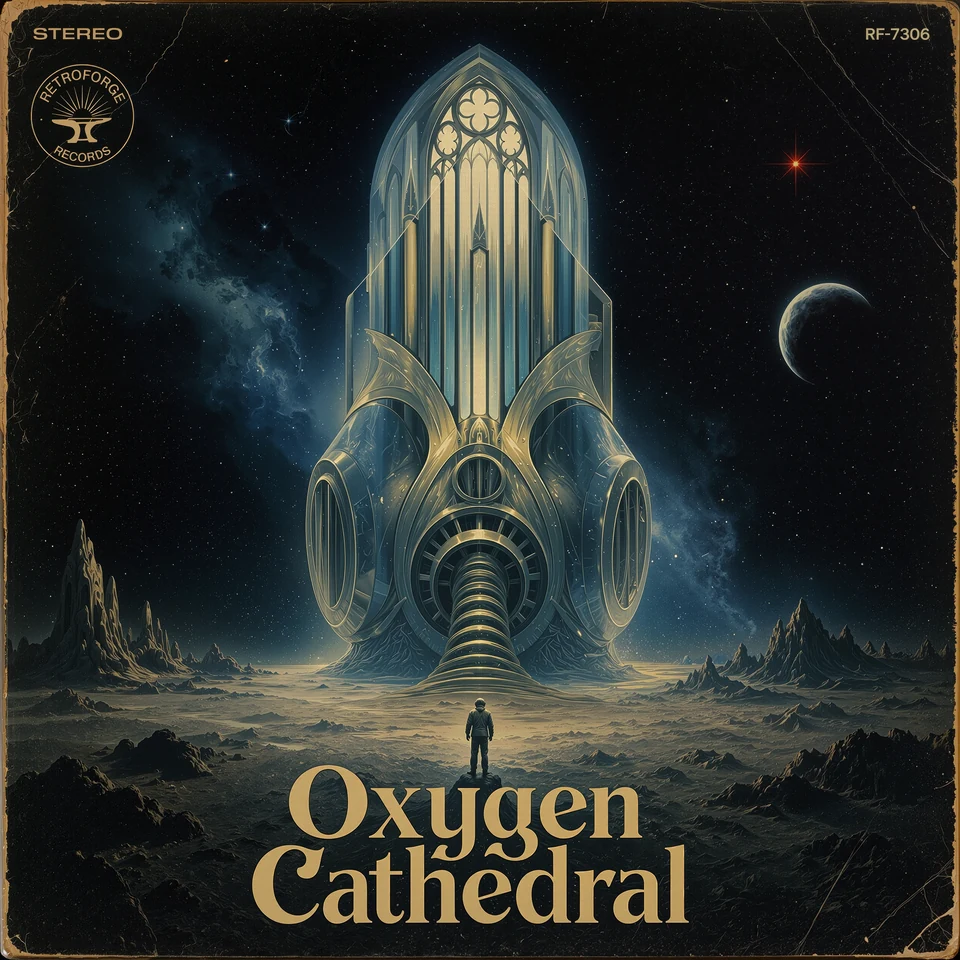
Adjacent: Cosmic Psychedelic Progressive Rock
Moog signals, Mellotron atmosphere and a journey measured against planetary memory.
Open the liner notes →Questions from the Record Room
Space music is an even broader listening category; space electronic specifically foregrounds electronic instruments and studio construction.
No. Spatial production and large-scale musical movement can establish the identity without a literal story.
Berlin School is a historical and technical lineage; space electronic includes artists from elsewhere and gives cosmic scale greater priority than one sequencing method.
Deeper Discovery
Start with A System Without Voices as a RetroForge companion, then return through Progressive Electronic to place it inside the wider family.
Curated paths into the people, records, events and ideas that give this subject its wider musical context.