Sequence Creates Travel
Repeating notes function as propulsion rather than accompaniment.

RetroForge Genre Guide
Analogue sequencers, slow harmonic change and electronic landscapes that develop across an entire album side.
The Sound
Berlin School electronic music emerged from the experimental German underground and made the synthesizer a complete long-form ensemble. Instead of using electronics as decoration, its key works build form from sequencer patterns, sustained tones, filter movement, tape effects and patient changes in density.
A repeating sequence supplies motion without behaving like a conventional rock groove. Notes can be added, removed or re-accented while the harmonic field changes slowly around them. The listener experiences development through texture and proportion: a pulse appears from noise, grows into architecture and eventually dissolves.
The style overlaps with krautrock and kosmische music, but the emphasis here is on synthesizer-led composition. Drums and guitars may appear, yet they are not required. Length is functional because small electronic changes need time to become physical.
What You’ll Hear
How It Works
Berlin School electronic music turns repeating analogue sequences into an engine for extended composition. Patterns establish velocity and scale while drones, Mellotron-like colour, improvised leads and gradual filter changes reshape the space around them.
The form often develops by accumulation. One sequence begins, a second changes the implied accents, harmony shifts beneath both and the listener discovers that a apparently stable machine has travelled far from its starting point.
Useful distinction: Boundary line: an arpeggiator pattern is not enough. Berlin School depends on long-range transformation, electronic performance and the architecture built around repetition.
Repeating notes function as propulsion rather than accompaniment.
Crossing patterns can alter where the listener feels the pulse.
Lead lines explore the scale established by the machines.
The full structure becomes clear only across an extended span.
Choose one sequence and notice when its accents, register or surrounding harmony change. Berlin School development is often gradual enough to be missed in the moment; its scale becomes clear when you compare where the piece began with where it has arrived.
Useful distinction: motorik krautrock usually depends on a physical rock rhythm section. Berlin School can create forward motion entirely through electronics.
RetroForge Connections
The catalogue does not yet contain a pure Berlin School release.
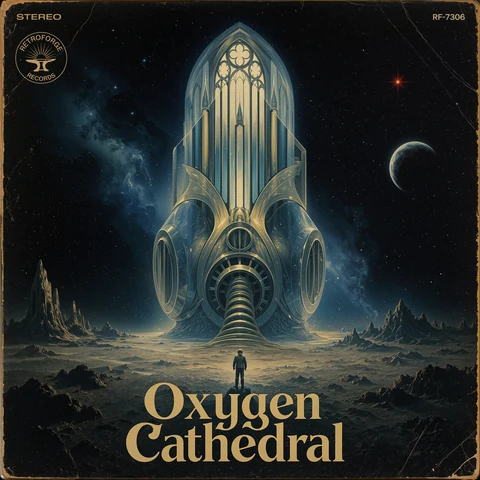
Radio signals, Moog and sustained cosmic atmosphere provide the closest electronic bridge.
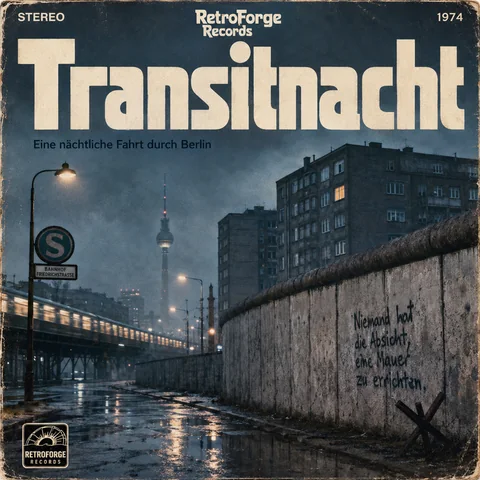
More rhythm-section driven, but connected through analogue repetition, tape loops and night travel.
Historical Development
Berlin School electronic music developed from the experimental culture around West Berlin at the beginning of the 1970s. Tangerine Dream, Klaus Schulze and related musicians moved from free-form psychedelic performance toward long instrumental works shaped by synthesizers, tape, organ and, increasingly, analogue sequencers. The name was applied retrospectively to a lineage rather than announced as a formal movement.
Sequencing changed the architecture. A repeating voltage pattern could establish pulse without a drummer, then alter one note, accent or filter setting at a time. Over that grid, sustained chords, improvised leads and noise created a second timescale. Phaedra, Rubycon, Timewind and Moondawn made this slow negotiation between pattern and atmosphere the centre of an album side.
The language influenced film scoring, ambient music, new age, techno and trance, but its classic form is neither background music nor dance music. It asks for attention to gradual instability: analogue equipment slips, patterns mutate and a piece that appears static is continually becoming something else.
The Real-World Foundations
Not a ranking: six useful doors into the style.
Unstable Moog sequencing gives the school its decisive recorded breakthrough.
Two continuous sides refine the balance of pulse, drift and improvised electronic detail.
Patient harmonic scale and repeating systems create a deeply immersive solo architecture.
Sequencer momentum and Harald Grosskopf's drums produce a powerful hybrid form.
Manuel Göttsching gives the language unusual melodic calm and transparency.
Interlocking sequences and broad harmonic motion provide a late classic of the first era.
Questions from the Record Room
The label identifies a lineage associated with Berlin-based musicians and studios, especially Tangerine Dream and Klaus Schulze.
A sequencer can organise pitch, accent and timbre as well as pulse, allowing harmonic pattern and rhythm to evolve together.
It can be atmospheric, but classic Berlin School usually has stronger forward pattern and dramatic development than ambient music requires.
Research Trail
Historical Routes
Deeper Discovery
Start with Der Eiserne Traum as a RetroForge companion, then return through Krautrock to place it inside the wider family.
Curated paths into the people, records, events and ideas that give this subject its wider musical context.