
History Archive · 1981
Moving Pictures: How Rush Brought Prog into the Eighties
Moving Pictures did not make Rush less progressive. It made development, odd metre and instrumental precision function inside a modern radio-scale album.
What Happened
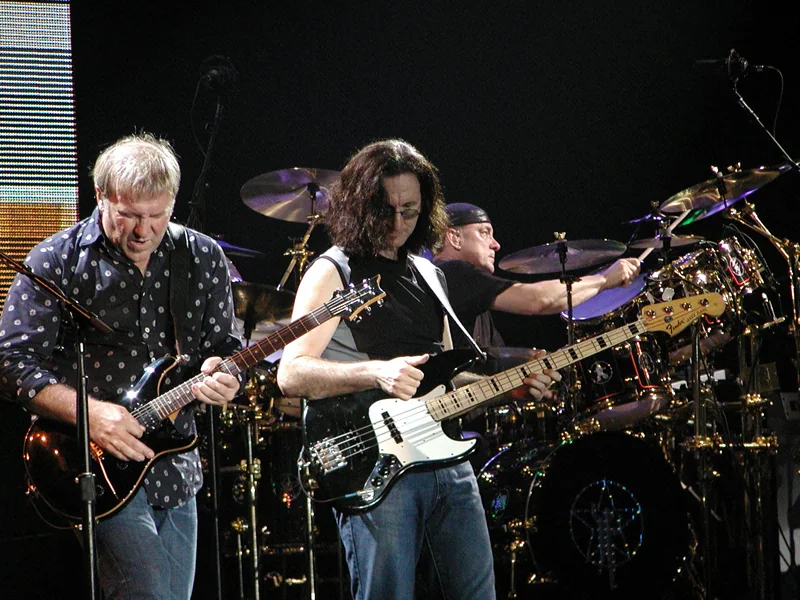
Rush recorded Moving Pictures at Le Studio in Quebec in late 1980 and released it in February 1981. The album followed Permanent Waves in moving away from side-long suites without abandoning complex arrangement or conceptual writing.
“Tom Sawyer”, “Limelight”, “Red Barchetta” and the instrumental “YYZ” became lasting parts of the band’s repertoire. The album reached number three in the United States and Britain and became Rush’s most commercially successful studio recording.
What the Music Sounded Like
Geddy Lee’s bass and synthesizers, Alex Lifeson’s spacious guitar and Neil Peart’s exact drumming share equal structural weight. “YYZ” turns an airport identification rhythm into a concise instrumental; “The Camera Eye” retains the longer form.
How It Was Made
Rush and producer Terry Brown recorded and mixed the album at Le Studio. The setting allowed the trio to combine live ensemble precision with synthesizer sequencing, guitar layering and sharply separated production.
The Wider Musical Context
MTV launched later in 1981, new wave had changed keyboard vocabulary and heavy metal was entering a more technical phase. Rush could communicate with all three environments without belonging completely to any of them.
What Followed
The band moved further toward synthesizers on Signals. For later progressive and metal musicians, Moving Pictures became proof that difficult playing and immediate songs were not opposites.
Complexity Learned to Move at Radio Speed
Rush did not abandon progressive rock on Moving Pictures; the band concentrated it. “Tom Sawyer,” “Red Barchetta,” “YYZ” and “Limelight” place unusual meters, instrumental precision and conceptual writing inside forms that announce themselves quickly. The listener can enter through a riff or chorus before discovering how much information the arrangement is carrying.
This compression had already begun on Permanent Waves. By 1981, it had become a confident language rather than a compromise. “YYZ” turns the rhythmic spelling of Toronto Pearson Airport’s code into a compact instrumental, while “The Camera Eye” preserves Rush's longer-form tradition in a ten-minute piece. Accessibility and duration coexist on the same record instead of competing for control.
Le Studio Became a Working Environment, Not a Myth
The album was recorded and mixed from October to November 1980 at Le Studio in Morin-Heights, Quebec, with longtime producer Terry Brown. The location gave the trio space to refine demanding performances while maintaining the clarity required by shorter arrangements. Geddy Lee’s bass and synthesizers, Alex Lifeson’s layered guitars and Neil Peart’s acoustic and electronic percussion occupy distinct positions without losing collective force.
Technology appears as both subject and instrument. “Vital Signs” draws reggae and new-wave influence into Rush’s vocabulary while its language of interference, information and systems mirrors the production. Synthesizers no longer arrive as orchestral decoration. They organise space, share melodic responsibility and point toward the more keyboard-driven records that followed.
Seven Tracks, Seven Different Pressures
“Red Barchetta” turns a story inspired by Richard S. Foster’s “A Nice Morning Drive” into physical motion: machinery, landscape and forbidden freedom heard through acceleration. “Limelight” examines the emotional cost of public visibility from inside a band becoming more famous. “Witch Hunt,” part of Peart’s “Fear” sequence, slows the album into ritual menace and warns how prejudice becomes collective action.
The variety never feels like a compilation because the record shares one discipline. Introductions are economical, instrumental sections change the argument rather than pausing it, and every player understands when to leave space. Even the cover makes compression playful: people move paintings, observers are emotionally moved and a film crew makes a moving picture. The visual pun reflects an album designed to operate on several levels without becoming obscure.
Prog Entered the Eighties by Changing Its Proportions
Moving Pictures became Rush’s most commercially successful studio album and reached number one in Canada and number three in both the United States and United Kingdom. That success matters because it contradicts a common history in which progressive rock simply vanishes after punk. The audience remained; the successful form had changed.
Later progressive metal and technical rock inherited the album’s balance of discipline, heaviness and concision. New-wave rhythm and synthesizer music also entered Rush’s next phase. The record’s achievement is not that it made difficult music harmless. It made every complicated decision serve momentum, proving that an album could be immediate on first contact and still reveal new internal systems after decades of listening.
Essential Listening
- Rush — Tom Sawyer
- Rush — Red Barchetta
- Rush — YYZ
- Rush — Limelight
- Rush — The Camera Eye
Related Genres and Guides
Related RetroForge listening
Hear the Archive Connection
Research notes
Sources and Further Reading
- Moving Pictures — Rush
- Moving Pictures 40th Anniversary — Rush
- Moving Pictures UK chart history ? Official Charts