
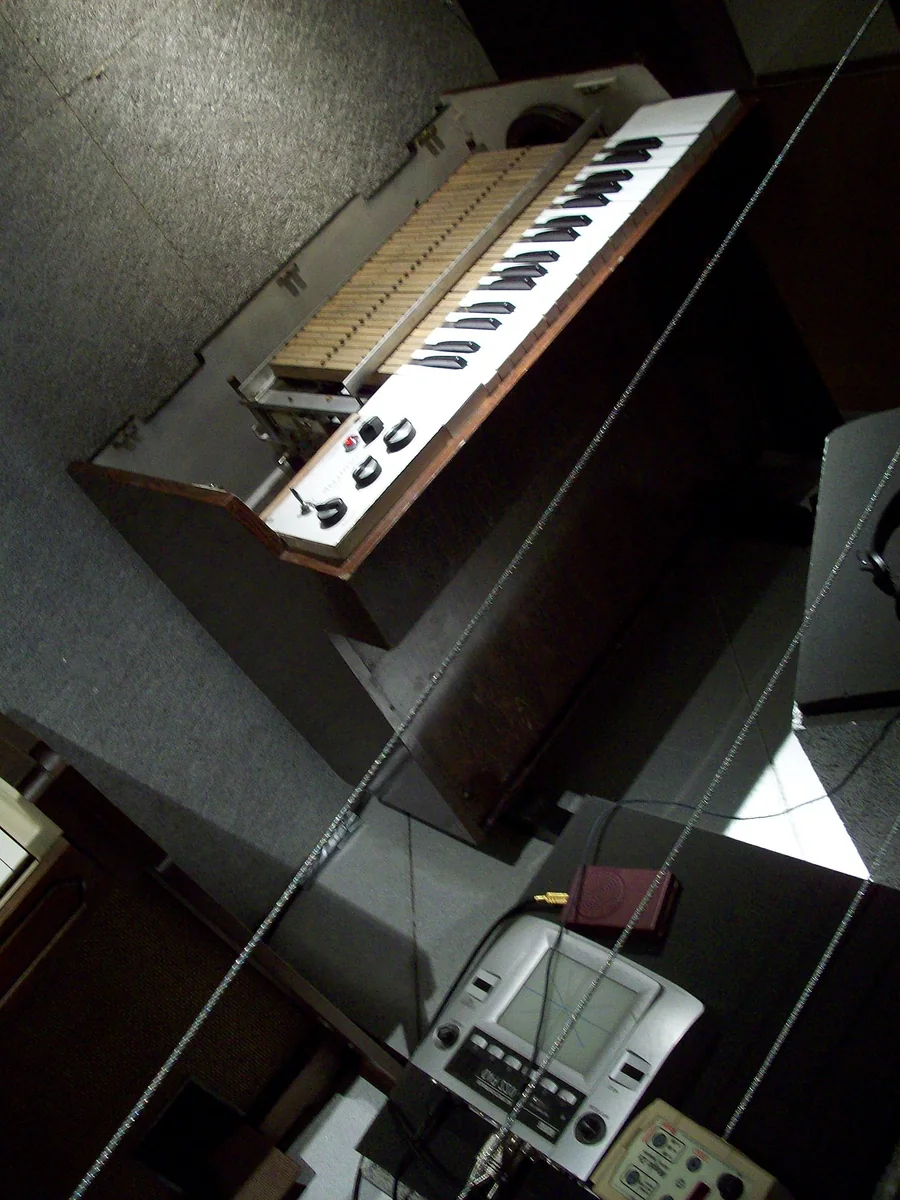
Then you have to release the keys and let the mechanism reset. This is how progressive rock got some of its most enormous choirs, most mournful strings and most ghostly flutes. Not with an orchestra. With dozens of tiny tape recordings being dragged through a temperamental wooden keyboard. The Mellotron should have been a transitional technology. Instead it became an emotional language.
It Was Never Really an Orchestra
The easiest way to misunderstand the Mellotron is to judge it by how accurately it reproduces acoustic instruments. Its strings do not sound exactly like a string section. Its choir does not behave like a choir. Its flute does not respond like a flautist standing in the room. Good. That gap between the real source and the reproduced result is where the Mellotron becomes interesting.
The original recordings contain real bow movement, breath, vocal tone and instrumental attacks. But those performances are detached from their original musical context and placed under a keyboard player's fingers. A player or small ensemble recorded a note years earlier. Now a rock musician presses a key and turns that recorded note into part of a chord the original performers never played as a chord.
The source is human. The result is strangely inhuman. That contradiction is the Mellotron. For the full mechanical background, see What Is a Mellotron?.
Progressive Rock Needed Scale
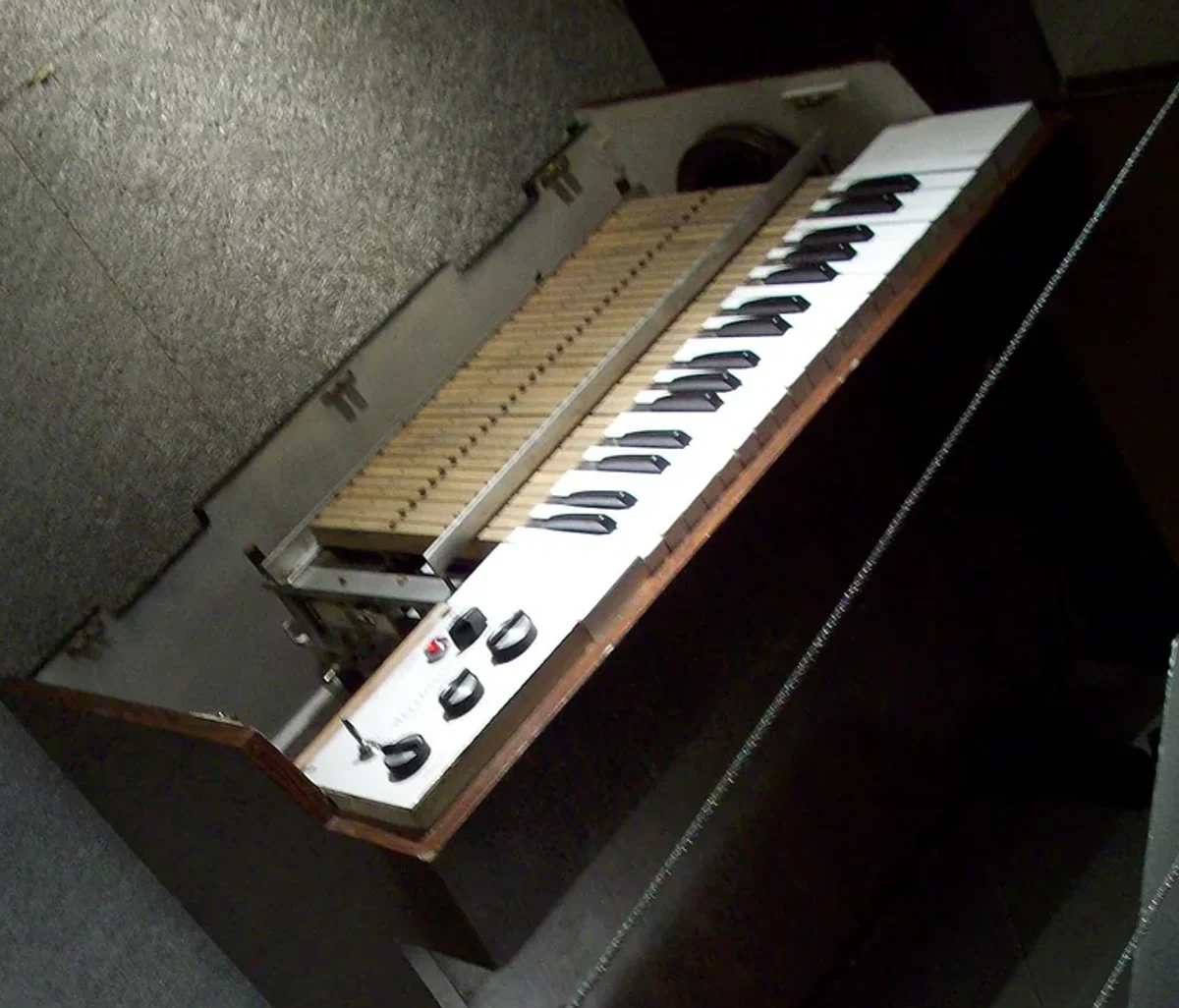
By the early 1970s, ambitious rock bands were asking their music to do things that a standard guitar-bass-drums lineup could not always provide easily. A composition might need to move from a quiet pastoral passage into something almost orchestral. A chorus might need voices larger than the band. A climax might demand strings. A bridge might need a colour that was neither guitar, organ nor piano.
Hiring an orchestra was possible, but expensive and logistically complicated. Touring with one was another matter entirely. The Mellotron compressed orchestral suggestion into a keyboard. Not orchestral accuracy. Orchestral suggestion. That distinction made it far more useful to progressive rock than a perfect imitation might have been. A Mellotron could fill the horizon without making the band sound as if a conventional orchestra had suddenly walked into the studio.
Three Sounds, Three Different Worlds
The classic Mellotron palette offered many tape sets, but three sounds became especially important to progressive and psychedelic music.
Strings
Mellotron strings can be beautiful, but they rarely sound comfortable. There is a grain in them. The attacks are slightly detached from one another. Pitch may wander. The recorded bowing remains trapped inside the note. When a chord is played, those separate performances stack into a moving texture. Real strings can sound luxurious. Mellotron strings often sound ancient.
That made them ideal behind electric guitar, voice or Hammond organ. They could enlarge a section while preserving ambiguity. Triumphant? Possibly. Mourning? Also possible. A single chord can contain both.
Choir
The choir tapes are even stranger. Human voices were recorded across separate notes and then placed under a keyboard player's control. There are no words forming a new sung phrase, no shared breath across the chord and no choir in the room deciding how that new progression should swell. Yet the ear still hears human presence. That produces a peculiar emotional distance. A real choir inhabits a room.
A Mellotron choir can sound as if the room is remembering a choir that has already left. Progressive rock, with its fascination for vast spaces, mythology, decay, technology and inner landscapes, could do a lot with that.
Flute
Then there is the famous flute sound, gentler and more intimate. The recording preserves enough breath and human attack to feel organic, but the keyboard allows the musician to phrase it in ways no single flute performance originally contained. Placed beside acoustic guitar or a soft vocal, it can make a recording feel pastoral without becoming orchestral.
That mattered because progressive rock thrived on contrast. The same album that gave you a choir large enough to open the heavens might, five minutes later, reduce itself to flute, twelve-string guitar and one voice. The Mellotron could survive both worlds.
It Was the Perfect Partner for the Hammond
Progressive keyboard rigs became crowded for a reason. A piano does one job. A Hammond does another. A synthesizer opens another door. The Mellotron occupies a space none of them quite reach. The Hammond organ is physical and assertive. Through a Leslie speaker, it has movement, bite and tremendous authority. Push it and it can challenge a distorted guitar.
The Mellotron usually behaves differently. It sits behind. It extends. It stains the air around the arrangement. That is why the two work so well together. A Hammond can define the structure of a chord progression while Mellotron strings widen it. The organ can attack a rhythmic figure while a choir hangs behind it. One has muscle.
The other has distance. Progressive rock loved combinations of timbres that allowed several layers to remain recognisable, and this pairing offered enormous range without requiring a vast ensemble.
Listen to How It Makes Space for Guitar
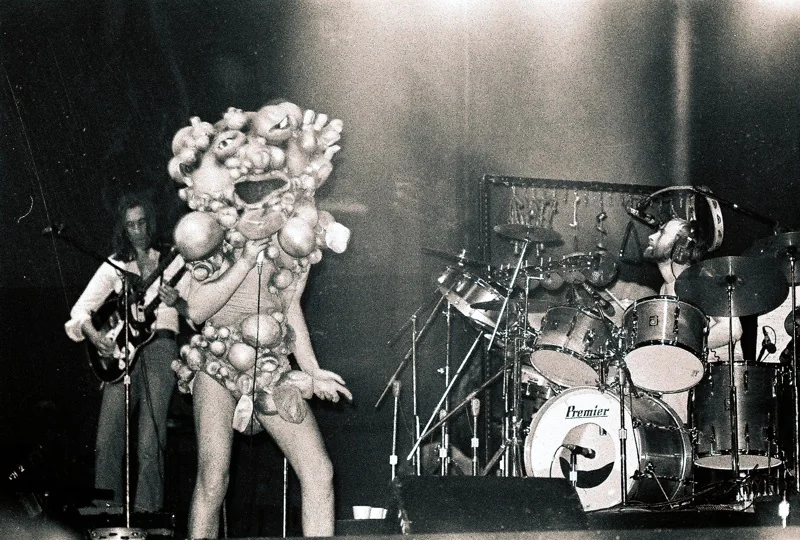
A common mistake when discussing "big" rock production is to assume every instrument must itself sound enormous. Classic progressive arrangements often do the opposite. The guitar is allowed to occupy the foreground. Bass and drums provide weight. Hammond supplies harmonic force. Mellotron creates the background plane. This separation makes the full arrangement feel bigger than any individual part.
A wall of overdubbed modern guitars can fill nearly the entire spectrum. A single guitar line against Mellotron strings can feel larger because the ear perceives depth. The guitar is here. The Mellotron is somewhere behind it. The mix gains perspective.
The Eight-Second Problem Became Musical Grammar
Hold a note on a piano and, depending on the instrument and pedal, it decays naturally. Hold a note on a synthesizer and it can theoretically continue indefinitely. Hold a key on a classic Mellotron and you are working against a clock. After roughly eight seconds, the prerecorded tape reaches its end. Players learned ways around this. Chords could be retriggered. Notes could be staggered. Voicings could shift before the tape ran out.
Those workarounds became phrasing. The machine forces the musician to refresh the texture. A sustained chord cannot remain static forever. Something has to move. It is an excellent example of a limitation becoming style without anybody planning it. Modern instruments can reproduce Mellotron samples with infinite sustain. Ironically, many musicians still prefer to imitate the old restriction because the restriction helps the part breathe.
The Wobble Matters
Pitch instability is not a romantic concept when you are on stage and your keyboard has gone out of tune. For musicians who had to maintain and tour Mellotrons, the instrument's mechanical sensitivity was a genuine problem. Temperature changes mattered. Transport mattered. Tape condition mattered. Adjustment mattered. The instrument could be unreliable in exactly the situations where a touring rock band most needed reliability.
But slight instability also contributes to the sound that later generations tried so hard to recreate. If several notes drift minutely around one another, the chord does not feel frozen. It moves. A perfectly stable sampled choir can be magnificent. A slightly unstable tape choir can feel vulnerable. That vulnerability is difficult to fake if everything is too perfect.
Why Didn't They Just Use Real Strings?
Sometimes they did. Progressive rock records contain genuine orchestras, string sections, brass players and choirs. The Mellotron did not replace them universally. It offered a different thing. Real orchestration brings the expressive behaviour of many musicians. A Mellotron brings the memory of those musicians, mechanised and reorganised. That difference is audible. If you want the sweep of a real string arrangement, hire strings.
If you want something that sounds orchestral but belongs to a parallel world, the Mellotron starts to make sense.
It Matched Progressive Rock's Favourite Subject: Time

This may be one reason the instrument still feels so appropriate to the genre. A Mellotron is built from recordings of moments that have already happened. The key does not generate a violin. It replays a captured violin. Every chord is therefore assembled from preserved fragments of the past. That is a beautiful fit for a genre repeatedly drawn to memory, history, mythology, futurism and the collision between old and new forms.
Classical timbres arrive through modern machinery. Human performance arrives through magnetic storage. An acoustic past is controlled by an electronic present. The technology itself contains the kind of contradiction progressive rock liked writing about.
From Studio Tool to Genre Symbol
Eventually the Mellotron became more than an instrument. It became a signal. Hear those strings and a particular family of records comes into view: symphonic prog, psychedelic rock, early art rock, progressive folk, certain forms of space rock. That association became so strong that modern artists can invoke an era with a few carefully chosen Mellotron chords.
This is useful, but dangerous. Used lazily, the instrument becomes vintage wallpaper. Used well, it still does what it did fifty years ago: alter the emotional size of a room. The key is not to ask, "Where can we add Mellotron?" Ask what the arrangement is missing. Distance? Fragility? Grandeur? Unease? A sense that the music has opened onto somewhere larger than the band? That is where it earns its place.
The Great Irony
Modern technology can reproduce the Mellotron with far greater reliability than the original machine. No fragile tape mechanism. No tuning panic. No eight-second ceiling unless you want one. No enormous wooden box sulking in the back of a van. And yet digital Mellotron emulations frequently include controls for tape wear, wobble, noise and instability. Half a century of engineering gave us the power to remove the instrument's flaws.
Then musicians asked for buttons to put them back. That tells you almost everything. The Mellotron's imperfections were never separate from its identity. They were its identity. Progressive rock loved the Mellotron because it could make a band sound larger without making it cleaner, grander without making it safer, and orchestral without ever quite becoming an orchestra. It offered scale with cracks in it. And through those cracks came the atmosphere.