
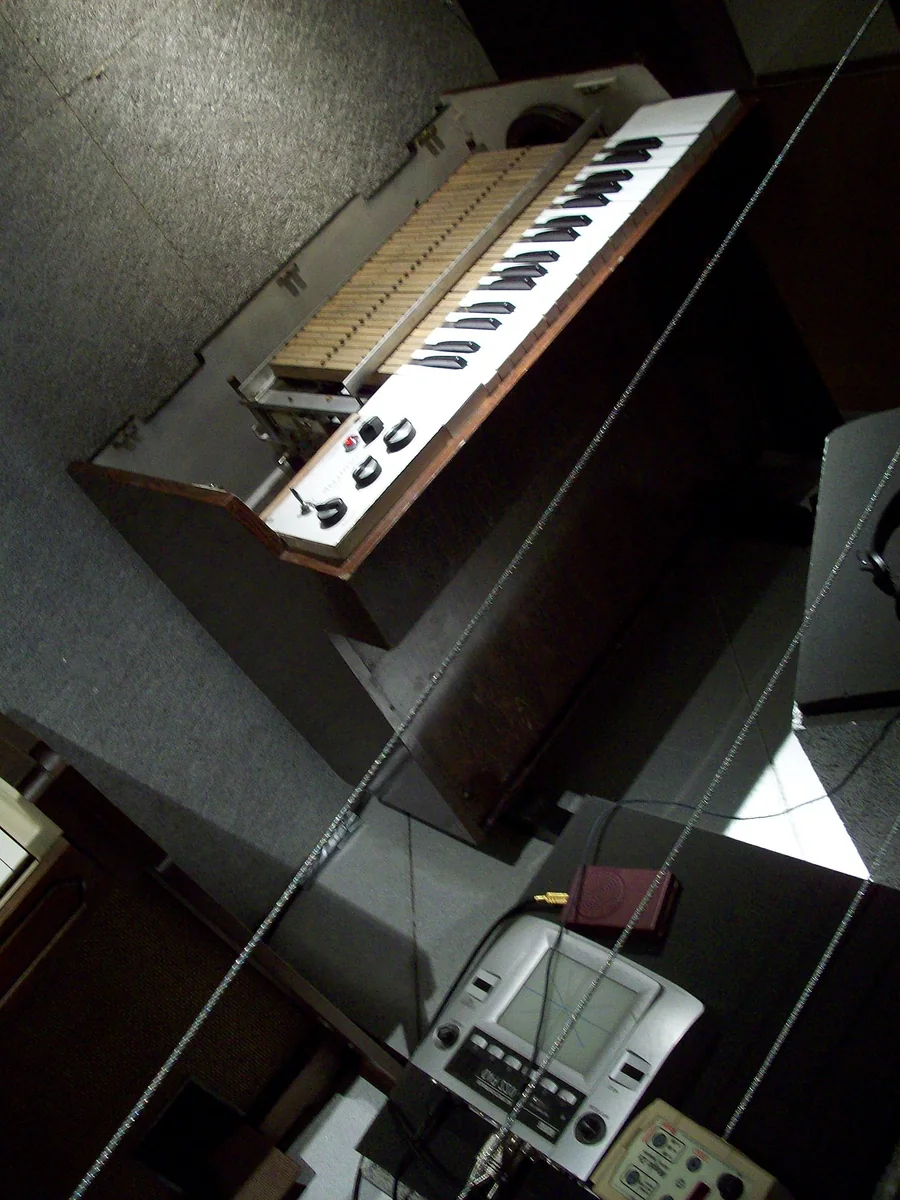
A Mellotron is not a synthesiser in the usual sense. It does not generate an electronic waveform and then shape it. Nor is it a modern digital sampler. On the classic machines, pressing a key sets a length of recorded tape in motion beneath a playback head; releasing the key allows the tape to return to its starting position.
That distinction explains the instrument's character. Every note began as a recorded performance, but pitch variation, tape wear, head alignment and the transport mechanism coloured the result. The familiar sound is therefore part musician, part recording and part machine.
How Does a Mellotron Work?
In the single-manual M400, each key controls its own tape strip. A pressure pad pushes that tape against a playback head while a pinch roller brings it into contact with a continuously turning capstan. When the key is released, a spring rewinds the strip. Because the tape is linear rather than looped, a note lasts only about eight seconds before it reaches the end.
An M400 tape carries three parallel recorded tracks. Moving the track selector places the heads over one track or between neighbouring tracks, allowing a player to choose or blend the installed sounds. A removable tape frame made it possible to exchange one three-sound set for another, although that was a physical change rather than instant preset selection.
The eight-second limit shaped technique. Players could release and restrike notes, stagger chord tones or move between inversions while individual tapes returned. A Mellotron can sustain a chord while other notes change; the real restriction is that each key's own tape must rewind before that same note can speak again from the beginning.
Where Did the Mellotron Come From?
The story begins with Harry Chamberlin in California. Chamberlin developed tape-replay rhythm and keyboard instruments from the late 1940s onward. In the early 1960s his salesman Bill Fransen took two Chamberlin machines to England and approached the Bradley brothers' Birmingham engineering firm, Bradmatic, without initially disclosing Chamberlin's ownership of the idea.
Leslie, Frank and Norman Bradley redesigned the mechanism for production, manufactured the instruments through the company that became Streetly Electronics and supplied Mellotronics, the sales organisation associated with Eric Robinson and David Nixon. When Harry Chamberlin learned what had happened, the dispute ended in a financial settlement in 1966. The Mellotron was therefore an English development of an American invention, not an independent discovery.
The first Mellotrons entered production in 1963. Early dual-manual models combined lead sounds with prerecorded rhythms and fills. The later M400 reduced the instrument to one 35-note manual and a removable tape frame. At 122 pounds it was still substantial, but its relative portability and more than 1,800 sales made it the best-known model of the 1970s.
How It Entered Rock Music
Mike Pinder had worked at Streetly before forming the Moody Blues. The band's official history records that he acquired and modified a second-hand Mellotron, used it from the 1967 single "Love and Beauty" onward and helped turn its string tapes into a flowing ensemble texture. His experience also helped him keep a difficult touring instrument operational.
The Beatles gave the instrument its most recognisable pop entrance. Abbey Road identifies Paul McCartney as the player of the Mellotron flute introduction recorded for "Strawberry Fields Forever" in late 1966. The sound is not a string section, and it is not the record's orchestral ending: it is the short, exposed flute figure at the beginning.
Two years later, King Crimson made Mellotron mass central to In the Court of the Crimson King. DGM's official credits identify Ian McDonald—not singer and bassist Greg Lake—on keyboards and Mellotron. The strings enlarge "Epitaph" and the title track; McDonald's acoustic flute supplies a different colour on "I Talk to the Wind" and within the title track.
Why Did Progressive Rock Love It?
The Mellotron let one keyboard player add recorded strings, brass, flutes or voices to a band arrangement without bringing those ensembles on tour. That practical advantage mattered, but it does not fully explain the instrument's place in progressive rock. Its attacks, limited note length and audible grain gave sustained chords a character unlike organ or later synthesisers.
Different musicians used that character differently. Pinder layered it into the Moody Blues' symphonic waves; Ian McDonald made it ominous and monumental; Tony Banks used choir, string and brass colours to enlarge Genesis transitions; Rick Wakeman placed it beside organ and synthesiser in Yes arrangements. The Mellotron was not a substitute for every orchestral instrument, but a distinct member of the keyboard palette.
Five Mellotron Listening Points
- The Beatles — "Strawberry Fields Forever" (recorded 1966, released 1967) — McCartney's opening flute figure presents the machine almost alone.
- The Moody Blues — "Nights in White Satin" (1967) — Pinder's Mellotron phrase sits inside the band arrangement; the London Festival Orchestra appears elsewhere on the album.
- King Crimson — "Epitaph" and "The Court of the Crimson King" (1969) — McDonald's strings create weight and scale rather than imitating a transparent orchestra. View the album on Amazon →
- Genesis — "Watcher of the Skies" (1972) — Tony Banks begins with a sustained Mellotron chord voiced to exploit the instrument's blended timbre. View the album on Amazon →
- Yes — "And You and I" (1972) — Mellotron enlarges the acoustic and electric ensemble without replacing Wakeman's organ and synthesiser colours. Read the album guide →
The Mellotron's Problems
A Mellotron contains many adjustments that must agree: key pressure, pinch rollers, springs, tape alignment, playback heads, motor speed and belt tension. Dirt, worn tape or poor adjustment can produce uneven level, slow return, mistracking or failed notes. Temperature and power conditions can affect motor speed and therefore pitch.
Touring magnified these vulnerabilities. The Moody Blues' history records a United States concert at which the back of Pinder's instrument opened and the tapes fell out; his factory experience allowed him to repair it. King Crimson's archive likewise records a failed Mellotron at an early Newcastle engagement. Such incidents were real, although a well-maintained machine was not designed to fail as part of its sound.
The instrument also demanded musical discipline. A player had roughly eight seconds per key, a limited keyboard range and a finite set of installed tapes. Those constraints encouraged staggered voicings and carefully timed entrances. They did not prevent polyphony, and they did not mean every performance had to sound unstable.
The Mellotron Today
Production history did not end neatly in 1980. Corporate changes caused Streetly-built instruments to appear under the Novatron name, and Streetly ceased trading in 1987. Interest in the tape library and surviving machines continued. Mellotron Archives restored the original masters, while revived manufacturers later offered both new tape-based instruments and digital products.
Mellotron's current catalogue includes the tape-based Mark VI, introduced in 1999, and the digital M4000D, introduced in 2009. The company describes the digital model as playing uncompressed 24-bit recordings taken from the original first-generation tape library. Software instruments and hardware recreations can therefore reproduce the recorded source material very closely, while omitting or modelling the behaviour of the original transport.
Whether that is preferable is an artistic choice, not a factual hierarchy. A restored tape machine includes mechanical variation, maintenance and physical interaction. A digital instrument offers repeatability, lighter touring and a wider library. Both can use recordings descended from the same historic tape archive.
Why It Still Matters
The Mellotron occupies an important middle ground in recording history. It turns recordings into playable keyboard material, yet every key remains tied to a finite performance on tape. That is why adjacent notes can differ in attack, tuning, bowing or breath even when the player holds a simple chord.
Its importance is therefore larger than the claim that it provided a cheap orchestra. The Beatles used a flute tape as an exposed hook; the Moody Blues treated string tapes as a flowing band voice; King Crimson used them for density and dread. The same machine language could be intimate, symphonic or threatening, and later samplers inherited its basic idea without inheriting its eight-second mechanical limit.
Sources and Verification
- Mellotron Archives — Mellotron and Chamberlin history
- Mellotron — M400 model and production information
- Sound On Sound — tape transport and playing mechanism
- Abbey Road Studios — the Mellotron and "Strawberry Fields Forever"
- The Moody Blues — Mike Pinder and the Mellotron
- DGM Live — In the Court of the Crimson King personnel
- Mellotron — M4000D specifications and source library