Anekdoten built a distinctive Swedish progressive-rock language from overdriven bass, cello, Mellotron and abrupt dynamic contrast.
The group began after a one-off King Crimson cover performance, but its own writing soon moved beyond tribute. The same quartet recorded six studio albums from Vemod in 1993 to Until All the Ghosts Are Gone in 2015. Across that catalogue, the dense attack of the early records gradually made room for psychedelic colour, clearer vocal lines and more spacious arrangements without abandoning the band's dark tonal centre.
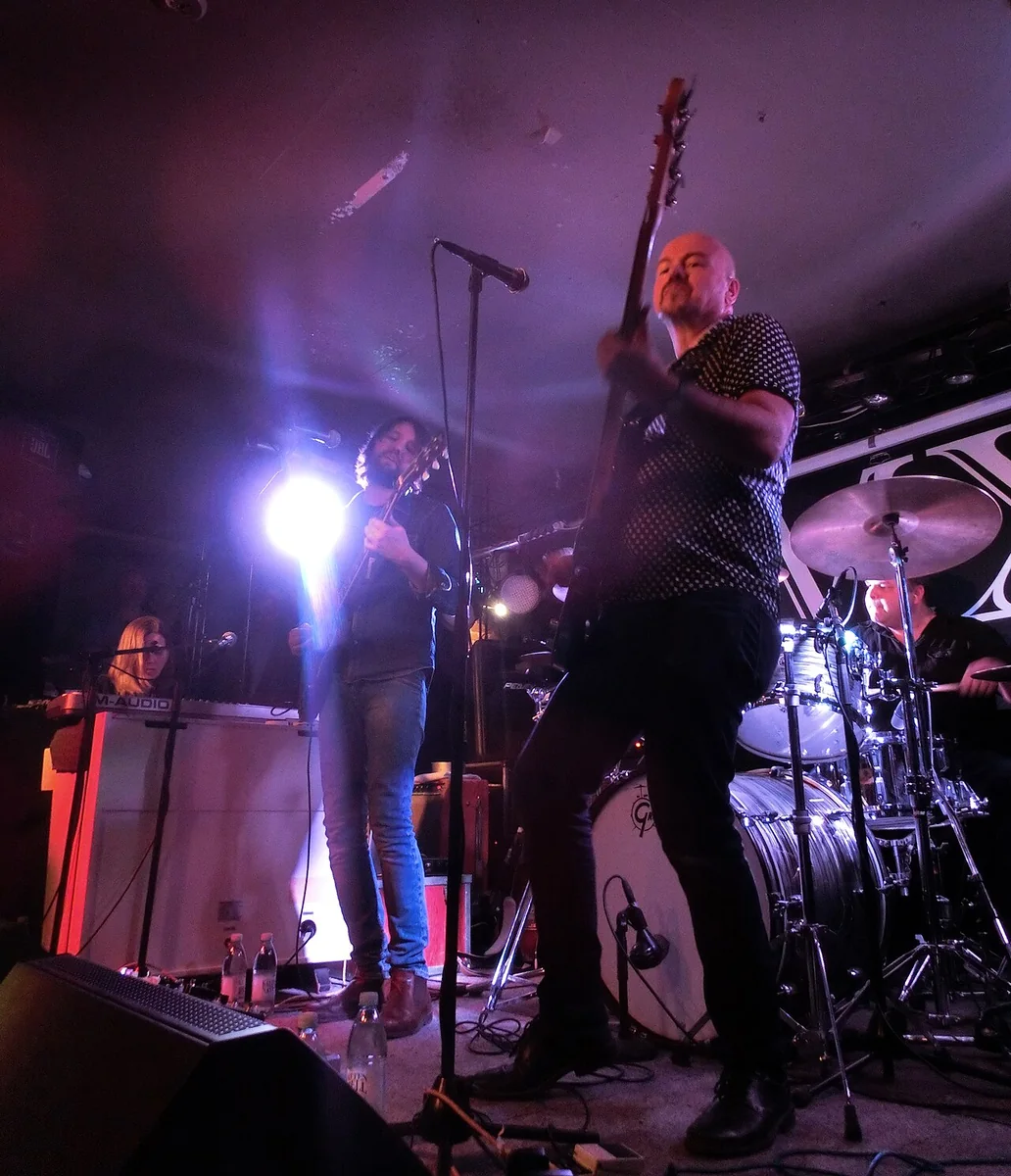
Anekdoten performing at MX Rockbar in 2016.Photo: Gunnar Creutz / Wikimedia Commons · Licensed under CC BY-SA 4.0. Converted to WebP for this page.
Formation & History
Nicklas Barker, Anna Sofi Dahlberg, Jan Erik Liljeström and Peter Nordins formed the quartet in 1991 after a short-lived King Crimson cover project.
Barker, Liljeström and Nordins planned the cover group King Edward in 1990 and played its only concert in May 1991. Dahlberg, who attended that show, subsequently joined them; their first rehearsal as a quartet took place that August. As their own material replaced the covers, the group adopted the name Anekdoten and prepared Vemod, recorded at Studio Largen in March and April 1993. Nucleus followed in December 1995, before From Within and Gravity broadened the arrangements. The four founding members remained together through Until All the Ghosts Are Gone in 2015.
Sound & Style
Overdriven bass often carries the riff while cello and Mellotron add bowed texture and tape-based orchestral colour.
Liljeström's bass supplies much of the early records' physical weight. Barker combines guitar with Mellotron and, on later records, instruments including Rhodes, Farfisa and vibraphone; Dahlberg moves between cello, Mellotron, keyboards and voice. Nordins answers the changing metres with forceful drums and cymbals rather than a fixed rock pulse. The arrangements leave room for sudden transitions between quiet suspension and full-band impact. On Gravity, a wider keyboard palette and more open production soften the edges without erasing the quartet's characteristic melancholy.
Essential Albums
1993
Vemod
Virtalevy · Original 1993 release
Vemod introduces Anekdoten through immediate physical contrast. “Karelia” builds Mellotron and cello atmosphere before distorted bass and drums strike; “The Old Man & the Sea” and “Wheel” alternate suspended melancholy with severe ensemble weight. King Crimson influence is audible, especially in the bass tone and dynamics, but Dahlberg's cello and the Swedish sense of wintry space prevent simple imitation. The independent production is raw enough to preserve room sound and attack. It remains the best starting point because the quartet's entire vocabulary appears in concentrated, emotionally direct form.
Key tracks: Karelia · The Old Man & the Sea · Wheel
Nucleus pushes the early Anekdoten sound toward abrasion. The title track, “Harvest” and “Book of Hours” use overdriven bass, Mellotron and jagged guitar in arrangements that feel closer and more pressurised than Vemod. Quiet passages still matter, but they resemble temporary clearings rather than pastoral refuge. Vocals are embedded in the instrumental mass, contributing to the album's claustrophobic character. This is the group's heaviest essential record, valuable not because complexity increases, but because tone and dynamics are pursued with uncompromising consistency.
Gravity reveals how far Anekdoten could move without losing its identity. “Monolith,” “Ricochet” and the title track favour clearer song forms, warmer keyboards and psychedelic space, while distorted bass and melancholy harmony remain recognisable. Recorded at Atlantis Grammofon and Sisu Sound, the production lets Barker's guitar and Dahlberg's keyboard colours breathe rather than stacking every instrument into one wall. The band can imply weight without constantly delivering it, making this the best entry for listeners drawn to atmosphere and songs before the harsher early catalogue.
Anekdoten turned a recognisable King Crimson starting point into a catalogue with its own consistent instrumental identity.
The sequence from Vemod and Nucleus through From Within, Gravity, A Time of Day and Until All the Ghosts Are Gone documents that development without a change of core personnel. Their importance lies less in reviving a 1970s style than in showing how Mellotron, cello and overdriven bass could support both severe ensemble writing and increasingly spacious psychedelic songs.
RetroForge Records publishes original music and independent editorial guides. This historical band guide is not affiliated with the artist, labels or rights holders. No unlicensed album artwork is reproduced.