Aphrodite’s Child moved from ornate psychedelic pop to the experimental double concept album 666.
Aphrodite's Child brought Greek musicianship to Paris in 1968 and first became famous through ornate, melancholy pop. That success makes the final transformation more remarkable. Vangelis's studio ambitions, Demis Roussos's unmistakable high tenor, Lucas Sideras's drumming and Costas Ferris's apocalyptic text produced 666, a record far beyond the compact singles on which the group's audience had been built.
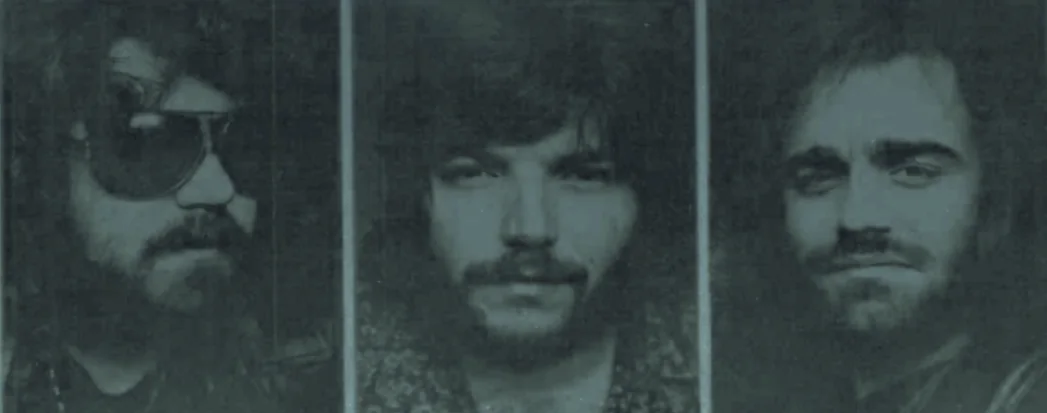
Aphrodite's Child in 1970.Photo: Philips / Wikimedia Commons · Licensed under Public domain. Converted to WebP for this page.
Formation & History
Vangelis Papathanassiou, Demis Roussos, Lucas Sideras and Argyris “Silver” Koulouris first worked together in Greece before the Paris-based trio made its breakthrough.
The four musicians recorded demos as the Papathanassiou Set before Vangelis, Roussos and Sideras moved to Paris in 1968; Koulouris remained in Greece for military service. “Rain and Tears,” built around the harmonic sequence of Pachelbel's Canon, became a European hit and established Aphrodite's Child as a trio. After End of the World and It's Five O'Clock, Vangelis withdrew from touring to concentrate on studio work while Harris Chalkitis replaced him on the road. Koulouris returned for the sessions that became 666. The group had dissolved by 1971, before Vertigo released the completed double album in June 1972.
Sound & Style
Organ, dramatic vocals and Mediterranean melody expand on 666 through narration, tape effects, percussion and improvisation.
The early records rely on organ, melodic bass, dramatic tenor and continental pop orchestration. On 666, percussion, narration, tape editing, choral layers, hard rock and electronic texture form a constantly changing sequence. Vangelis treats the studio as an instrument, while Roussos's voice can be devotional, intimate or forceful. The contrast between Mediterranean colour and experimental montage is the catalogue's defining tension.
Essential Albums
1972
666
Vertigo · Original 1972 release
666 interprets the Revelation of John as a spectacle taking place while actual apocalypse unfolds outside it. Short songs, narration, percussion rituals and recurring announcements accumulate across four sides. “The Four Horsemen” gives Roussos one of his defining performances; “Aegian Sea” opens enormous space around guitar and voice; “All the Seats Were Occupied” recombines earlier material into a final montage. Irene Papas's controversial “Infinity” is only one extreme inside a much wider design. Recorded after the touring group had effectively fractured, the album turns disintegration into form. It is the masterpiece, but also the end.
Key tracks: The Four Horsemen · Aegian Sea · All the Seats Were Occupied
End of the World documents Aphrodite's Child as a newly displaced Greek trio making ornate European pop. “Rain and Tears” builds its melody over the harmonic movement associated with Pachelbel's Canon, with Roussos singing at once delicately and unmistakably. The title track and “The Grass Is No Green” reveal a darker psychedelic current beneath the successful single. Vangelis's organ and arrangements make the record sound larger than its small lineup. It is uneven in the way many 1968 debuts are, yet essential for understanding that the band reached 666 through real pop craft rather than appearing fully experimental.
Key tracks: End of the World · Rain and Tears · The Grass Is No Green
It's Five O'Clock refines the trio's baroque-pop language while hinting at separation. The title song uses piano, organ and Roussos's voice to create a solemn, almost liturgical atmosphere. “Wake Up” and “Annabella” show the melodic directness that sustained the group's continental audience, but the album also contains more studio colour and dramatic pacing than the debut. Vangelis was becoming less willing to tour, so the polished record masks a band already diverging in purpose. Hear it between the innocent breakthrough and the radical final project: its elegance makes the coming rupture more visible.
Key tracks: It’s Five O’Clock · Wake Up · Annabella
The transformation from concise psychedelic pop to 666 is the essential story.
The group's short history contains two distinct identities: a successful European psychedelic-pop trio and an experimental concept-album ensemble. Reducing everything to 666 misses the melodic craft that preceded it; ignoring 666 misses the scale of the band's final studio transformation. The later solo fame of Vangelis and Roussos should not obscure that collective development.
RetroForge Records publishes original music and independent editorial guides. This historical band guide is not affiliated with the artist, labels or rights holders. No unlicensed album artwork is reproduced.