Atomic Rooster placed Vincent Crane’s Hammond organ at the centre of a dark meeting point between progressive rock, hard rock and blues. Crane could carry bass motion, harmony and riff at once, allowing the band to remain recognisable even as its singers, guitarists and drummers changed.
The defining early sequence moved quickly: the bass-and-flute colour of Atomic Roooster, the organ-guitar power trio of Death Walks Behind You, and the transitional personnel heard on In Hearing of Atomic Rooster. Across those records, Crane’s minor-key figures and themes of anxiety gave the music a consistent psychological pressure.
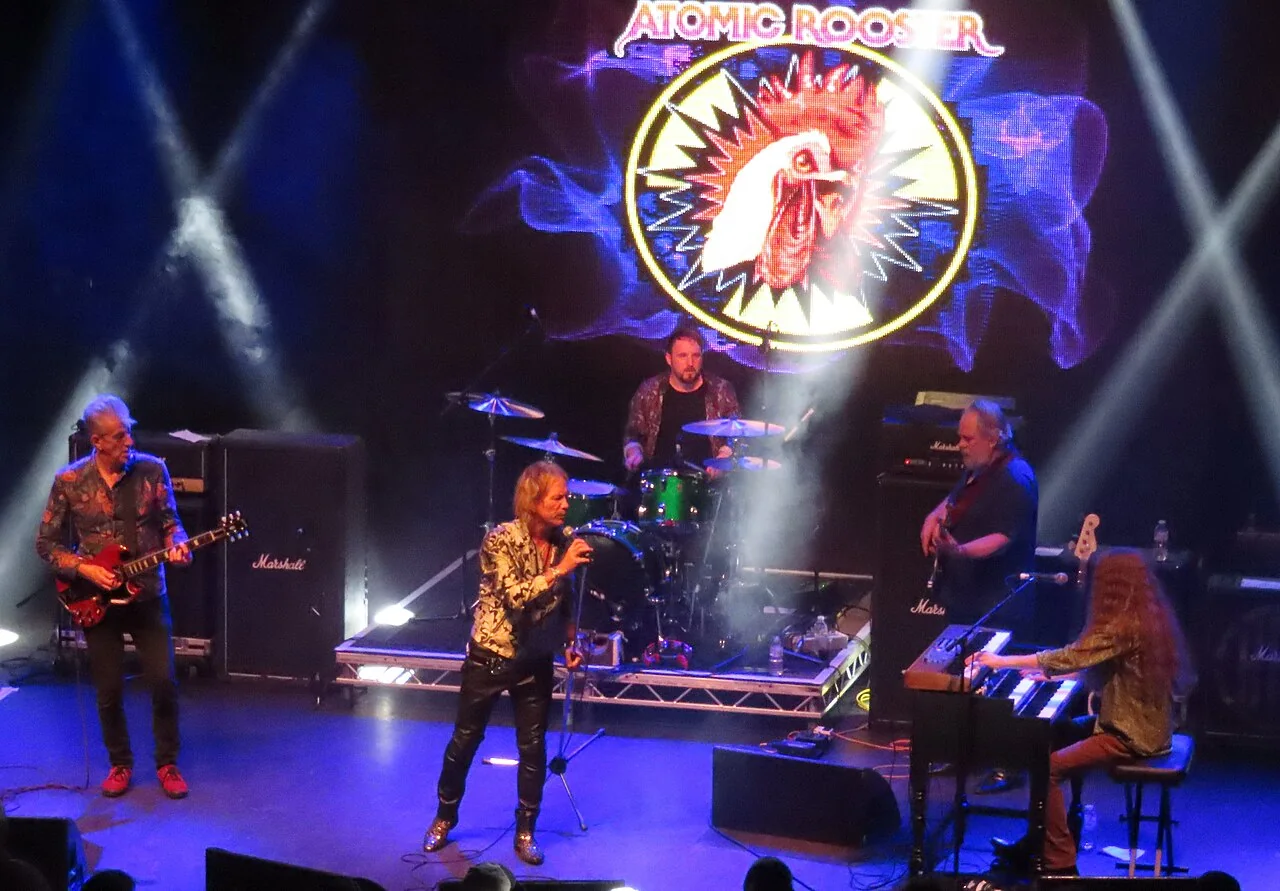
Atomic Rooster performing at HRH Prog X, Shepherd’s Bush Empire, London, 5 September 2021.Photo: kitmasterbloke / Wikimedia Commons · Licensed under CC BY 2.0. Converted to WebP for this page.
Formation & History
Crane and drummer Carl Palmer formed Atomic Rooster in London in 1969 after leaving the Crazy World of Arthur Brown, recruiting Nick Graham on bass, flute and vocals. That trio recorded Atomic Roooster. Graham left shortly after its release; John Du Cann joined on guitar and vocals, and Crane used Hammond pedals and his left hand to cover the missing bass role. Palmer departed in June 1970 to join Emerson, Lake & Palmer, and Paul Hammond became the drummer.
Crane, Du Cann and Hammond recorded Death Walks Behind You. “Tomorrow Night” reached number 11 in the UK and the album number 12 in early 1971; “Devil’s Answer” then reached number 4. During In Hearing of Atomic Rooster, Pete French replaced Du Cann as lead singer while Du Cann’s recorded guitar remained on the album. Du Cann and Hammond left, and later lineups with Steve Bolton, French and then Chris Farlowe moved toward soul, funk and brass arrangements.
Crane took the band off the road in 1975, revived it with Du Cann in 1980 and disbanded it again in 1984. After Crane’s death in 1989 the name remained inactive until Steve Bolton and Pete French obtained permission from Crane’s widow, Jean, to return in 2016. French left during a 2023 tour; the Bolton-led group has continued with keyboardist Adrian Gautrey also taking lead vocals.
Sound & Style
On the debut, Nick Graham’s bass and flute give Crane room to move between jazz-inflected organ lines, blues and psychedelia. After Graham left, Crane’s Hammond assumed the low-end function as well as harmony and riff, creating the denser, bass-less attack of the Du Cann–Hammond trio.
Du Cann’s dry, heavily driven guitar often doubles or challenges the organ instead of decorating it, while Paul Hammond’s drumming remains forceful without losing mobility. Later lineups reintroduced bass, piano, guitar and brass, but Crane’s recurring minor-key figures and tightly repeated motifs preserved the band’s identity. The heaviness comes from harmonic pressure and restricted space as much as sheer volume.
Essential Albums
1970
Death Walks Behind You
B&C · Original 1970 release
Death Walks Behind You establishes the best-known Atomic Rooster sound in its opening seconds: Crane’s distorted Hammond figure, Du Cann’s guitar and Paul Hammond’s drums move as one heavy mechanism. “Tomorrow Night” turns that weight into a concise single, while “Sleeping for Years” and the title track sustain the album’s atmosphere of paranoia and mortality. With no conventional bassist, Crane’s left hand and pedals carry the floor beneath the trio.
Key tracks: Death Walks Behind You · Tomorrow Night · Sleeping for Years
In Hearing of Atomic Rooster documents a lineup transition. Pete French sings on the completed album while John Du Cann’s guitar remains from the sessions, and Crane broadens the keyboard writing with more piano. “Breakthrough” and “Break the Ice” retain hard-rock force; “Head in the Sky” and “Decision/Indecision” push toward a more theatrical and unstable direction. The result is less monolithic than its predecessor and shows how quickly Crane’s arrangements were expanding.
Key tracks: Breakthrough · Break the Ice · Head in the Sky
The debut catches Atomic Rooster before the classic guitar trio existed. Nick Graham handles bass, flute and vocals, while Carl Palmer’s drumming gives “Friday the Thirteenth” and “Before Tomorrow” a nimble progressive motion. Crane’s organ already dominates “Winter,” but the original album contains more jazz and psychedelic space than its successor. After Graham left, John Du Cann overdubbed guitar and replacement vocals on several tracks for a revised edition, so the pressing determines which lineup is heard.
Key tracks: Friday the Thirteenth · Winter · Before Tomorrow
Atomic Rooster occupy a revealing fault line between progressive rock and early-1970s hard rock. The bass-less Death Walks Behind You lineup demonstrates that keyboards could carry the physical role usually assigned to guitar or bass while retaining harmonic complexity.
The rapid changes of personnel also make Crane’s authorship unusually audible: singers, guitarists and rhythmic approaches alter, yet the compressed Hammond voicings and anxious minor-key language persist. That continuity distinguishes the band from both keyboard-led symphonic prog and more blues-centred heavy rock.
RetroForge Records publishes original music and independent editorial guides. This historical band guide is not affiliated with the artist, labels or rights holders. No unlicensed album artwork is reproduced.