Le Orme began in the Italian beat and psychedelic world before becoming one of the defining keyboard-led groups of Italian progressive rock. The classic trio of Aldo Tagliapietra, Tony Pagliuca and Michi Dei Rossi created a surprisingly large sound from bass, voice, keyboards and drums. Their economy distinguishes them from ensembles built around multiple soloists: melody and arrangement carry the drama, while instrumental restraint makes each change of colour count.
Collage, Uomo di pezza and Felona e Sorona chart a rapid development from organ-driven prog to concise songcraft and then full concept-album architecture. The group later expanded its lineup, explored chamber instrumentation and continued through many personnel changes. Dei Rossi, who joined in 1967 before the first album, remains in the current band; the Le Orme name therefore connects the present lineup to both the psychedelic and progressive periods without implying an unchanged ensemble.
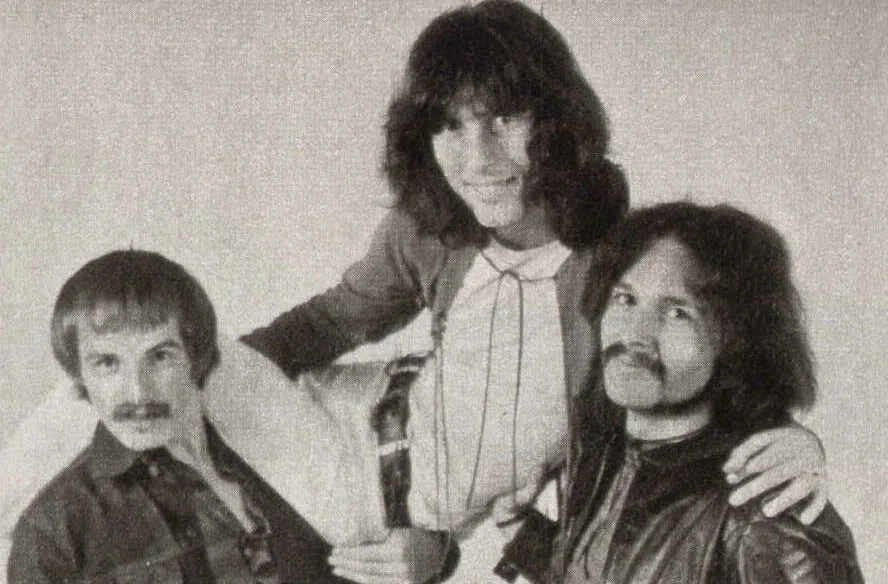
Le Orme in 1969: Dave Baker, Tony Pagliuca and Aldo Tagliapietra.Photo: Unknown author / Wikimedia Commons · Licensed under Public domain. Converted to WebP for this page.
Formation & History
Le Orme formed in the Venice-area district of Marghera in 1966. Aldo Tagliapietra, Nino Smeraldi, Claudio Galieti and Marino Rebeschini began in beat music; drummer Michi Dei Rossi soon replaced Rebeschini, and keyboard player Tony Pagliuca joined during the psychedelic period surrounding Ad gloriam. Subsequent departures reduced the band to the Tagliapietra–Pagliuca–Dei Rossi trio.
That apparent limitation became the foundation of their classic sound. Collage in 1971 placed organ and keyboards at the centre, with Tagliapietra handling bass and lead voice. Uomo di pezza brought wider popularity in 1972, helped by “Gioco di bimba,” while Felona e Sorona developed an album-length cosmic narrative the following year.
An English version of Felona e Sorona appeared through Charisma in 1974 with lyrics adapted by Peter Hammill, and the band toured outside Italy. Later records added guitarists or replaced rock instrumentation with chamber colours: Florian in 1979 is the clearest example of the latter approach. Pagliuca left the regular lineup in the early 1990s, and Tagliapietra departed in 2009, but Dei Rossi continued the group through further configurations.
The official lineup currently lists Dei Rossi on drums, Michele Bon on organ and synthesizer, Aligi Pasqualetto on piano, and Luca Sparagna on voice and bass. The Le Orme & Friends project also brought historical contributors—including Pagliuca, Tolo Marton and Francesco Sartori—back into a new studio project without pretending that the classic trio itself had reunited.
Sound & Style
The classic trio’s sound depends on clarity. Pagliuca’s Hammond organ, piano and synthesizer provide harmony, bass-like weight and solo colour; Tagliapietra’s melodic bass leaves room around a high, expressive voice; Dei Rossi’s drumming can move from song accompaniment to forceful progressive punctuation. Acoustic guitar appears strategically, making the keyboard passages feel larger by contrast and giving quieter transitions their own identity.
Le Orme often favours concise themes and direct vocal melody even when an album carries a large concept. That economy separates them from denser Italian peers. Their music can be pastoral, ominous or cosmic, but the listener rarely loses the song underneath the arrangement.
Essential Albums
1973
Felona e Sorona
Philips · Original 1973 release
Felona e Sorona tells of two linked planets whose fortunes move in opposite directions: one flourishing while the other suffers, before their conditions reverse. The trio keeps that cosmic premise concise. “Sospesi nell’incredibile” establishes weightless keyboards and vocal tension; short transitions bind the narrative, and “Ritorno al nulla” closes with instrumental finality rather than a conventional song ending. Pagliuca’s organ and synthesizer create scale, but Tagliapietra’s melodies keep the record human. An English adaptation with lyrics by Peter Hammill widened its reach. This is Le Orme’s definitive album-length statement and the best starting point for symphonic listeners.
Uomo di pezza balances progressive arrangement with some of Le Orme’s most immediate songs. “Una dolcezza nuova” opens expansively, moving from keyboard atmosphere to a strong vocal theme, while “Gioco di bimba” compresses unsettling subject matter into a deceptively simple melody. “La porta chiusa” gives the trio room to build greater instrumental tension without abandoning the record’s economy. Acoustic guitar and piano soften the organ-led core, and Tagliapietra’s singing remains central throughout. The album is less conceptually unified than Felona e Sorona, but its mixture of accessibility and shadow makes it the clearest introduction to Le Orme as songwriters.
Key tracks: Una dolcezza nuova · Gioco di bimba · La porta chiusa
Collage marks Le Orme’s decisive break from their earlier beat and psychedelic identity. The title instrumental foregrounds classical references and keyboard power, but the album’s importance lies in how the new trio format reshapes the songs around organ, melodic bass and drums. “Sguardo verso il cielo” joins a memorable vocal line to a driving arrangement, while “Cemento armato” gives the closing stretch a harsher social and urban weight. The production is leaner and rougher than the two albums that followed. That directness lets listeners hear the group discovering how much space three musicians could command without filling every moment.
Key tracks: Collage · Cemento armato · Sguardo verso il cielo
Le Orme demonstrated that symphonic progressive rock did not require a large lineup or continuous virtuoso competition. Their classic trio used limitation as an arranging principle, producing records where organ timbre, bass movement, voice and silence all carry structural responsibility. The 1974 Charisma edition of Felona e Sorona, with Peter Hammill's English adaptation, also gave an Italian concept album a deliberate route to English-speaking listeners.
The group’s evolution from beat and psychedelia through progressive rock and later chamber experiments makes it a compact history of changing Italian rock ambitions. Alongside PFM and Banco, Le Orme is essential—but its melodic economy and trio discipline make it anything but interchangeable with those bands.
RetroForge Records publishes original music and independent editorial guides. This historical band guide is not affiliated with the artist, labels or rights holders. No unlicensed album artwork is reproduced.