Blossom Toes compressed a striking musical transformation into two original albums. We Are Ever So Clean arranges compact psychedelic pop with vocal harmonies, orchestration and abrupt comic turns; If Only for a Moment replaces much of that decoration with longer forms, twin electric guitars and a heavier rhythm section.
The change was not simply a genre switch. The same writing partnership of Brian Godding and Jim Cregan moved from manager Giorgio Gomelsky's studio concept toward music developed through live performance. Hearing the albums together reveals how quickly one British group responded when the ornate language of 1967 ceased to match its stage identity.
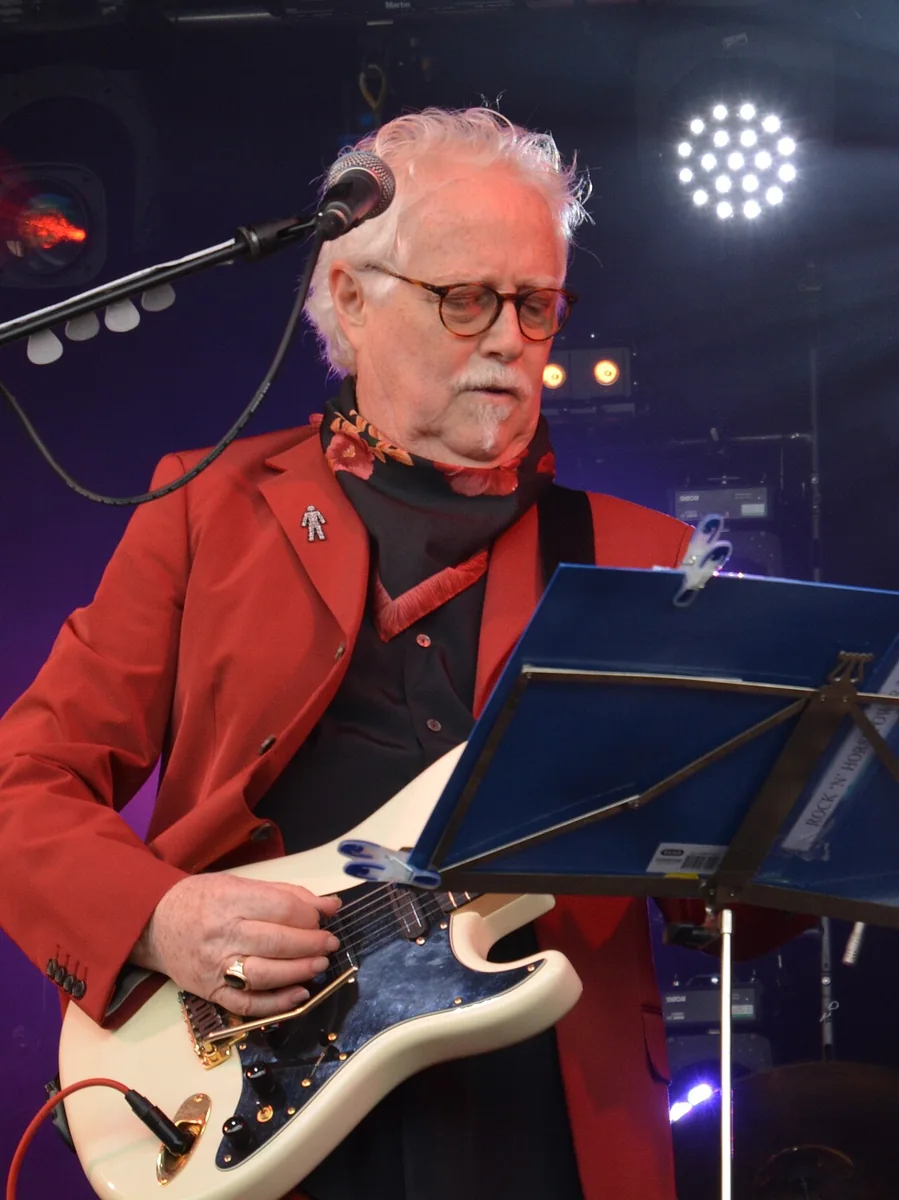
Blossom Toes guitarist Jim Cregan performing at the Rock N Horsepower Festival in 2016.Photo: Mark Kieve / Wikimedia Commons · Licensed under CC BY 2.0. Converted to WebP for this page.
Formation & History
Brian Godding and Brian Belshaw had played together before the Ingoes became a working rhythm-and-blues and soul band. Under Giorgio Gomelsky's management, the Ingoes developed through sustained work in Paris and elsewhere in Europe. Jim Cregan joined during that period. Back in London in 1966, Gomelsky took the musicians off the road, housed them together in Fulham and recast the group as Blossom Toes. Kevin Westlake replaced the Ingoes drummer Colin Martin for the new quartet.
Godding, Cregan, Belshaw and Westlake recorded We Are Ever So Clean during the summer of 1967 for Gomelsky's new Marmalade label. The sessions emphasized a carefully constructed studio identity, while contemporary live recordings from Stockholm show that their repertoire already extended beyond the album's concise arrangements. Singles and BBC sessions followed during 1967–68.
Westlake subsequently left. John “Poli” Palmer played during the transition and appears on “Peace Loving Man”; Barry Reeves became the principal drummer on If Only for a Moment. The second album, released in July 1969, grew from the band's heavier working repertoire. Blossom Toes ended in 1970. Godding, Belshaw and Westlake continued together as B.B. Blunder, while Cregan formed Stud and later joined Family; Palmer also joined Family.
Sound & Style
On We Are Ever So Clean, orchestral colour, music-hall timing, close harmony and short scene changes surround a guitar band whose arrangements rarely settle into one texture for long. Godding's keyboards and writing help shape the whimsical surface, but Cregan and Belshaw also sing and write, giving the fifteen-track sequence multiple voices rather than one fixed narrator.
If Only for a Moment makes the players themselves the arrangement. Godding and Cregan exchange lead and rhythm roles across sustained guitar lines; Belshaw's bass and the changing drum chair create more physical space. “Peace Loving Man,” “Kiss of Confusion” and “Love Bomb” use repetition, distortion and longer development, while Shawn Phillips's twelve-string guitar and sitar on “Just Above My Hobby Horse's Head” preserve a different psychedelic colour inside the heavier set.
Essential Albums
1967
We Are Ever So Clean
Marmalade · Original 1967 release
Recorded during summer 1967, the fifteen-track debut turns the new Blossom Toes identity into a deliberately crowded studio album. “Look at Me I’m You” opens with shifting perspectives; “The Remarkable Saga of the Frozen Dog” makes narrative absurdity part of its arrangement; “What on Earth” condenses the record's orchestral colour and melodic unease. The concise sequencing differs sharply from the longer R&B and psychedelic pieces preserved in the band's August 1967 Stockholm set.
Key tracks: Look at Me I’m You · What on Earth · Love Is
The eight-track second album documents a live band's priorities rather than repeating Gomelsky's earlier pop design. Godding and Cregan share guitar and lead-vocal duties, Belshaw sings two pieces, and Barry Reeves drives most of the set after Palmer's transitional appearance on the opener. “Peace Loving Man” establishes the heavier scale; “Kiss of Confusion” turns the twin guitars into the argument; the extended “Love Bomb” lets ensemble development replace rapid studio montage.
Key tracks: Peace Loving Man · Kiss of Confusion · Love Bomb
2009
What on Earth: Rarities 1967–69
Sunbeam · Original 2009 release
This Sunbeam compilation is an archive rather than a third studio album. Its home demos, early takes and otherwise scattered material trace the working steps between the two Marmalade LPs. It is most useful after those albums: alternate versions and unreleased songs show which ideas survived the move from the controlled 1967 studio environment to the more guitar-led final lineup.
The March 1968 single “I'll Be Your Baby Tonight” places a Bob Dylan song inside the first lineup's vocal and arrangement language.
Love Bomb: Live 1967–69 collects surviving concert recordings and makes the distance between the stage band and the debut's studio construction audible.
B.B. Blunder's Workers' Playtime reunites Godding, Belshaw and Westlake and is the clearest post-Blossom Toes continuation by former members.
Blossom Toes provide unusually compact evidence of the tension between a managed psychedelic-pop image and a band's developing stage language. The debut is not merely “whimsical,” and the second album is not simply “heavy”: each solves a different question about how Godding, Cregan, Belshaw and their drummers could organize songs, shared vocals and two guitars.
The archive strengthens that comparison. The 1967 Stockholm recordings reveal a working group whose live range already exceeded the debut, while BBC sessions, singles and demos fill in the route toward If Only for a Moment. The small catalogue rewards chronological listening because its change is documented rather than retrospectively invented.
RetroForge Records publishes original music and independent editorial guides. This historical band guide is not affiliated with the artist, labels or rights holders. No unlicensed album artwork is reproduced.