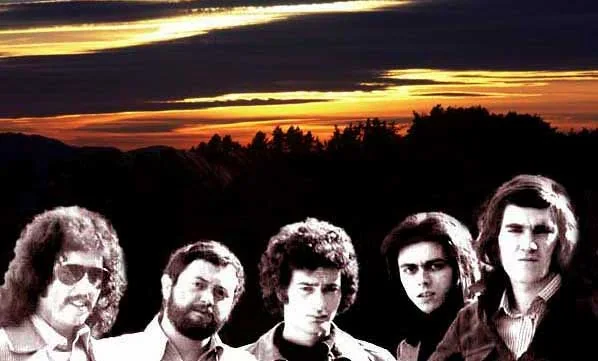
Museo Rosenbach emerged from the progressive-rock scene around Sanremo and released its only contemporary studio album, Zarathustra, on Ricordi in April 1973. Its blend of Mellotron, Hammond organ, hard-rock guitar and Stefano Galifi’s abrasive voice made one LP sufficient to establish a lasting identity.
The group dissolved after its summer 1973 concerts. Later projects revived the name with changing combinations of original and newer musicians, but they form separate chapters rather than an uninterrupted continuation of the classic band. The distinction matters when tracing how one initially little-heard album became a central reference point for Italian progressive rock.
Museo Rosenbach in a photograph released for reuse by the band.Photo: Museo Rosenbach archive; reuse authorised by Alberto Moreno / Wikimedia Commons · Public domain. Converted to WebP for this page.
Formation & History
The band began around 1971 as Inaugurazione Museo Rosenbach, drawing musicians from the local groups La Quinta Strada and Il Sistema. Leonardo Lagorio and Walter Franco appeared in an early formation; the lineup that made Zarathustra settled around vocalist Stefano “Lupo” Galifi, guitarist Enzo Merogno, keyboardist Pit Corradi, bassist and pianist Alberto Moreno, and drummer Giancarlo Golzi.
The album’s material was ready by the end of 1972, and a Ricordi contract led to its release in April 1973. Contemporary accounts report controversy around Wanda Spinello’s cover collage and its political imagery, but that disputed reception should not be reduced to a single explanation for the album’s limited reach. After concerts in the summer of 1973, the original group split without recording a second LP.
Moreno and Golzi revived the name with new collaborators for Exit in 2000. A different formation assembled in 2012 around Galifi, Golzi and Moreno, alongside Sandro Libra, Max Borelli, Fabio Meggetto and Andy Senis; it re-recorded Zarathustra, made Barbarica in 2013 and released Live in Tokyo in 2014. Golzi’s death in 2015 meant that incarnation could not continue unchanged.
Sound & Style
The original credits explain the density of Zarathustra. Corradi layers Mellotron, Hammond organ, Farfisa and vibraphone; Moreno adds both bass and piano; Merogno’s guitar supplies the harder edge; and Golzi reinforces the drums with timpani. These colours are arranged as interacting parts rather than as a keyboard wash placed over a conventional rock rhythm section.
Side one’s five-part title suite moves through recurring themes, sudden changes in weight and passages in which keyboards and guitar exchange the lead. The three pieces on side two tighten that method into shorter forms. Galifi’s grainy, declamatory singing gives Mauro La Luce’s philosophical lyrics a physical urgency that keeps the record from becoming polite symphonic display.
Essential Albums
1973
Zarathustra
Ricordi · Released April 1973 · SMRL 6113
Zarathustra devotes its first side to a five-part suite composed by Alberto Moreno, with lyrics by Mauro La Luce, and follows it with “Degli uomini,” “Della natura” and “Dell’eterno ritorno.” The suite’s recurring motifs allow Mellotron, Hammond, guitar and rhythm section to change scale without losing direction. Wanda Spinello designed the much-discussed cover, using photography by Caesar Monti; accounts of the album’s early reception frequently cite controversy over its imagery, although that does not by itself explain the record’s limited contemporary reach. Musically, this remains the defining Museo Rosenbach statement.
Key tracks: Zarathustra · Degli uomini · Della natura
Exit belongs to a revival lineup built by original members Alberto Moreno and Giancarlo Golzi with new collaborators, not to a missing 1974 follow-up. Its ten compact tracks, turn-of-the-century production and different voices establish a separate identity linked to Museo Rosenbach through personnel and symphonic intent. Heard after the debut, it is most useful as evidence of how the name was reopened in a changed musical world rather than as an attempt to erase the intervening decades.
2013
Barbarica
Immaginifica · Original 2013 release
Barbarica was made by the 2012 revival formation: Galifi, Golzi and Moreno with Sandro Libra, Max Borelli, Fabio Meggetto and Andy Senis. After first revisiting the classic suite in the studio, this lineup turned to newly written material and presented it internationally, including in Japan. Galifi’s return supplies a recognisable vocal link, while the enlarged guitar-and-keyboard lineup avoids pretending that the sound of 1973 could simply be reproduced four decades later.
Zarathustra is a corrective to the idea that Italian progressive rock merely softened British symphonic models. Its keyboards are orchestral, but the bass, timpani, guitar and forceful Italian vocal writing give the music its own physical grammar.
The group also illustrates how a canon can change after release. Reissues, international collectors and renewed performances brought an initially little-heard album to a much wider audience, while the later revival projects made clear that historical importance does not require inventing an unbroken career. One concentrated 1973 record remains enough to explain the band’s place in the genre.
RetroForge Records publishes original music and independent editorial guides. This historical band guide is not affiliated with the artist, labels or rights holders. No unlicensed album artwork is reproduced.