U.K. compressed two sharply different bands into a catalogue of two studio albums and one contemporary live record. The 1978 quartet joined John Wetton and Bill Bruford’s King Crimson experience to Eddie Jobson’s keyboards and electric violin and Allan Holdsworth’s legato guitar. The 1979 trio retained Wetton and Jobson but replaced the open guitar-and-drum dialogue with Terry Bozzio’s forceful, composed precision.
That small catalogue captures a larger argument inside late-1970s progressive rock: whether advanced technique should lead toward improvisation or toward concise, modern song architecture. U.K. never settled the question. Instead, the debut and Danger Money preserve opposing answers, both anchored by Wetton’s melodic bass and voice.
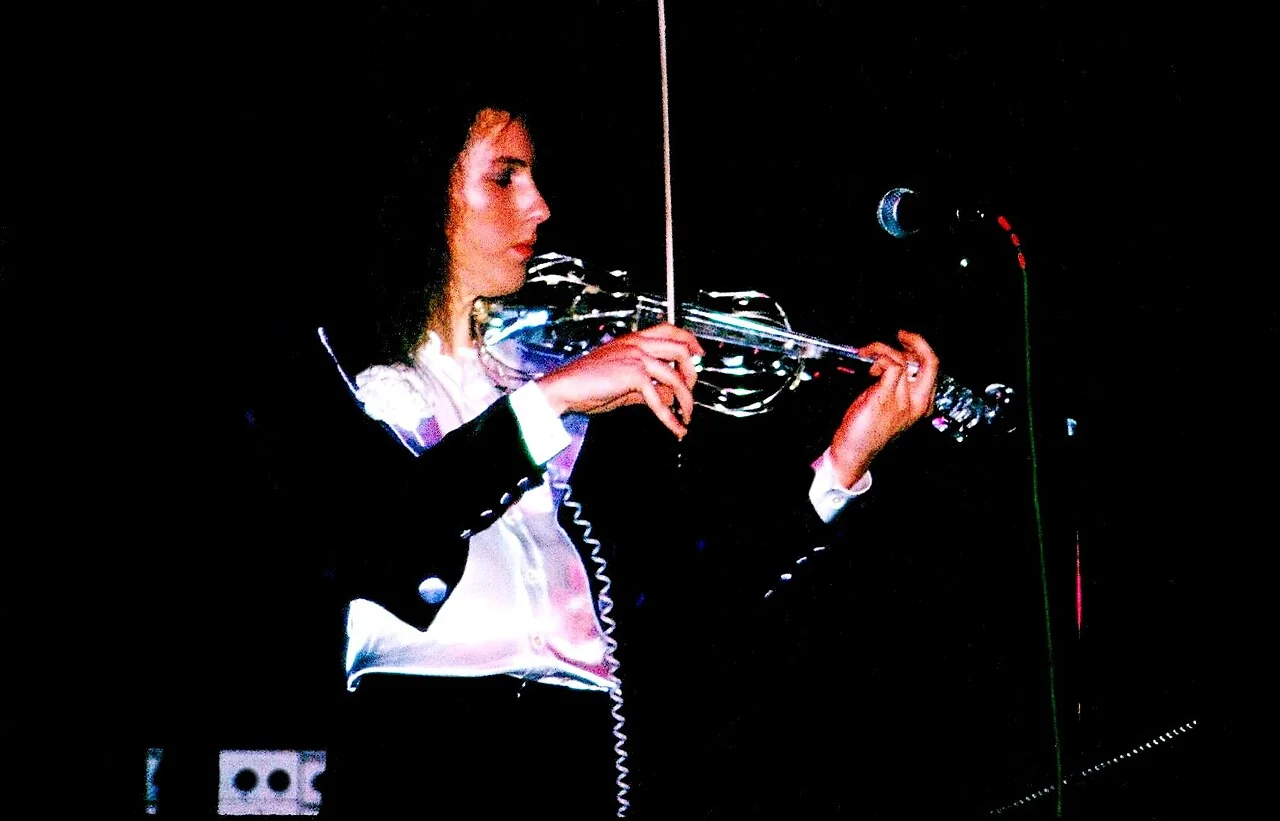
U.K. co-founder Eddie Jobson performing in 1973.Photo: Klaus Hiltscher / Wikimedia Commons · Licensed under CC BY-SA 2.0. Converted to WebP for this page.
Formation & History
Wetton invited Bruford to form a new group in 1977 and proposed recruiting Jobson from Frank Zappa’s band. Bruford, concerned that the project might lean too far toward pop, suggested Holdsworth as a counterweight. The four recorded their debut at Trident Studios in November 1977 and released it the following spring. “In the Dead of Night” and “Thirty Years” drew on ideas Wetton and Jobson had already been developing, while the quartet arrangement left room for Holdsworth and Bruford to pull the music toward jazz-rock.
After extensive touring in 1978, that balance collapsed. Holdsworth and Bruford wanted more improvisational freedom; Wetton and Jobson preferred a more composed rock direction. The quartet ended, and Jobson recruited his former Zappa colleague Terry Bozzio. Unable to secure a replacement guitarist, the new U.K. continued as a trio for Danger Money. They toured through 1979, recorded Night After Night in Tokyo in May and June, and finished their last European dates in December. The group dissolved before a planned third studio album. Jobson and Wetton revived U.K. for concerts from 2011, with changing supporting musicians, and the final reunion performances took place in 2015.
Sound & Style
On the debut, Wetton’s bass is both hook and harmonic anchor. Jobson layers organ, synthesizer and electric violin around it, while Holdsworth’s lines avoid conventional blues phrasing and Bruford places accents across the written pulse. “In the Dead of Night” can therefore move from a firm vocal refrain into solos that seem to loosen the bar structure without losing the composition underneath.
The trio changes the distribution of space. Jobson must cover more harmony and counterpoint without a guitarist, and Bozzio treats every composed turn as a physical event. “Danger Money” becomes denser and more theatrical; “Rendezvous 6:02” makes room for a compact, melancholy melody; “Carrying No Cross” rebuilds the long form through keyboard layers and escalating dynamics. Both versions sound polished, but the debut’s mobile interplay and the trio’s concentrated weight are genuinely different designs.
Essential Albums
1978
U.K.
E.G./Polydor · Original 1978 release
U.K. captures the quartet before its competing priorities became unsustainable. The opening suite joins Wetton’s vocal melody to Jobson’s synthesizers, Bruford’s displaced pulse and a Holdsworth solo that glides across the bar line. “Thirty Years” moves from a suspended opening into tightly controlled ensemble impact; “Nevermore” gives Holdsworth wider harmonic space; “Mental Medication” closes with the rhythm section pulling written material toward fusion. The record’s tension is structural, not merely biographical: composition and improvisation keep testing each other.
Key tracks: In the Dead of Night · Thirty Years · Nevermore
Danger Money replaces the debut’s quartet transparency with the concentrated power of a trio. Jobson uses keyboards to occupy the missing guitar register and brings electric violin forward as a contrasting voice. Bozzio makes the title track’s stops and accents feel percussively inevitable, while “Rendezvous 6:02” reduces the scale to Wetton’s melancholy songcraft. The twelve-minute “Carrying No Cross” then lets the trio rebuild symphonic breadth without recreating the debut’s instrumentation.
Recorded at Tokyo’s Nakano Sun Plaza and Nippon Seinenkan in May and June 1979, Night After Night is more than a tour souvenir. The title track and “As Long as You Want Me Here” were new pieces absent from the studio albums, and the trio recasts “In the Dead of Night” without guitar by redistributing its lines between keyboards, violin, bass and drums. The original sequence is concise, but it documents how Bozzio, Jobson and Wetton made the reduced line-up sound complete onstage.
Key tracks: Night After Night · Rendezvous 6:02 · In the Dead of Night
U.K. offer an unusually clear comparison between two approaches to progressive rock after its early-1970s peak. The quartet treats virtuosity as conversation: written songs remain permeable to Holdsworth’s guitar and Bruford’s rhythmic displacement. The trio treats virtuosity as concentration: Jobson, Wetton and Bozzio make every part carry more harmonic or rhythmic weight.
Because the catalogue is so small, neither design becomes routine. The melodic directness later associated with Wetton remains beside the exploratory instincts of his former Crimson colleagues, while Jobson’s violin and rapidly developing keyboard technology connect symphonic rock to a cleaner late-1970s production language. Technical rock musicians still return to U.K. because arrangement and instrumental identity are inseparable on these records.
RetroForge Records publishes original music and independent editorial guides. This historical band guide is not affiliated with the artist, labels or rights holders. No unlicensed album artwork is reproduced.