
Physical Systems, Not One Analogue Sound
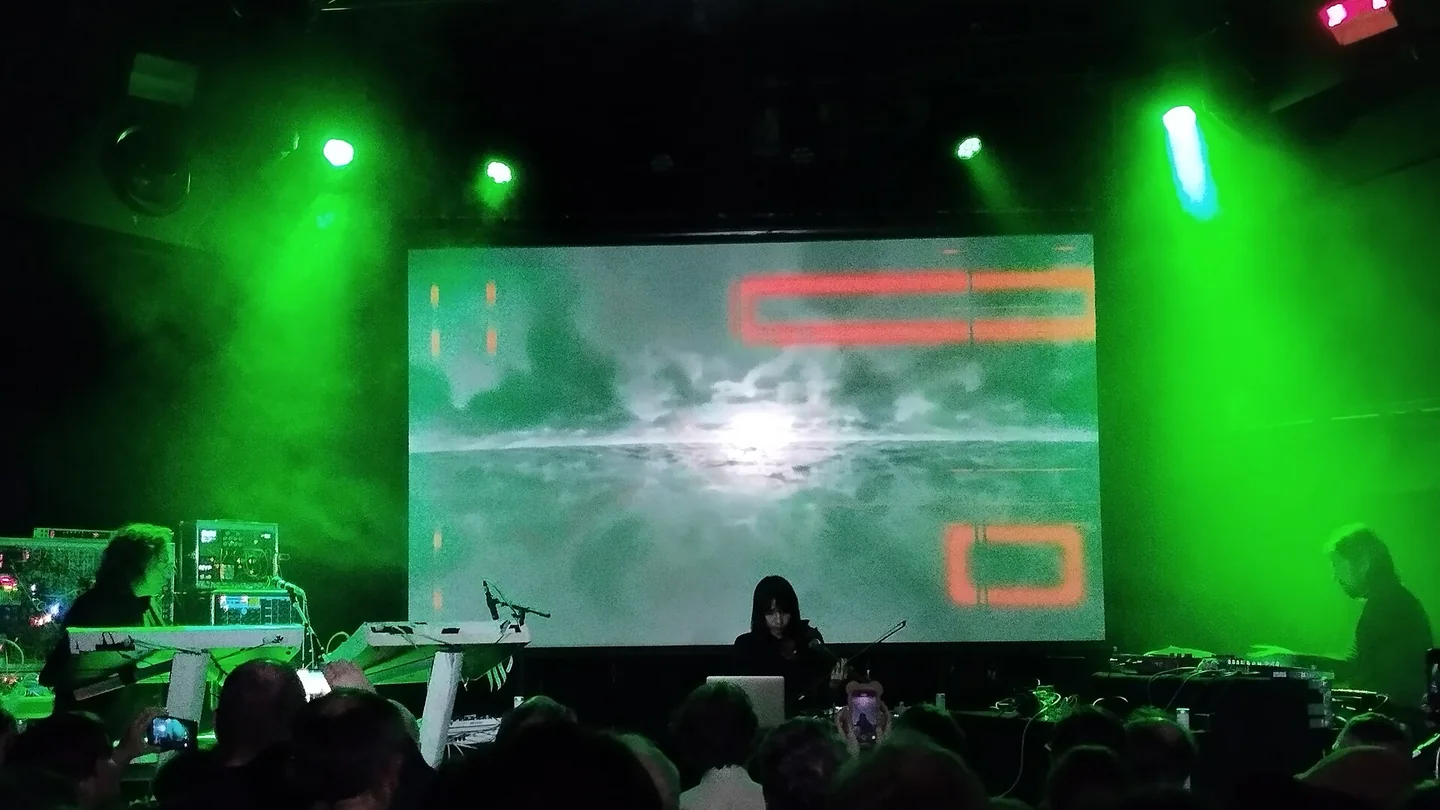
The first Moog modular system, introduced in 1964, separated sound generation and processing into individual voltage-controlled modules connected by patch cords. Britain’s portable EMS VCS3, introduced in 1969, used a pin matrix instead. These were not libraries of finished presets: the musician assembled a signal path from oscillators, filters, amplifiers, envelopes and controllers.
That architecture made electronic performance partly an act of engineering. Repatching changed the instrument itself; tuning and balance had to be managed in real time; a useful configuration might be carefully documented or simply lost. “Analogue” therefore describes a technology, not a single tone or a guarantee of warmth.
Tape Made the Studio an Instrument
Magnetic tape widened the vocabulary beyond synthesis. Splicing could reorder events, a loop could turn a short recording into a pulse, and changes in playback speed altered both duration and pitch. The Science Museum identifies reel-to-reel machines and tape splicing as central tools for early electronic experimenters, including the BBC Radiophonic Workshop.
In progressive electronic records, tape could document a live adjustment and then become material for further composition. This does not mean every album was constructed by editing, but it explains why the boundary between performance, sound design and production was often unusually thin.
Phaedra and Sequencer-Led Form
Tangerine Dream recorded Phaedra at The Manor in November 1973 and released it on Virgin in 1974. The band’s official archive identifies it as their first album built around the sequencer-driven sound that became a trademark. Its title piece places repeating patterns inside a shifting field of Mellotron, flute, noise and electronic processing.
The sequence is not merely a mechanical bass line. Its regularity gives the listener a fixed reference while timbre, density, register and emphasis change around it. Alexander C. Harden’s analysis of “Phaedra” likewise treats sonic design, acoustic space and performative agency as structural features, not decoration added after the composition.
Berlin School Is a Route, Not the Whole Field
“Berlin School” is now commonly used for the sequencer-led lineage associated with Tangerine Dream, Klaus Schulze and related 1970s German electronic music. It is useful when it identifies long-form development around repeating patterns, but it should not be stamped on every German synthesizer record or treated as a synonym for progressive electronic music.
The wider field includes very different priorities: Cluster’s compact and irregular pieces, Jean-Michel Jarre’s melodic studio constructions and Vangelis’s keyboard-led blend of improvisation, percussion and cinematic scale. Geography and equipment alone do not erase those distinctions.
What “Before Digital” Actually Means
The title marks a dominant working environment rather than a clean historical border. Analogue and digital systems overlapped, and change arrived feature by feature. The 1978 Sequential Circuits Prophet-5 remained an analogue synthesizer while becoming one of the first to provide programmable memory; preset instruments and increasingly precise control already complicated any simple opposition.
Earlier modular patches, tape edits and sequencer states often demanded more manual reconstruction, but “no recall” is too broad as a description of an entire era. What matters is the exact system used on a particular record and the choices it made easy, difficult or irreversible.
A Five-Record Listening Route
Begin with Tangerine Dream’s Phaedra for sequencer-led motion and unstable studio space. Klaus Schulze’s Timewind stretches gradual change across side-long forms, while Cluster’s Zuckerzeit compresses electronic invention into short, off-centre pieces. Jean-Michel Jarre’s Oxygène foregrounds melody and layered production; Vangelis’s Albedo 0.39 sets electronic timbre beside percussion and keyboard performance.
Do not stop at the phrase “warm analogue sound.” Listen for the source of repetition, the elements changed by hand, the role of tape and effects, and the way depth is created. The machines are historically interesting because of the musical decisions made through them, not because old circuitry possesses an independent magic.
The RetroForge Route
Transitnacht / Westlicht follows motorik movement into nocturnal electronics. Frozen Skies places progressive electronic architecture inside a colder conceptual world. Oxygen Cathedral uses cosmic texture and orbital scale in a compact album form.
Together they offer three related but distinct uses of the vocabulary described above: the sequence as road, the synthesizer as architecture and the studio as imagined space.
Sources and Further Reading
This article uses the sources below for instrument history, recording dates and production context. Genre boundaries and listening descriptions are editorial interpretations and are identified as such in the text.