
History Archive · 1975
Wish You Were Here, Rubycon and the Sound of Absence
In 1975, some of the era’s most powerful progressive music was defined not by how much it played, but by the spaces it refused to fill.
What Happened
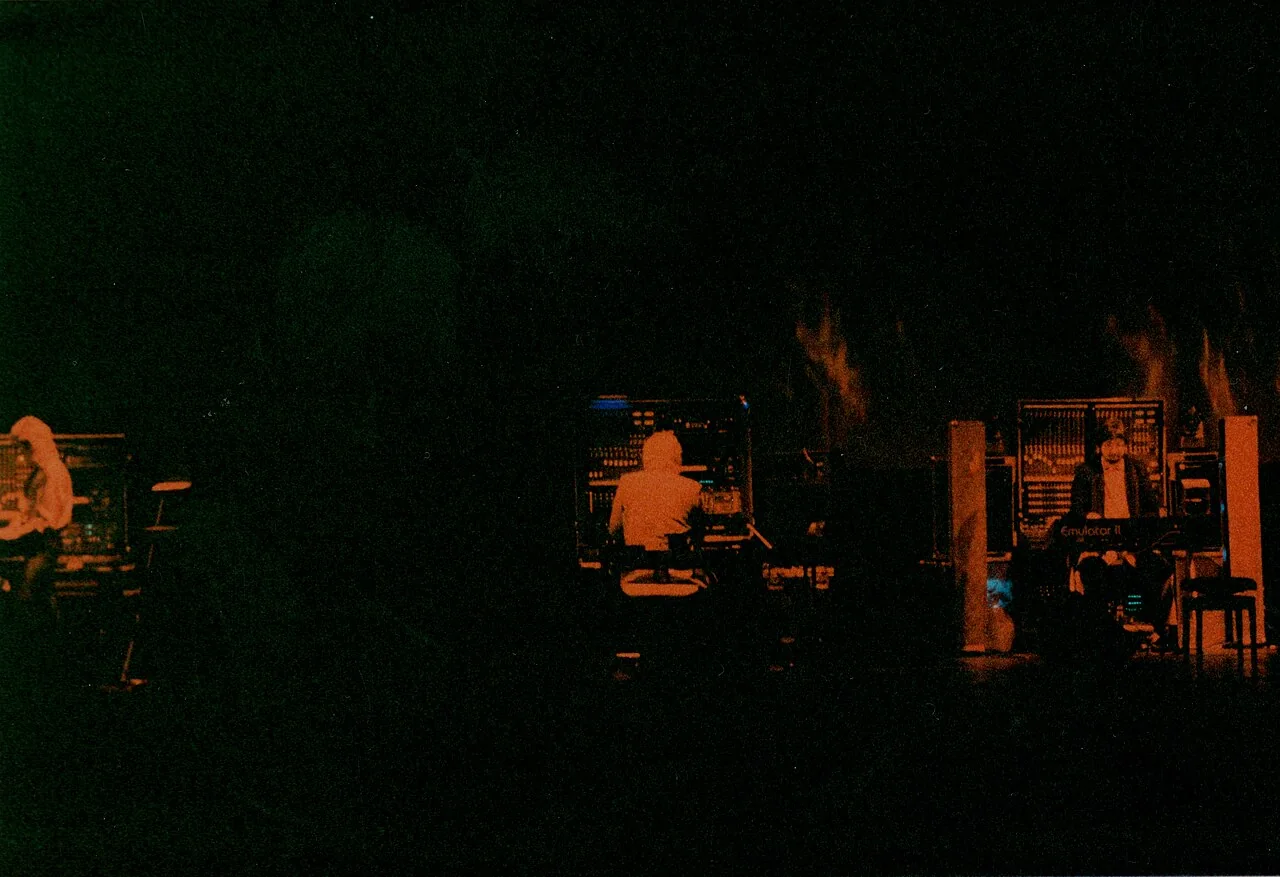
Pink Floyd followed its largest success with Wish You Were Here, an album concerned with absence, industry alienation and Syd Barrett. Tangerine Dream released Rubycon, two side-long electronic pieces that developed the sequencer-driven language introduced on Phaedra.
The records came from different scenes and production methods, yet both treated the album side as a continuous field rather than a sequence of independent songs.
What the Music Sounded Like
Pink Floyd framed songs with the long return of “Shine On You Crazy Diamond”: restrained guitar, organ, synthesizer and saxophone emerging from near-silence. Tangerine Dream used Mellotron, analogue synthesis and sequencers to let rhythm surface, recede and change scale.
How It Was Made
Pink Floyd worked at Abbey Road and built the concept across music and Hipgnosis packaging. Tangerine Dream’s Edgar Froese, Christopher Franke and Peter Baumann shaped Rubycon with analogue synthesizers, Mellotron and sequencers whose technical alterations were often custom-built.
The Wider Musical Context
Progressive rock had reached stadium scale while electronic music was leaving specialist environments. Ambient music was not yet a settled category, but records such as Rubycon were already exploring attention without conventional song drama.
What Followed
Pink Floyd’s next work became sharper and more political. Tangerine Dream continued its live electronic work and expanded its profile as a film-music group. Both records became reference points for artists interested in atmosphere as structure.
Success Created a Problem of Presence
The Dark Side of the Moon gave Pink Floyd an audience on a scale few experimental rock groups had ever reached. It also left the band facing a less glamorous question: what could four musicians say after the machinery around them had become enormous? Early 1975 sessions at Abbey Road were slow and strained. The group experimented with sounds made from household objects, then abandoned the idea. The music that survived did not disguise that uncertainty. It turned absence, fatigue and the feeling of being only partly present into the album’s subject.
“Shine On You Crazy Diamond” grew from David Gilmour’s four-note guitar phrase and became a frame around the record. Its dedication to Syd Barrett gave the album an emotional centre, but the writing also reaches beyond one former member. “Welcome to the Machine” and “Have a Cigar” examine an industry capable of converting musicians into products, while the title song makes distance feel personal rather than institutional. Barrett’s unexpected visit to Abbey Road during the sessions has become part of the album’s mythology because it made the idea of absence physically visible.
Rubycon Found Drama Without a Narrator
Tangerine Dream approached long-form music from another direction. Rubycon, released in March 1975, contains two side-long pieces rather than a sequence of titled songs. Edgar Froese, Christopher Franke and Peter Baumann used synthesizers, sequencers, Mellotron and studio processing to create motion without a conventional rhythm section. Pulses arrive gradually, change density, lose definition and disappear. The listener is not carried by a singer or a repeated chorus, but by the changing relationship between texture, pitch and time.
The machines did not make this process automatic. Tangerine Dream improved its sequencers through custom-built technical alterations, while the layers still had to be shaped through performance and close listening. That human intervention is part of the record's life. Rubycon can sound architectural, yet its structures are always moving at the edges. The album reached number 10 in the UK and showed that sustained electronic composition could find a rock audience without pretending to be a conventional band performance.
Two Studios, Two Kinds of Immersion
Pink Floyd worked with recognisable instruments but made their entrances feel momentous: a guitar appearing from radio static, a saxophone lifting a long elegy, a synthesizer turning an industry metaphor into an enclosed mechanical room. Tangerine Dream blurred the identity of individual instruments until sound seemed to exist without a visible source. One record speaks through songs and characters; the other lets changing timbre carry the argument. Both rely on the LP side as a unit of time.
This is why neither album works especially well as background “space music.” Their apparent stillness is active. A quiet opening establishes scale; a repeated figure trains attention; a small harmonic shift becomes an event because the music has taught the listener to wait for it. Progressive rock’s mid-seventies vocabulary was often associated with speed and virtuosity, but these records demonstrate another kind of ambition: controlling duration without filling every second.
The Mid-Seventies Turned Inward
By 1975, the optimism attached to the earlier progressive and psychedelic boom had become harder to sustain. Major bands were businesses, touring systems and employers. Electronic instruments promised new worlds while making the labour behind them less visible. Wish You Were Here and Rubycon do not respond with nostalgia. They make uncertainty productive and allow technology to reveal isolation as readily as wonder.
Their later influence runs through ambient music, Berlin School electronics, post-rock, film scoring and atmospheric metal. More important than any single borrowed sound is their shared discipline. Both albums understand that scale can be created by withholding information. Silence is not empty, repetition is not immobility and an album can feel immense without constantly announcing its importance.
Essential Listening
- Pink Floyd — Shine On You Crazy Diamond
- Pink Floyd — Welcome to the Machine
- Tangerine Dream — Rubycon, Part One
- Tangerine Dream — Rubycon, Part Two
- Klaus Schulze — Timewind
Related Genres and Guides
Related RetroForge listening
Hear the Archive Connection
Research notes
Sources and Further Reading
- Wish You Were Here — Pink Floyd
- Rubycon — Tangerine Dream
- Tangerine Dream 1974–1983 — Tangerine Dream
- Pink Floyd biography — Pink Floyd
- Rubycon Anniversary — Tangerine Dream
- Rubycon chart history — Official Charts Company
- Tangerine Dream: Changing Use Of Technology 1967-1977 — Sound On Sound