Bass as Command
The low register establishes both rhythm and compositional direction.

RetroForge Genre Guide
Bass-led progressive music of ritual repetition, massed force and movement that feels larger than the individual players.
The Sound
Zeuhl was created by Magma and grew from that band’s singular musical world. Its most recognisable language combines insistent bass, powerful and often polyrhythmic drums, repeating keyboard figures, massed vocal writing and long accumulations of tension. Jazz, modern composition and rock are present, but the result does not behave like a casual mixture of the three.
The rhythm section is usually the centre of gravity. Bass does not merely support harmony; it can lead the entire structure while drums create cycles inside cycles. Repetition is physical and developmental: a phrase returns with another layer, another accent or a different harmonic pressure until the same material feels transformed.
Vocals are important to much historical Zeuhl, but they are not the only route into its force. Instrumental work can carry the same ritual motion through bass, organ, Mellotron and tightly controlled dynamics. The style is demanding because small changes matter over long spans.
What to Follow
How It Works
Zeuhl builds intensity through disciplined repetition, massed voices and rhythm sections that feel both ritualistic and physically precise. Bass frequently carries the central argument while drums, keyboards and choir alter the pressure around a repeating figure.
The music develops vertically as much as horizontally. Instead of abandoning one theme for the next, it adds voices, accents, harmonic friction and dynamic weight until the same material feels transformed. That process gives zeuhl its sense of ceremony and propulsion.
Useful distinction: Boundary line: darkness, invented language or repetition by themselves do not define zeuhl. The term begins with Magma and the musical lineage that grew from its example.
The low register establishes both rhythm and compositional direction.
Chant and choir act as instrumental force rather than decoration.
Small changes alter pressure without dissolving the central figure.
Collective discipline creates an atmosphere larger than individual display.
Do not wait for a conventional chorus. Choose one repeating bass or keyboard figure and hear how the ensemble changes its weight. A new vocal layer, cymbal pattern or harmonic note may alter the whole system without changing its outline.
Important context: Zeuhl is not a general label for every dark or complex prog album. Its vocabulary begins with Magma and the musical lineage that developed from that example.
Historical Development
Zeuhl began with Magma, formed in France in 1969 by drummer and composer Christian Vander. The band did more than combine jazz, rock and modern composition: it developed an invented language, a recurring mythology and a rhythmic vocabulary built around dominant bass, massed voices and accumulating repetition. The result was distinctive enough to become the name of a wider musical lineage.
Magma's 1970s albums established several possible centres for the style. Mëkanïk Dëstruktïẁ Kömmandöh made choral propulsion and ritual repetition inseparable; Köhntarkösz explored slower, darker cycles. Former members and related musicians carried the language into groups such as Zao and Weidorje, while Eskaton later intensified its ensemble precision and vocal counterpoint.
Zeuhl is often described through its surface signs—invented words, chanting and science-fiction mythology—but its deeper identity lies in collective motion. Bass and drums create an engine, voices function as instrumental mass, and small harmonic changes acquire enormous weight through repetition. Later Japanese groups such as Koenjihyakkei demonstrated that the language could expand far beyond Magma without losing that physical discipline.
The Real-World Foundations
Not a ranking: six useful doors into the style.
The foundational synthesis of choral force, invented language, bass movement and ritual repetition.
Slower cycles and darker space show that Zeuhl can build pressure without constant acceleration.
Jazz-derived flexibility and Zeuhl rhythm open the language beyond Magma's most monumental form.
Former Magma musicians focus the style into a dense, bass-led and highly accessible statement.
Interlocking voices and urgent ensemble writing turn repetition into continuous transformation.
Hyperactive Japanese Zeuhl proves the vocabulary can become brighter, faster and more angular.
Research Trail
Start Here
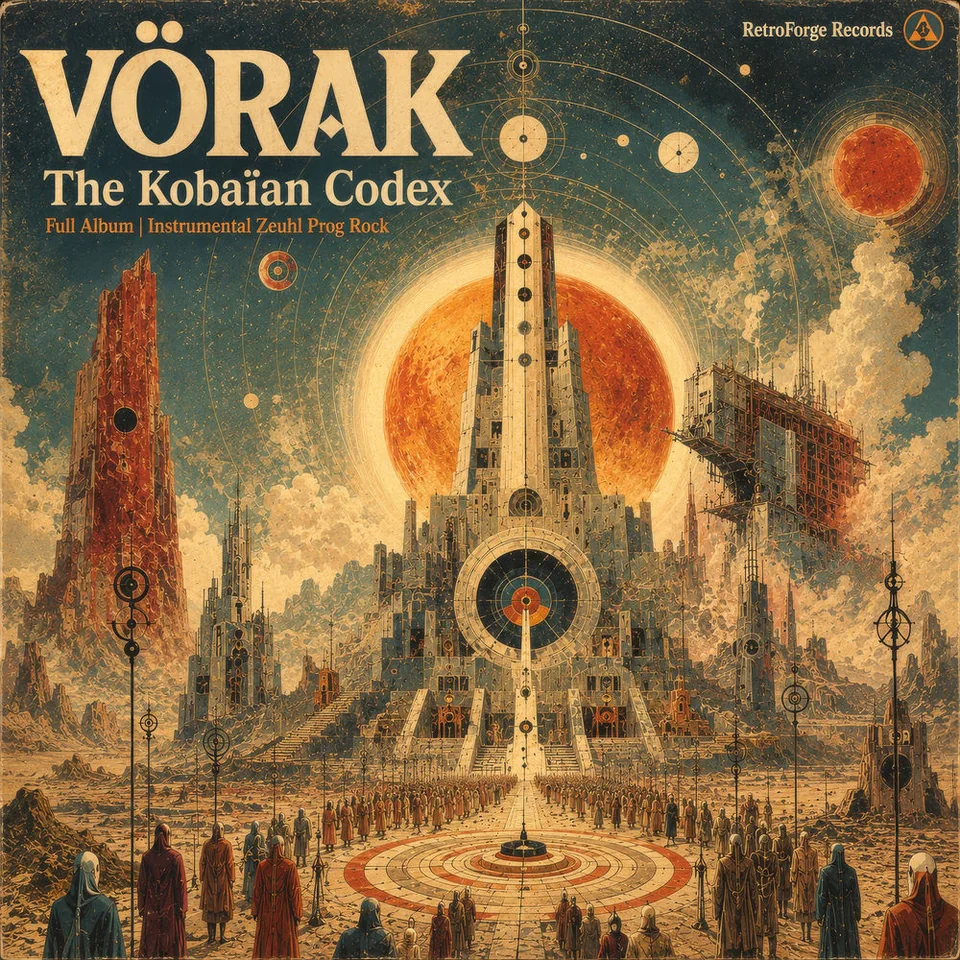
1976 · Instrumental Zeuhl Prog
Fretless bass, polyrhythmic drums and analogue keyboards trace an alien civilisation without relying on lyrics.
Open the liner notes →Go to the Source
Questions from the Record Room
Yes. The term and the core musical language originate with Magma, although later groups developed distinct approaches within it.
No. Invented or non-lexical vocals are historically important, but the defining engine can also be carried instrumentally through bass, drums, keyboards and repetition.
Jazz is one ingredient, but Zeuhl's ritual repetition, choral mass and compositional mythology give it a different centre from conventional fusion.
Related Styles
Deeper Discovery
Start with A System Without Voices as a RetroForge companion, then return through Progressive Rock to place it inside the wider family.
Curated paths into the people, records, events and ideas that give this subject its wider musical context.