
History Archive · 1968
Electric Ladyland and the Heavier Edge of Psychedelia
Electric Ladyland did not abandon songs for experimentation. It made the song, the jam and the studio process parts of the same changing environment.
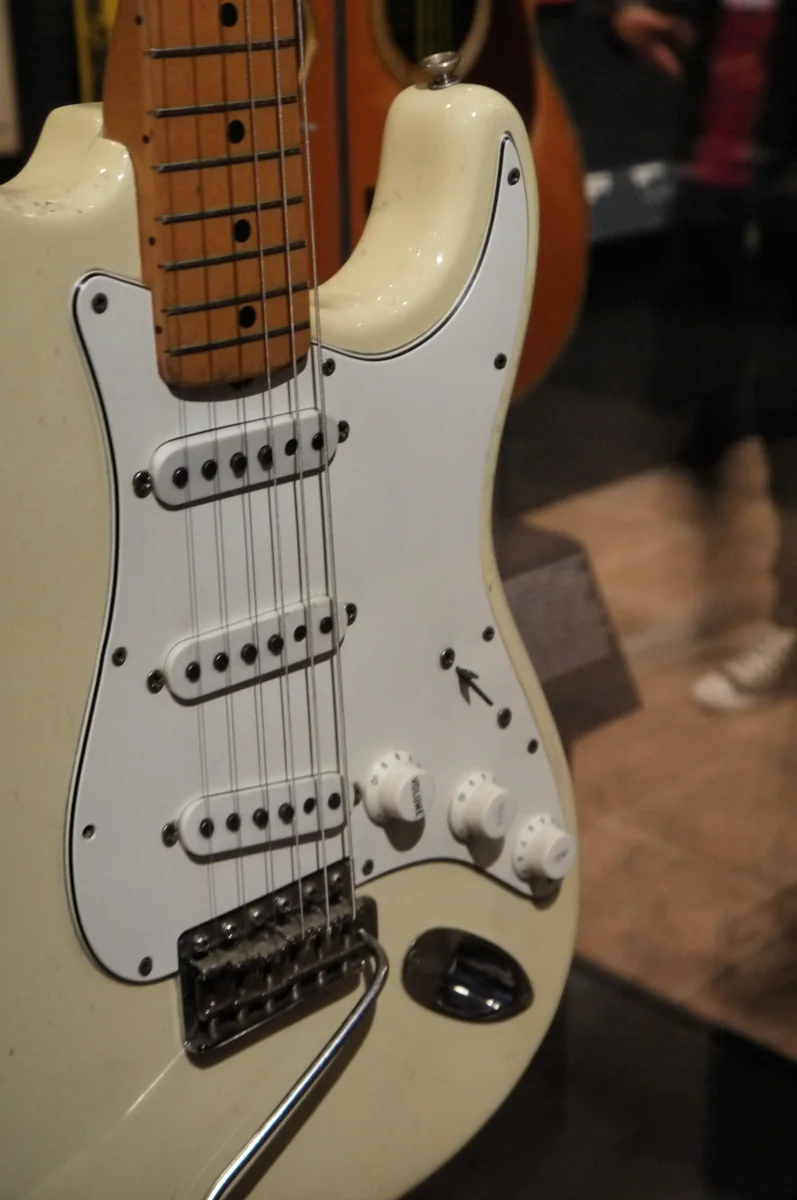
What Happened
The Jimi Hendrix Experience completed Electric Ladyland in 1968, largely at the Record Plant in New York. It was the first Hendrix album produced and directed by Hendrix himself and included contributions from musicians beyond the core trio.
The double album ranged from compact pieces such as “Crosstown Traffic” to the extended studio blues of “Voodoo Chile” and the underwater scale of “1983… (A Merman I Should Turn to Be)”.
What the Music Sounded Like
Fuzz, wah-wah, flanging, tape manipulation and stereo movement surround a rhythm section that can be tight or fluid. “All Along the Watchtower” builds drama through layered guitars; “Voodoo Child (Slight Return)” turns a riff into physical architecture.
How It Was Made
Hendrix worked closely with engineer Eddie Kramer, using repeated takes and overdubs as compositional tools. The official Hendrix archive documents hands-on flanging during “Gypsy Eyes” and Hendrix’s detailed concern with the finished package.
The Wider Musical Context
By 1968, psychedelia was splitting into heavier rock, progressive form, folk experiment and electronic exploration. Cream, Blue Cheer, the Doors and Pink Floyd represented very different answers to the same expansion.
What Followed
Heavy psych fed directly into early metal and hard rock, while Hendrix’s studio practice remained a model for guitarists who treated recording as more than documentation.
Hendrix Takes Control of the Studio
Electric Ladyland is the point where Jimi Hendrix’s identity as a producer becomes inseparable from his identity as a guitarist. Sessions moved between Olympic Studios in London and the Record Plant in New York, with engineer Eddie Kramer helping translate an expanding set of ideas. Hendrix pursued performances through repeated takes, overdubs and tonal adjustments, sometimes frustrating collaborators accustomed to faster decisions. The result is not simply a larger version of the Experience’s stage sound. It is an environment built from rooms, tape and electrical depth.
The double album format gave that environment space to change shape. Short, compressed songs sit beside long performances; studio construction gives way to the feeling of musicians discovering form in real time. Hendrix could place a dry vocal near the listener, send a guitar across the stereo field, then dissolve the entire image into echo. Psychedelia had often suggested escape from ordinary space. Here, space itself becomes playable.
A Band Opens into a Community
Noel Redding and Mitch Mitchell remain essential to the album, but the Experience is no longer a sealed trio. Steve Winwood plays organ on “Voodoo Chile,” Jack Casady contributes bass, and musicians including Buddy Miles, Al Kooper and Chris Wood appear across the sessions. Their presence supports Hendrix’s “Electric Sky Church” idea: a music capable of bringing different players and traditions into one charged, communal field.
“Voodoo Chile” grows from electric blues but expands it into a studio ritual. “1983… (A Merman I Should Turn to Be)” uses fantasy, war anxiety and underwater transformation across an extended arrangement that behaves more like cinema than a blues song. “Crosstown Traffic,” by contrast, is brutally concise. The range demonstrates that heaviness is not only volume. It can mean density, duration, pressure, or the sensation that a familiar form is being forced to contain more than it comfortably can.
Rewriting a Song Without Erasing Its Author
Hendrix’s version of Bob Dylan’s “All Along the Watchtower” is central to the album because it reveals his interpretive method. He does not treat the composition as sacred sheet music or as raw material to be casually claimed. The arrangement clarifies the song’s circular tension, using layered guitars, percussion and carefully shaped dynamics to build a landscape around Dylan’s verses. The performance became so authoritative that Dylan later adopted elements of Hendrix’s arrangement onstage.
That exchange matters in a period when rock increasingly valued original authorship. Hendrix showed that interpretation could itself be a profound creative act. His arrangement does not diminish Dylan’s writing; it hears possibilities inside it that the original recording left open. The record connects folk-rock language, electric blues and studio modernism without pretending their histories are interchangeable.
The End of One Psychedelic Moment
Issued in autumn 1968—with separate American and British release dates—the album arrived as the bright communal imagery of 1967 was darkening under war, political violence and internal strain. Hendrix’s music reflects that change. The colours remain vivid, but they are surrounded by storms, sirens, distorted broadcasts and apocalyptic water. “Voodoo Child (Slight Return)” closes the record with immense confidence, yet the figure speaking through it sounds elemental rather than comfortably human.
The original Experience would not make another studio album. That fact gives Electric Ladyland the character of both culmination and opening. Hard rock inherited its weight, progressive and space rock inherited its scale, and later studio guitarists inherited its treatment of amplification as architecture. The album does not leave psychedelia behind. It proves that psychedelia could become heavier, more collaborative and more technically exact without losing mystery.
Essential Listening
- The Jimi Hendrix Experience — Voodoo Chile
- The Jimi Hendrix Experience — 1983…
- The Jimi Hendrix Experience — All Along the Watchtower
- Blue Cheer — Summertime Blues
- Cream — White Room
Related Genres and Guides
Related RetroForge listening
Hear the Archive Connection
Research notes
Sources and Further Reading
- Electric Ladyland 50 — Experience Hendrix
- Electric Ladyland completion notes — Experience Hendrix
- Electric Ladyland — The Official Jimi Hendrix Site