
Timeline Archive · 1966
Revolver
Revolver captures the point at which four-track recording stopped being a limitation and became an instrument in its own right.
The Record in Context
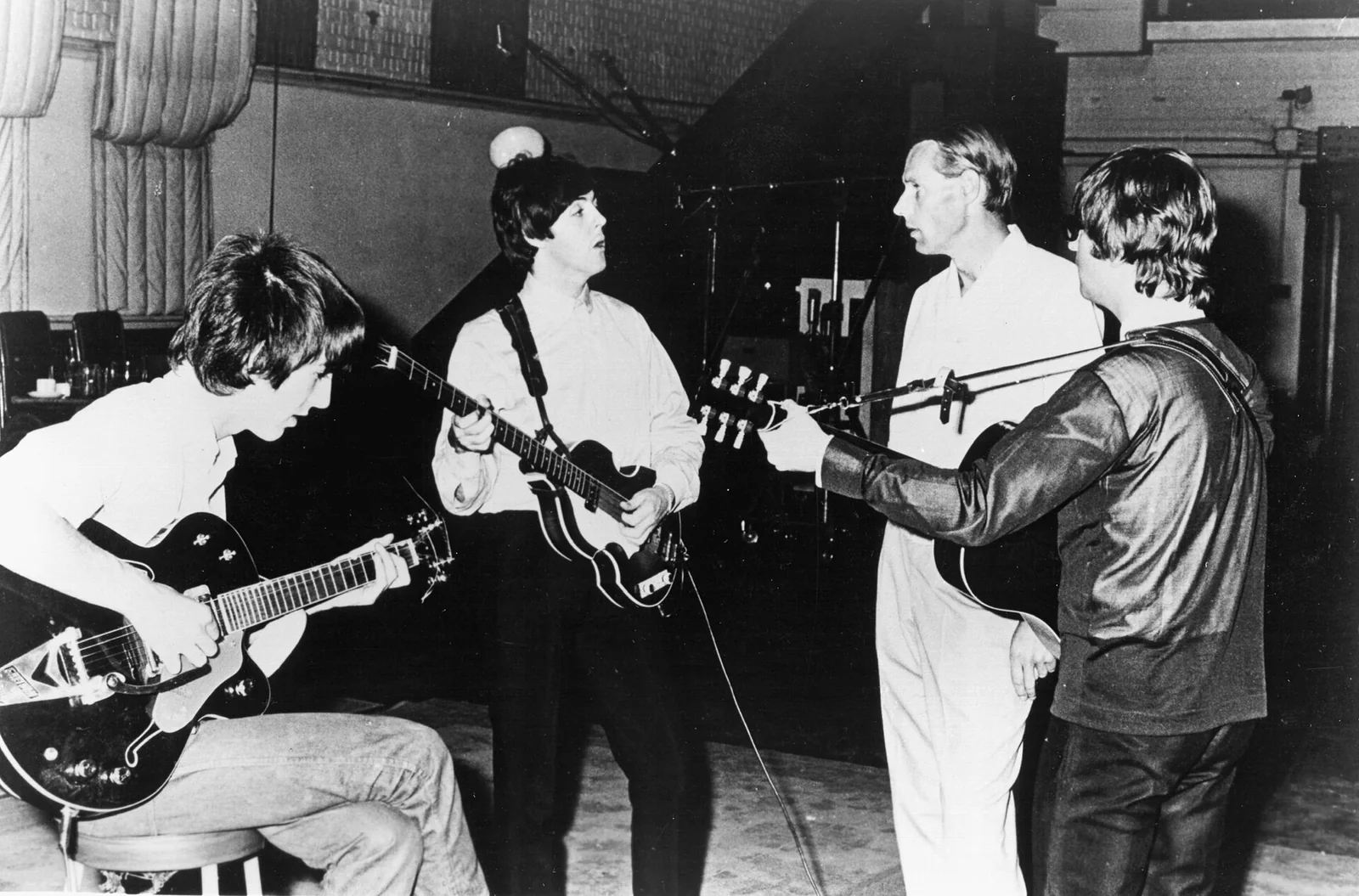
Revolver arrived while the Beatles were still officially a touring band, but it already belongs to a different kind of musical life. After years of films, radio sessions, package tours and near-continuous public appearances, the group entered EMI Studios in April 1966 with an unusual stretch of uninterrupted recording time. They began with Tomorrow Never Knows, the song that would close the album, and immediately asked the studio to produce sounds that conventional live performance could not reproduce.
The result is not a single sustained concept. Its strength comes from contrast: the chamber arrangement of Eleanor Rigby, the clipped soul brass of Got to Get You into My Life, the dry guitar attack of Taxman, the domestic melancholy of For No One and the suspended drone of Tomorrow Never Knows all occupy the same record. Rather than smoothing those differences away, producer George Martin and engineer Geoff Emerick helped make each track feel like a separate room connected by the personalities of the four musicians.
Historical Context
The Beatles had released Rubber Soul only eight months earlier. That album had already widened their harmonic language and lyrical range, but Revolver went further by making recording technique inseparable from arrangement. The group had also encountered Indian music through George Harrison, contemporary soul and Motown records, and the emerging possibilities of electronic and tape-based composition. These influences were not presented as a survey. They were absorbed into songs that remained concise enough to sit beside Yellow Submarine and Good Day Sunshine.
Work began at EMI on 6 April 1966. The official Beatles archive identifies Tomorrow Never Knows as the first recording attempted for the album. The sessions continued until late June, just before the group left for another international tour. That compressed period matters: the record sounds exploratory, but not casual. Ideas were tested, edited and layered within the practical limits of four-track tape. Reduction mixes freed tracks for further overdubs, while changes in tape speed altered the colour and weight of voices and instruments.
The British release contained fourteen songs. Capitol removed three Lennon compositions from the American edition because they had already appeared on Yesterday and Today. That difference shaped how listeners in the two markets first understood the album; the UK sequence presents a broader and more balanced view of the group at this moment.
Sound and Production
Tomorrow Never Knows is the clearest demonstration of the new studio logic. Ringo Starr holds a forceful, circular drum pattern against tambura drone, bass and a vocal processed through a rotating Leslie speaker. Tape loops prepared by members of the group were fed into machines around the studio and brought into the mix as live gestures. A reversed guitar solo adds another layer whose attack and decay do not behave like a conventionally played instrument.
The experimentation is just as significant when it is less obvious. Geoff Emerick used close microphone placement and heavy compression to give the drums a dense, immediate body. I’m Only Sleeping uses reversed guitar to create phrases that seem to inhale before the note arrives. For No One places McCartney’s restrained vocal and keyboard writing beside a French horn part played by Alan Civil. Eleanor Rigby removes the band’s normal instrumental setup entirely and relies on a double string quartet arranged by George Martin.
Those choices do not turn the album into a catalogue of effects. Each method serves the song’s internal atmosphere. The close strings sharpen Eleanor Rigby’s emotional distance; the slowed and reversed textures make I’m Only Sleeping feel pleasantly detached; the hard-edged brass on Got to Get You into My Life gives the track physical momentum. The technical imagination is persuasive because the songs remain legible underneath it.
Key Tracks
- Tomorrow Never KnowsA one-chord framework transformed by tambura, compressed drums, Leslie-treated voice, tape loops and reversed guitar.
- Eleanor RigbyA narrative song carried by voices and George Martin’s double string quartet rather than the Beatles’ usual instruments.
- I’m Only SleepingA deliberately unhurried performance whose altered tape speed and reversed guitar make drowsiness audible.
- TaxmanGeorge Harrison opens the album with a tense, rhythmically clipped complaint driven by bass, guitar and dry ensemble attack.
- For No OneMcCartney’s compact account of a relationship ending, set against clavichord-like keyboard colour and Alan Civil’s horn line.
Artwork and Visual Identity
Klaus Voormann, a friend from the Beatles’ Hamburg period, designed the sleeve by combining pen-and-ink portraits with a collage of photographs. The black-and-white design refused the bright colour associated with much mid-1960s pop packaging. Its dense hair, overlapping faces and miniature images mirror the record’s mixture of intimacy and disorientation without illustrating any particular song.
The design won the Grammy for Best Album Cover, Graphic Arts. It also gave a varied collection a single visual identity: recognisable faces, fragmented and recombined. That balance between familiarity and transformation is exactly what the music achieves.
Legacy and Influence
Revolver is often described as a threshold between pop and psychedelic rock, but its influence is wider than genre. It offered a practical example of the studio as a place where parts could be edited, reversed, compressed, layered and recontextualised until the recording became a composition that existed only on tape. Later artists did not need to copy its sitar, strings or tape loops to inherit that idea.
The album also resists the assumption that ambition requires length. Most tracks remain compact. Their scale comes from arrangement and timbre rather than extended duration. That made Revolver useful to psychedelic groups, art-rock bands, producers and songwriters who wanted records to contain more detail without abandoning the force of a short song.
What Came Next
The Beatles played their final paid concert at Candlestick Park on 29 August 1966. Freed from the need to reproduce new work on stage, they returned to EMI later that year and began Strawberry Fields Forever, Penny Lane and the sessions that became Sgt. Pepper’s Lonely Hearts Club Band.
Sgt. Pepper expanded the theatrical framing and packaging, but Revolver had already established the working method: use the recording studio to realise ideas that a four-piece band could not simply perform in a room. The next album made that freedom visible; Revolver is where it first became systematic.
The Studio Stops Documenting and Starts Composing
Revolver did not invent studio experimentation, but it made experimentation the organising principle of a mainstream pop album. The Beatles entered EMI Studios on 6 April 1966 with “Tomorrow Never Knows,” a song built around one chord, a tambura-like drone and a rhythm that refuses the usual verse-to-chorus release. Tape loops, a vocal routed through a Leslie speaker and a backwards guitar solo were not decorations added to a completed performance. They were the performance. The finished record could not be recreated by four musicians simply standing on a stage.
That distinction changed what a band could be. Recording had previously captured, refined or sweetened a musical event. Here, microphones, tape speed, splicing, close placement and artificial double tracking became compositional tools. Producer George Martin, engineer Geoff Emerick and technical engineer Ken Townsend translated requests that often began as images rather than instructions. The musicians might ask for a voice to sound distant, a brass section to strike with impossible force or a guitar to arrive from the wrong direction. The control room became a place where metaphor could be converted into sound.
Four Writers, Several Futures
The album’s range is as important as its technology. McCartney’s “Eleanor Rigby” removes the rock band entirely and gives its compressed social tragedy to a string octet. Harrison opens the British edition with “Taxman” and contributes three songs for the first time on a Beatles album, making his Indian musical interests and sceptical voice impossible to treat as side details. Lennon’s songs turn sleep, isolation and altered perception into unstable rooms. Starr’s “Yellow Submarine” makes communal simplicity part of the same record rather than an embarrassment to be excluded from it.
That variety prevents Revolver from becoming a catalogue of effects. “Here, There and Everywhere” depends on controlled harmony rather than audible novelty; “For No One” makes emotional distance feel architectural; “And Your Bird Can Sing” uses twin guitars as a bright, tightly wound mechanism. The album’s deeper claim is that popular music can move between chamber writing, soul, psychedelia, children’s song and hard guitar pop without surrendering identity. The band is recognisable not because every track sounds alike, but because curiosity has become its style.
The Touring Machine Reaches Its Limit
The sessions took place between the Beatles’ final British tour and their last international concerts. Their summer itinerary brought controversy in the Philippines, protests over Lennon’s “more popular than Jesus” remark in the United States and performances increasingly overwhelmed by crowd noise. Candlestick Park on 29 August became their final paid concert. The retreat from touring is often presented as a sudden artistic liberation, but Revolver shows that the transition was already happening while the machinery of Beatlemania was still running.
Once the stage ceased to be the final test, arrangements could be designed for repeated private listening. Details no audience could have heard through a stadium public-address system became central. The record rewards headphones, replay and comparison between songs. In that sense, it belongs to a wider 1966 shift: the album was becoming less a souvenir of hit singles and more a self-contained environment. Rock listeners were being trained to notice production decisions as closely as melodies or lyrics.
Why the Breakthrough Was Larger Than Psychedelia
The album is routinely described as psychedelic because of its drones, reversed sounds and altered states. That label is accurate but incomplete. Its influence also lies in the permission it gave to arrangers, engineers and musicians outside psychedelia. Progressive rock inherited the belief that instrumentation could change from track to track. Electronic music inherited the treatment of tape as material. Art rock inherited the assumption that a band could construct a distinct world without having to reproduce it live.
Sgt. Pepper would make studio ambition more theatrical and publicly legible one year later. Revolver is the quieter structural revolution beneath it. The record demonstrates that experiment and concision are not opposites: most of its songs are short, but almost none accepts the obvious solution. Its lasting modernity comes from that economy. Technology expands the imagination without replacing songwriting, and the studio becomes an instrument without becoming the only thing worth hearing.
Related listening
Hear the RetroForge Echo
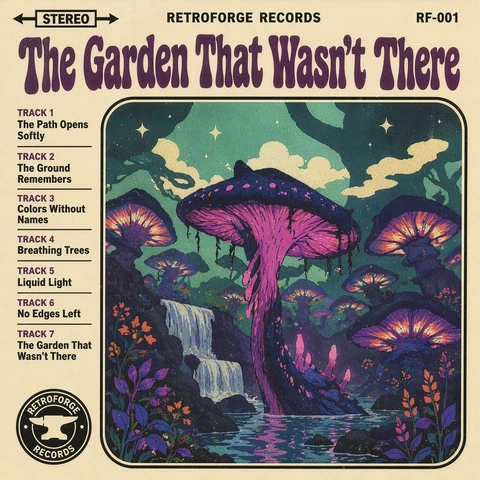
The Garden That Wasn’t There
For another late-1960s world built from tape echo, organ colour and songs that gradually loosen their grip on ordinary reality.
Open liner notes →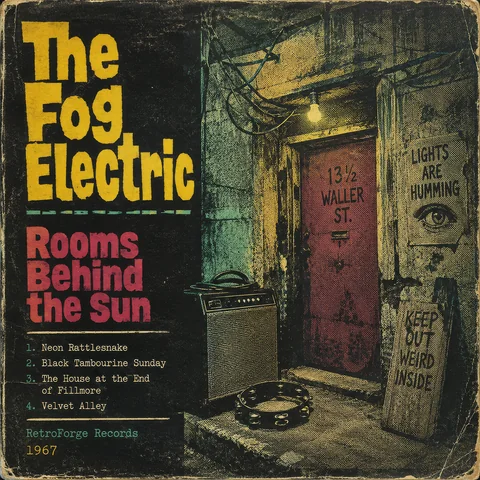
The Fog Electric — Rooms Behind the Sun
Its compact psychedelic forms and shifting studio textures connect with the concise experimental side of Revolver.
Open liner notes →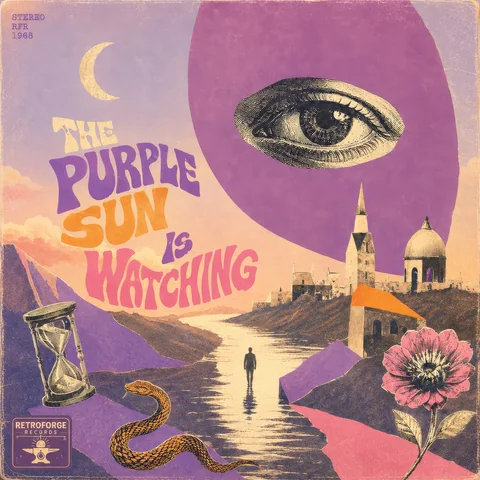
The Purple Sun Is Watching
Listeners drawn to layered analogue colour and surreal transitions may find a related atmosphere here.
Open liner notes →Research notes
Sources and Further Reading
- Revolver — The Beatles
- Announcing Revolver Special Editions — The Beatles / Apple Corps (7 September 2022)
- The Beatles Take Aim With 1966’s Revolver: For the Record — The Recording Academy, Renée Fabian (2 August 2018)
- Tomorrow Never Knows ? The Beatles
- Beginning of the Revolver sessions, 6 April 1966 ? The Beatles
- Klaus Voormann Grammy history ? Recording Academy