Pulse Replaces Beat
Motion can persist after conventional drumming disappears.

Krautrock & Electronic Family
The cosmic side of the 1970s German underground: electronics, improvisation and music escaping the gravitational pull of conventional rock.
The Sound
Kosmische Musik is often folded into krautrock, but the distinction is useful. Krautrock names a broad and varied field; kosmische points more specifically toward cosmic scale, synthesizer drift, tape manipulation and forms that may abandon the rock rhythm section altogether.
Some records float without a stable beat. Others use guitar, percussion or a sequencer as a vehicle through long electronic space. The common quality is expansion: harmony changes slowly, texture becomes architecture and the studio feels less like a room than an environment.
Transitnacht / Westlicht is the clearest RetroForge bridge because the catalogue already identifies it with krautrock and kosmische rock. It remains a contemporary release presented through an imagined 1974 vocabulary.
What You’ll Hear
How It Works
Kosmische music turns electronics, drone, improvisation and studio space toward the sensation of vast movement. Compared with motorik rock, the body may recede: rhythm becomes pulse, texture becomes landscape and form unfolds like travel without a visible road.
The term is historically linked to a particular German experimental context, yet the music itself is diverse. Listen for how instruments lose their ordinary scale. Guitar may become a wash of light, synthesizer a horizon and tape delay a way of measuring impossible distance.
Useful distinction: Boundary line: cosmic atmosphere alone does not establish kosmische lineage. The term carries historical and geographic context as well as a sonic association.
Motion can persist after conventional drumming disappears.
Processing turns instruments into environments.
Long changes matter more than sharply divided sections.
Celestial scale becomes a way of altering human perspective.
Historical Development
Kosmische Musik—cosmic music—developed in West Germany around the turn of the 1970s as musicians moved beyond Anglo-American rock models toward electronics, drone, improvisation and new concepts of space. The term predates some later uses of krautrock and was preferred by artists and listeners who rejected that English label, although neither name ever described one uniform sound.
Tangerine Dream, Klaus Schulze and Ash Ra Tempel pursued long electronic or electro-acoustic forms. Cluster made abstract sound intimate and tactile. Popol Vuh began with Moog-based work before finding a different cosmic language through piano, voice and acoustic instruments. Harmonia connected electronic texture to rhythm and concise ensemble form.
Kosmische is therefore broader than sequencer music and less specific than Berlin School. Its unity is cultural and imaginative: studios, communes and small labels made sound a route beyond inherited rock grammar. Space is not merely a subject but a compositional condition in which repetition, silence and gradual change become primary.
The Real-World Foundations
Not a ranking: six useful doors into the style.
Early Moog, percussion and patience create a singular electronic ritual.
Free guitar and electronics move between violent momentum and suspended atmosphere.
Four sides of near-motionless sound give cosmic music its deepest scale.
Processed organ and orchestral tape construct a dark universe before sequencers took control.
Electronic abrasion, pulse and empty space make technology feel handmade.
Compact rhythm and glowing electronics connect cosmic experiment to everyday motion.
Start Here
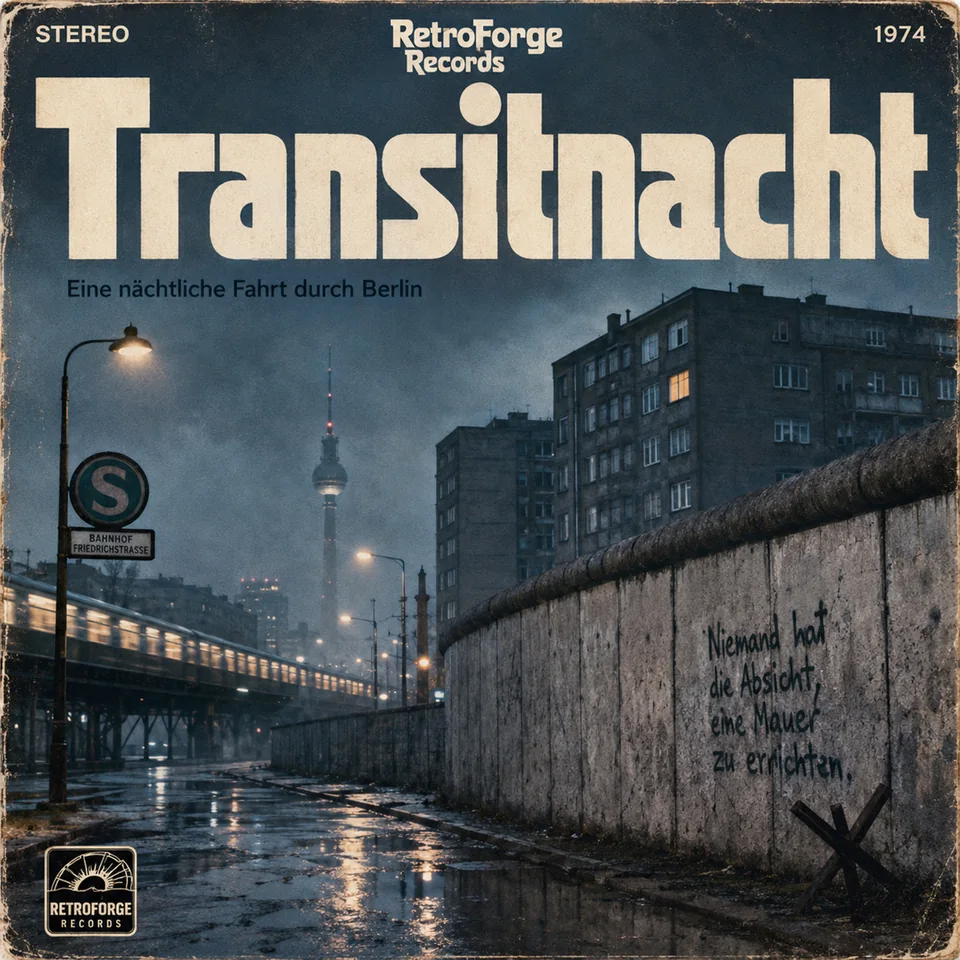
1974 · Krautrock · Kosmische Rock
Two night journeys through analogue repetition, tape texture and forward motion.
Open the liner notes →Questions from the Record Room
The terms overlap, but kosmische usually emphasises the cosmic, electronic and atmospheric branch of the wider West German scene.
No. Guitar, organ, tape, percussion, voice and acoustic instruments can be equally important.
Berlin School is a more specific sequencer-led electronic lineage; kosmische includes freer, rock-based and acoustic approaches as well.
Research Trail
Deeper Discovery
Start with Der Eiserne Traum as a RetroForge companion, then return through Krautrock to place it inside the wider family.
Curated paths into the people, records, events and ideas that give this subject its wider musical context.