

Overview
The Incredible String Band widened the vocabulary of British folk without abandoning the intimacy of songs carried by voices and acoustic strings. Robin Williamson and Mike Heron wrote separately, sang in sharply contrasting styles and moved among guitar, fiddle, mandolin, sitar, oud, gimbri, whistle and keyboards. That range made their records sound exploratory without turning them into demonstrations of unusual instruments.
Their concentrated peak runs from The 5000 Spirits or the Layers of the Onion through Wee Tam and the Big Huge. The commercial high point was The Hangman's Beautiful Daughter, which reached number five on the UK albums chart in 1968. Its success is unusually tangible evidence that this intricate, eccentric music once reached far beyond a specialist folk audience.
Formation & History
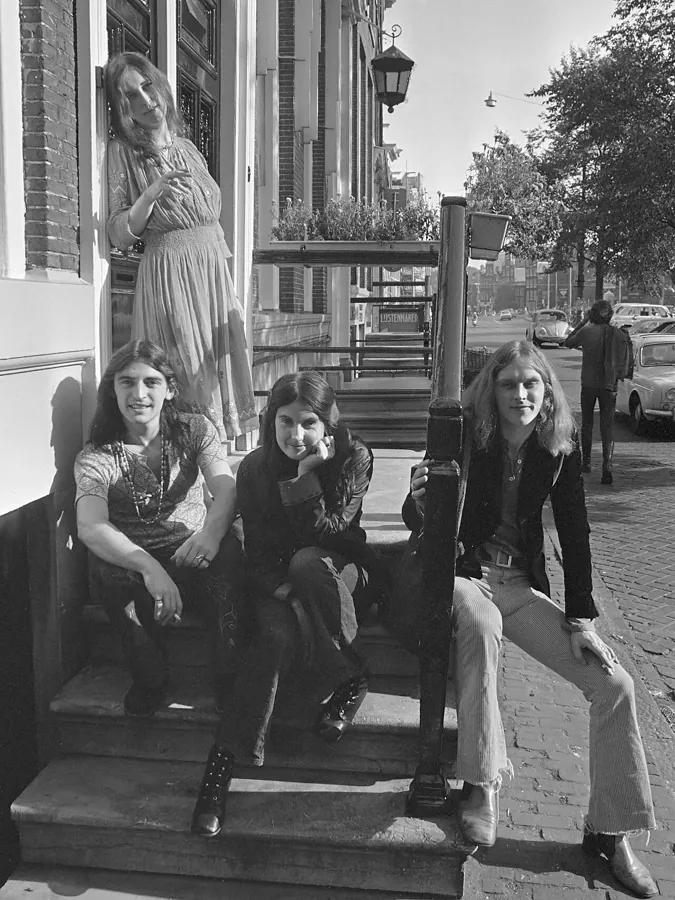
Williamson and Clive Palmer were already performing as a duo in Edinburgh before Mike Heron joined them. The trio became the house band at Palmer's Incredible Folk Club in Glasgow and recorded its self-titled debut for Joe Boyd in 1966. It then broke apart almost immediately: Palmer travelled east, Williamson went to Morocco and Heron remained in Scotland. Williamson returned with Moroccan instruments, and he and Heron reconvened as the duo heard on the second album.
The sequence accelerated quickly. The 5000 Spirits appeared in 1967; The Hangman's Beautiful Daughter and Wee Tam and the Big Huge followed in 1968. Licorice McKechnie and Rose Simpson became increasingly important as singers and instrumentalists. At Woodstock in August 1969, the group declined to perform during Friday's rain and was moved to Saturday evening. The lineup later expanded further, but the original run ended in 1974. Williamson, Heron and Palmer reunited in 1999; changing lineups continued until 2006.
Sound & Style
The early records are built less like electric rock albums than like small acoustic ensembles assembled song by song. Plucked strings supply both rhythm and drone; fiddle, whistle and bowed lines enter as colour; hand percussion can replace a conventional drum kit. At Sound Techniques, producer Joe Boyd and engineer John Wood used overdubbing to let Williamson and Heron layer instruments while preserving the close, dry presence of their voices.
Williamson often favoured winding melodies, changing metres and long episodic forms. Heron's writing more readily moved toward blues, piano-led pop and direct refrains. The productive tension is clearest on The Hangman's Beautiful Daughter: the side-long scale of “A Very Cellular Song” sits beside compact pieces without making the album feel divided between experiment and songcraft.
Essential Albums
Recorded at Sound Techniques with Joe Boyd and John Wood, the ten-track third album turns the Williamson–Heron partnership into a densely layered studio language. “A Very Cellular Song” joins Bahamian spiritual material, folk melody and shifting instrumental episodes across more than thirteen minutes; the shorter songs make the same world feel intimate rather than miniature.
Key tracks: Koeeoaddi There · A Very Cellular Song · The Minotaur's Song
Open album guide → View on Amazon →The first album by the Williamson–Heron duo establishes the group's mature method. Danny Thompson's double bass anchors seven tracks while guests add sitar, tambura, piano and Licorice McKechnie's voice and finger cymbals. “The Mad Hatter's Song” and “Painting Box” show how quickly the writing had moved beyond the comparatively spare debut.
Key tracks: Chinese White · The Mad Hatter's Song · Painting Box
Open album guide → View on Amazon →The eighteen-track fourth album was issued as a double LP in Britain and divided into two separate albums in the United States. Rose Simpson and Licorice McKechnie add violin, harp, percussion and backing voices to Williamson and Heron's expanding palette. Its scale comes from the accumulation of concise songs and longer meditations, not from a single continuous suite.
Key tracks: Job’s Tears · Maya · The Circle Is Unbroken
Open album guide → View on Amazon →Affiliate note: Amazon links on this page may earn RetroForge Records a small commission, at no extra cost to you.
Deeper Cuts
Changing Horses
1969The first album to present Williamson, Heron, McKechnie and Simpson as a settled four-person group. Its six long tracks give ensemble singing and extended arrangements more room than the compact abundance of the 1968 records.
Open album guide → View on Amazon →I Looked Up
1970A concise six-track studio album recorded around the same period as the group's Woodstock appearance. Heron's “Black Jack Davy” adaptation and Williamson's long “Pictures in a Mirror” place traditional material beside newly written, increasingly theatrical arrangements.
Open album guide → View on Amazon →A thirteen-track 1971 album made by an expanded group that included Malcolm Le Maistre. “Darling Belle” and “Painted Chariot” retain the acoustic intricacy of the earlier work while the fuller ensemble points toward the band's later, more overtly theatrical phase.
Open album guide → View on Amazon →Why They Still Matter
The Incredible String Band demonstrated that folk instrumentation could support ambitious studio composition without surrendering the character of individual voices and hand-played instruments. Their best work treats musical traditions as active materials rather than decorative references, a distinction that still separates these records from much period psychedelia.
The run from The 5000 Spirits to Wee Tam and the Big Huge also documents unusually rapid development: a spare trio becomes a multi-instrumental duo and then a four-person ensemble in little more than two years. That pace, together with the chart success of The Hangman's Beautiful Daughter, makes the group central to any account of British psychedelic folk.
Sources & Further Reading
This guide was checked against Mike Heron's official biography, the Scottish Traditional Music Hall of Fame profile, the official Woodstock performer history, and the Official Charts artist archive. Album recording details were cross-checked with the linked RetroForge album guides and their source trails.
Connected archive routes
Explore This Band
Continue through the RetroForge knowledge graph
Curated paths into the people, records, events and ideas that give this subject its wider musical context.
Genres and scenes
- Psychedelic Folk
- Psychedelic Rock