

Overview
Traffic joined British psychedelia to rhythm and blues, folk and jazz without settling permanently into any one of them. Steve Winwood’s voice and keyboards supplied the centre, while Chris Wood’s flute and saxophone, Jim Capaldi’s drumming and lyrics, and Dave Mason’s contrasting pop craftsmanship made the early records unusually mobile. The catalogue moves from compact 1967 singles to the open, improvisatory forms of the early 1970s.
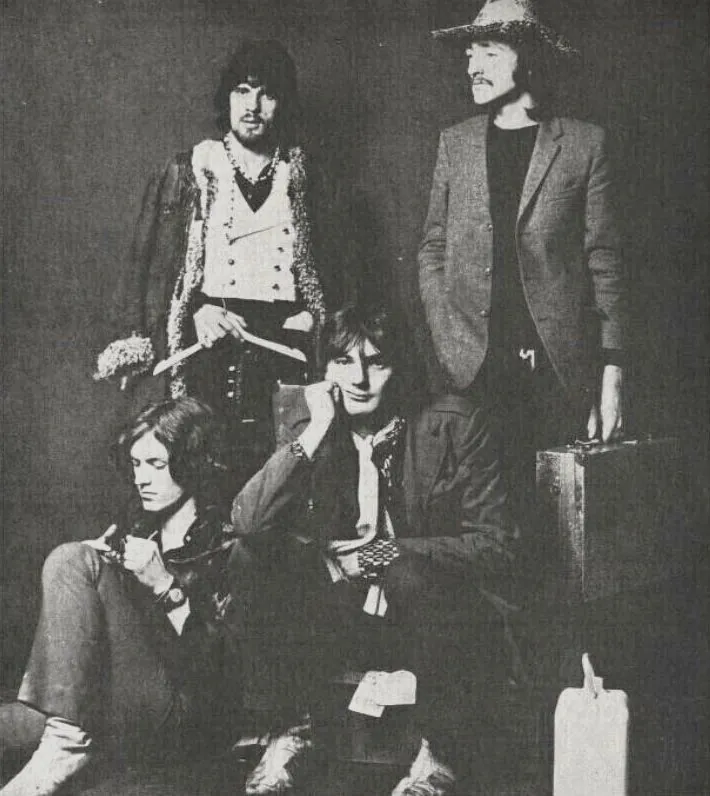
Formation & History
Winwood left the Spencer Davis Group in 1967 and formed Traffic with Mason, Capaldi and Wood after the musicians had met in Birmingham’s club scene. They worked from a cottage near Aston Tirrold in Berkshire. “Paper Sun” reached No. 5 in Britain that summer, and Mason’s “Hole in My Shoe” followed at No. 2. The British debut Mr. Fantasy arrived in December; its American counterpart used a different title and running order.
Mason left, returned for the self-titled second album, and departed again as his concise songwriting diverged from the others’ increasingly improvisatory direction. Traffic first dissolved when Winwood joined Blind Faith in 1969. Sessions begun as a Winwood solo record with Wood and Capaldi became the 1970 reunion album John Barleycorn Must Die. Later line-ups added Ric Grech, percussionist Rebop Kwaku Baah and other players; the Muscle Shoals musicians David Hood and Roger Hawkins anchored the 1973 studio and live records. After When the Eagle Flies, Traffic ended again in 1974. Winwood and Capaldi revived the name for Far from Home and a tour in 1994, and the original quartet was inducted into the Rock & Roll Hall of Fame in 2004.
Sound & Style
The early singles use phased percussion, sitar, Mellotron and close vocal harmonies, but the band’s lasting identity comes from instrumental conversation. Winwood moves between Hammond organ, piano, guitar and bass; Wood answers with breathy flute lines or grainier saxophone; Capaldi can hold a rock pulse while leaving room around it. Mason brings acoustic guitar, sitar and sharply shaped songs such as “Hole in My Shoe” and “Feelin’ Alright?”
On John Barleycorn Must Die, the traditional title song places Winwood’s voice and acoustic guitar beside Wood’s flute, while “Glad” develops through piano, saxophone and rhythm rather than a sung refrain. The Low Spark of High Heeled Boys stretches that method into longer forms: the title track builds patiently from electric piano and a spare groove instead of treating length as an excuse for continuous soloing.
Essential Albums
What began as Winwood solo sessions became a trio record when Capaldi and Wood joined him. “Glad” opens with piano-led jazz rock, “Freedom Rider” brings Wood’s reeds forward, and the traditional title song strips the arrangement to acoustic guitar, voice, flute and restrained percussion. The contrast makes the reunion feel deliberate rather than accidental.
Key tracks: Glad · Stranger to Himself · Every Mother’s Son
Open album guide → View on Amazon →Mr. Fantasy
1967The British debut does not simply collect the hit singles: “Paper Sun” and “Hole in My Shoe” were left off its original running order. Instead it moves between Mason’s compact “House for Everyone,” the modal drift of “Heaven Is in Your Mind,” Wood’s reed-led “Giving to You” and the slow emotional pull of “Dear Mr. Fantasy.” The sequencing reveals a band already larger than its psychedelic-pop reputation.
Key tracks: Heaven Is in Your Mind · Dealer · Giving to You
Open album guide → View on Amazon →The expanded six-piece line-up makes space the organising principle. “Hidden Treasure” opens acoustically; the eleven-minute title track grows from Winwood’s electric piano and Jim Gordon’s measured beat toward saxophone and guitar peaks; “Rock & Roll Stew” answers with a harder ensemble drive. The record balances long development with sharply different song textures.
Key tracks: Hidden Treasure · The Low Spark of High Heeled Boys · Many a Mile to Freedom
Open album guide → View on Amazon →Affiliate note: Amazon links on this page may earn RetroForge Records a small commission, at no extra cost to you.
Deeper Cuts
Traffic
1968The second album, also known as the "self-titled" record. Mason's songwriting is at its most integrated; "Feelin' Alright" became a standard.
Open album guide → View on Amazon →The expanded lineup in full flight. Roger Hawkins and David Hood from Muscle Shoals bring a Southern soul element that suits Winwood better than expected.
Open album guide → View on Amazon →On the Road
1973A live document of the touring band. The extended improvisations translate beautifully to concert; essential for understanding how the music actually worked in performance.
Open album guide → View on Amazon →Why They Still Matter
Traffic’s importance lies in how naturally they moved between formats. The chart success of “Paper Sun” and “Hole in My Shoe” proves that they could make concise psychedelic pop, yet John Barleycorn Must Die and The Low Spark of High Heeled Boys show the same musicians building album-length arguments from folk material, jazz phrasing and rhythm-and-blues weight. Wood’s flute is a structural voice rather than ornament, while the Winwood–Capaldi writing partnership gives the improvisation a firm lyrical and melodic frame. Their 2004 Rock Hall induction recognised a catalogue that helped widen the vocabulary of British rock.
Sources & Further Reading
Official Charts — Traffic chart history
Rock & Roll Hall of Fame — Traffic
AllMusic — Traffic biography
AllMusic — Shoot Out at the Fantasy Factory credits
Wikimedia Commons — photograph and rights information
Connected archive routes
Explore This Band
Continue through the RetroForge knowledge graph
Curated paths into the people, records, events and ideas that give this subject its wider musical context.
Genres and scenes
- Psychedelic Pop
- Psychedelic Rock
Sounds and instruments
- Hammond Organ
- Mellotron