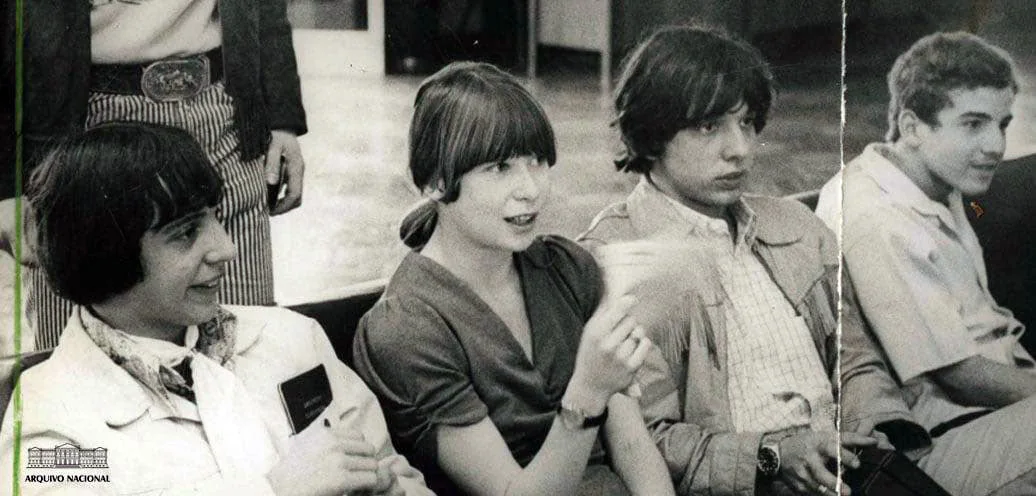
Os Mutantes formed in São Paulo in 1966 around Rita Lee and brothers Arnaldo Baptista and Sérgio Dias. Their early records connect electric rock to Brazilian song, festival culture, orchestral arrangement and comic theatre. Rather than treating imported equipment and local tradition as opposing choices, the trio turned their collision into the subject of the music.
The classic catalogue changes quickly. The 1968 debut is closely tied to the wider Tropicália circle; Mutantes makes the group’s own collage language more self-contained; A Divina Comédia ou Ando Meio Desligado brings Liminha and Dinho Leme into a more muscular studio sound. Rita Lee’s departure in 1972 and Arnaldo Baptista’s in 1973 opened a separate progressive-rock phase. The name therefore covers distinct creative units rather than one unchanged band lasting from 1966 to the present.
Os Mutantes in 1971.Photo: Unknown creator / Wikimedia Commons · Licensed under Public domain. Converted to WebP for this page.
Formation & History
The group grew from Rita Lee’s Teenage Singers and the Baptista brothers’ Wooden Faces and O’Seis projects. Ronnie Von suggested the final name, and Os Mutantes made their television debut on his programme on 15 October 1966. Arranger Rogério Duprat subsequently connected them with Gilberto Gil. They accompanied Gil on “Domingo no Parque” at the 1967 TV Record festival and became active participants in Tropicália, appearing on the 1968 collective manifesto Tropicália ou Panis et Circencis and backing Caetano Veloso during the confrontational festival performance of “É Proibido Proibir.”
Producer Manoel Barenbein brought the group to Polydor for the June 1968 debut, with Duprat supplying arrangements. Liminha and drummer Dinho Leme expanded the working lineup around the second and third albums. Rita Lee left in 1972; Arnaldo Baptista departed the following year. Sérgio Dias then led a different progressive-rock formation with keyboardist Túlio Mourão, bassist Antônio Pedro de Medeiros and drummer Rui Motta, recording Tudo Foi Feito pelo Sol for Som Livre in 1974. That original era ended in 1978. A 2006 reunion brought Dias and Baptista back together with Dinho Leme and singer Zélia Duncan; Dias continued later versions after Baptista’s renewed departure.
Sound & Style
Sérgio Dias’s fuzz guitar, Arnaldo Baptista’s bass and keyboards, and Rita Lee’s voice, percussion, recorder and electronic colour form the centre of the early sound. Their brother Cláudio César Dias Baptista designed instruments and effects specifically for the group, while Duprat’s strings, brass and orchestral quotations give the first records a scale the trio could abruptly puncture with jokes, household noises or hard edits.
The arrangements do more than mix “Brazilian” and “foreign” ingredients. “A Minha Menina” drives Jorge Ben’s song through clipped fuzz; “Panis et Circenses” sets domestic satire inside Duprat’s stop-start chamber-pop frame; “Dom Quixote” treats fanfare, dialogue and collage as part of the song; “Ando Meio Desligado” leaves more room for electric bass, organ and guitar. Harmony singing and humour hold these changes together, while the later progressive lineup replaces the early miniature theatre with longer keyboard-and-guitar development.
Essential Albums
1968
Os Mutantes
Polydor · Released June 1968 · LPNG 44.018
The debut captures Os Mutantes inside Tropicália’s collaborative network rather than as an isolated rock trio. Caetano Veloso and Gilberto Gil wrote “Panis et Circenses” and “Bat Macumba”; Jorge Ben supplied “A Minha Menina”; Duprat’s arrangements continually reshape the scale of the songs. The group answer those materials with fuzz, group vocals, abrupt edits and handmade electronics. “Trem Fantasma” and “O Relógio” show that their own writing could already move between theatrical collage and intimate melody.
Key tracks: Panis et Circenses · A Minha Menina · Bat Macumba
The second album makes collage feel less like an introduction and more like the band’s native grammar. “Dom Quixote” opens with orchestral ceremony before splintering into rock and spoken interruption; “Dia 36” places homemade electronic colour around a darker song; “Dois Mil e Um,” written by Rita Lee with Tom Zé, turns science-fiction imagery into rural-futurist pop. Dinho Leme and Liminha appear as the trio develops toward a fuller performing unit, while Duprat’s arrangements remain central to the record’s theatrical reach.
Key tracks: Dom Quixote · Não Vá Se Perder por Aí · Dois Mil e Um
The third album moves closer to a self-contained rock-band sound without abandoning satire or arrangement. The title track rides electric bass, organ and distorted guitar; “Ave, Lúcifer” compresses vocal harmony and menace; the six-minute “Meu Refrigerador Não Funciona” gives Lee an unusually extended blues-rock performance. Liminha and Dinho Leme reinforce the rhythm section, Naná Vasconcelos contributes congas, and Duprat’s treatment of “Chão de Estrelas” turns a Brazilian standard into deliberately unstable studio theatre.
Key tracks: Ando Meio Desligado · Ave, Lúcifer · Meu Refrigerador Não Funciona
Os Mutantes make a purely US–UK account of psychedelia impossible to sustain. Their decisive context was the Brazilian television festival, recording studio and Tropicália movement under military rule—not an attempt to reproduce a London or San Francisco scene at a distance. Electric instruments, orchestral writing, Brazilian repertoire and mass-media satire meet in records that treat cultural hierarchy itself as material.
The 1990s international rediscovery and Universal’s later reissues brought the early catalogue to listeners who had known the group mainly through endorsements from artists such as David Byrne, Kurt Cobain and Beck. Those admirers helped circulation, but the continuing importance belongs to the work: the albums show how technical invention, comedy and collaborative authorship can make hybrid music sound specific rather than generic.
RetroForge Records publishes original music and independent editorial guides. This historical band guide is not affiliated with the artist, labels or rights holders. No unlicensed album artwork is reproduced.