

Overview
The American Kaleidoscope — not to be confused with the British group of the same name — treated stylistic range as the basis of the band rather than an occasional experiment. The original five musicians brought California folk-club experience, country and bluegrass playing, blues, jazz and Middle Eastern instruments into a psychedelic-rock setting. A Kaleidoscope album can move from an oud-and-saz instrumental to an old-time song, an electric guitar improvisation or a Cab Calloway arrangement without presenting one tradition as decorative scenery.
That breadth came from specific players. David Lindley and Chris Darrow had roots in Southern California string-band music; Solomon Feldthouse had grown up partly in Turkey and performed flamenco and Middle Eastern repertory; Chester Crill covered violin, keyboards and harmonica; drummer John Vidican held the original lineup together. Four Epic albums document both that founding ensemble and the personnel changes that followed.
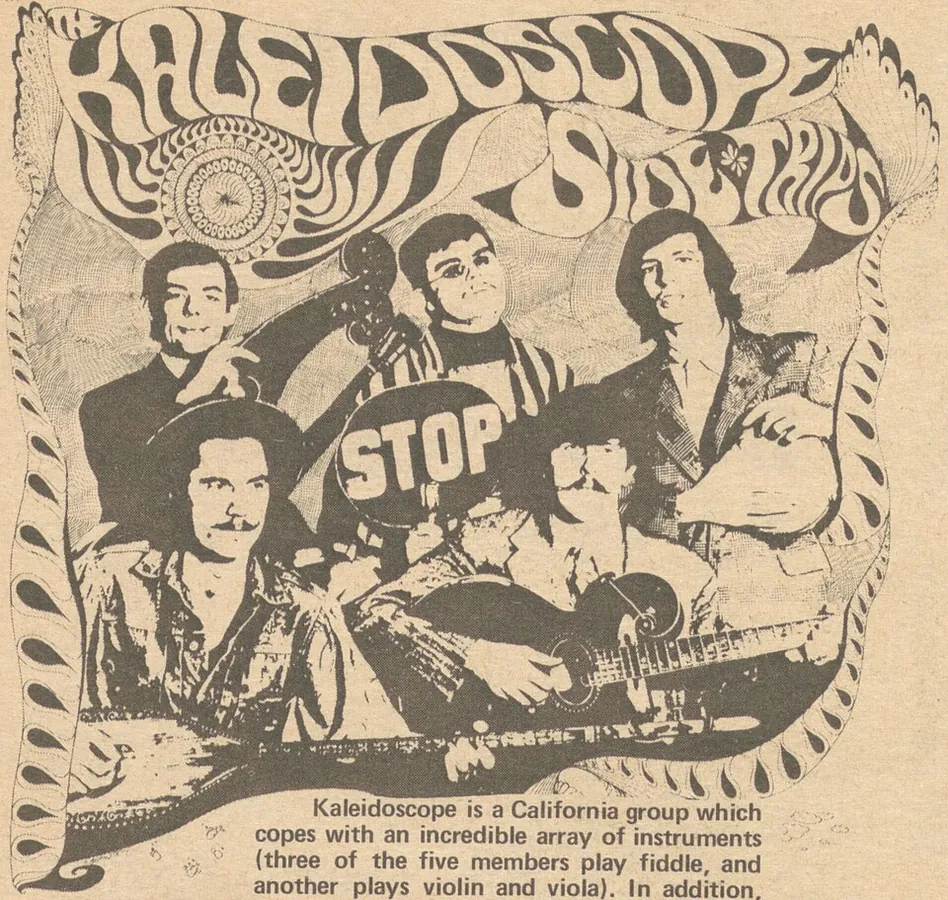
Formation & History
Kaleidoscope formed in Los Angeles in 1966 after Lindley and Feldthouse had performed together as David and Solomon. Crill joined them, followed by Darrow and Vidican. Epic released the Barry Friedman-produced debut single "Please" in December 1966 and the first album, Side Trips, in 1967. The same lineup made A Beacon from Mars, whose two long closing pieces, "Taxim" and the title track, preserved the group's live scale more fully than the debut.
Darrow and Vidican left before the third album. Stuart Brotman took over bass and Paul Lagos drums for Incredible! Kaleidoscope, which became the group's only Billboard-charting album. The lineup changed again during Bernice: Jeff Kaplan and Ron Johnston appeared, Feldthouse departed, and the music leaned more heavily toward electric guitar and country. Kaleidoscope also contributed "Brother Mary" and "Mickey's Tune" to the Zabriskie Point soundtrack before the original run ended in 1970.
The 1976 reunion did produce a complete album, When Scopes Collide; Lindley participated as a guest under the name De Paris Letante. Crill and Darrow organized another reunion around 1990–91 for Greetings from Kartoonistan (We Ain't Dead Yet), this time without Lindley. Lindley's later work with Jackson Browne, his studio career and El Rayo-X made him the best-known alumnus, but the reunion records confirm that Kaleidoscope's history did not stop with the four Epic LPs.
Sound & Style
Kaleidoscope's unusual instruments are audible as working parts of arrangements. Feldthouse's oud, saz, bouzouki, doumbek and other strings establish tuning, ornament and rhythmic direction; Lindley moves among electric guitar, banjo, fiddle and mandolin; Darrow and Crill add further string, keyboard and vocal colours. "Egyptian Gardens" and "Pulsating Dream" compress that range into short studio pieces, while "Taxim" develops it through extended instrumental exchange.
The band also resists a single exoticist label. Side Trips places Dock Boggs' "Oh Death" and Cab Calloway's "Minnie the Moocher" beside original psychedelic material. A Beacon from Mars contrasts the live-in-the-studio title track's bowed and amplified guitar with the Middle Eastern framework of "Taxim." The revised lineup on Incredible! Kaleidoscope tightens the song writing around "Lie to Me" but still closes with the 7/8 instrumental "Seven-Ate Sweet." Bernice then foregrounds country and electric guitar without fully abandoning the older palette.
Essential Albums
Side Trips
1967Barry Friedman produced the ten-track debut, which immediately establishes the original quintet's range. Feldthouse's "Egyptian Gardens" brings Middle Eastern strings and melodic shapes into the foreground; "Pulsating Dream" moves through a tighter psychedelic arrangement; and the versions of Cab Calloway's "Minnie the Moocher" and Dock Boggs' "Oh Death" reveal how readily the group could recast older American material. The contrasts are the point: this is not one dominant style decorated with unusual instruments, but five multi-instrumentalists negotiating several traditions inside concise songs.
Key tracks: Egyptian Gardens · Pulsating Dream · Minnie the Moocher
Open album guide → View on Amazon →A Beacon from Mars
1968The second LP preserves more of Kaleidoscope's stage scale. "I Found Out" and "Baldheaded End of a Broom" retain the group's compact, song-based side, but the record is defined by its two extended closers. "Taxim" develops through Feldthouse's Middle Eastern string language and ensemble exchange; the title track turns a heavy electric riff into a long improvisational performance, with Lindley's amplified guitar and violin bow central to its sound. Those pieces were recorded without overdubs, making the album the clearest document of how the original lineup interacted in real time.
Key tracks: I Found Out · Taxim · A Beacon from Mars
Open album guide → View on Amazon →Stuart Brotman and Paul Lagos replace Chris Darrow and John Vidican on the third album, changing the rhythm section without narrowing the repertory. "Lie to Me" is a direct rock song, Sidney Bechet's "Petite Fleur" is reshaped as an instrumental, and the closing "Seven-Ate Sweet" builds its momentum in 7/8 around electric and Middle Eastern timbres. It was Kaleidoscope's only album to enter the US album chart, yet its accessibility comes from sharper arrangements rather than a retreat from the ensemble's breadth.
Key tracks: Lie to Me · Petite Fleur · Seven-Ate Sweet
Open album guide → View on Amazon →Affiliate note: Amazon links on this page may earn RetroForge Records a small commission, at no extra cost to you.
Deeper Cuts
Bernice
1970The fourth Epic album documents a band in transition. Jeff Kaplan and Ron Johnston appear alongside Lindley, Crill, Brotman and Lagos, while Feldthouse left during this final phase. The arrangements give country playing and electric guitar more room than the first two albums, but pieces such as "Chocolate Whale" and the title track still resist a single stylistic lane. It is less an endpoint to the original quintet than a record of Kaleidoscope changing personnel and emphasis before the 1970 split.
Open album guide → View on Amazon →Why They Still Matter
Kaleidoscope's importance lies in the depth of its musicianship rather than in an unverifiable claim to have invented a later genre. Feldthouse's knowledge of Middle Eastern repertory, Lindley and Darrow's command of American string traditions, and Crill's movement between bowed strings and keyboards allowed the group to change musical language from track to track without treating those languages as interchangeable effects. The four Epic albums preserve different versions of that method as the lineup and production evolved.
Lindley's later work with Jackson Browne, Ry Cooder and El Rayo-X made his multi-instrumental approach familiar to a much wider audience. Kaleidoscope's own catalogue, however, remains a collective achievement: Side Trips shows the founding range, A Beacon from Mars captures extended ensemble playing, Incredible! Kaleidoscope records a revised rhythm section, and Bernice traces the final personnel shift. The two reunion albums also make the band's history more substantial than a four-LP footnote to Lindley's solo career.
Sources & Further Reading
This guide was checked against the NAMM Oral History interview with David Lindley, Sundazed notes for A Beacon from Mars, and the AllMusic entries for Kaleidoscope, Side Trips, Incredible! Kaleidoscope and Bernice. Album dates can vary between catalogue listings; this page follows the release years used by the RetroForge album guides.
Connected archive routes