

Overview
Renaissance began in 1969 with former Yardbirds Keith Relf and Jim McCarty, then changed personnel so completely that the best-known 1970s group contained none of the founders. By Prologue in 1972, Annie Haslam, John Tout, Jon Camp, Terry Sullivan and guitarist Rob Hendry had established a new working band. Michael Dunford supplied much of its music while initially remaining offstage, then returned as guitarist to complete the long-lived Haslam-era quintet.
That group developed a distinct form of British progressive rock from Haslam's wide-ranging soprano, Tout's piano, Dunford's acoustic guitar, Camp's melodic bass and Sullivan's percussion. Betty Thatcher wrote most of the lyrics without performing in the band. The catalogue ranges from the compact “Carpet of the Sun” to the multipart “Song of Scheherazade”, recorded at Abbey Road in 1975 with orchestration by Tony Cox and the London Symphony Orchestra.
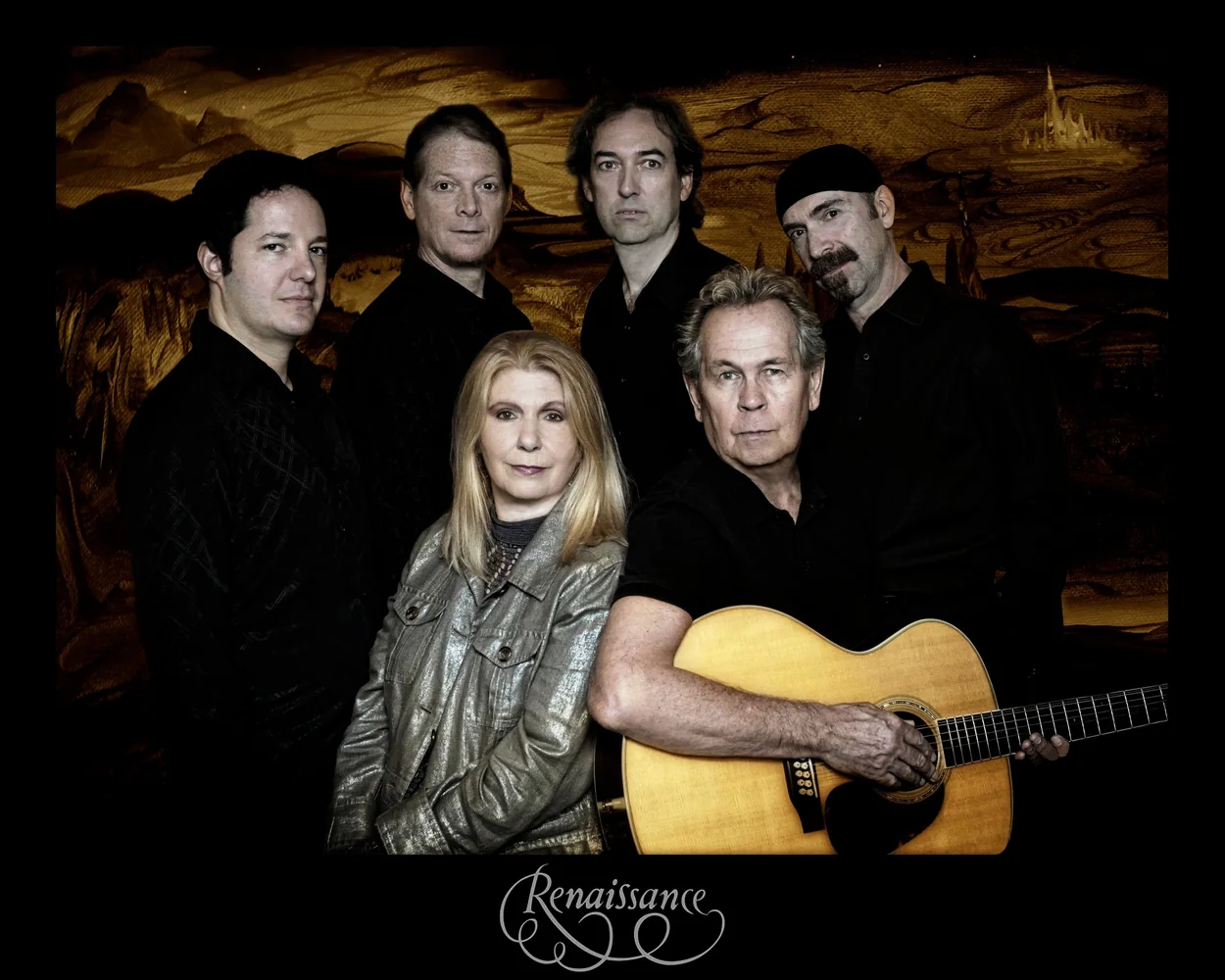
Formation & History
Relf and McCarty formed the original Renaissance with singer Jane Relf, pianist John Hawken and bassist Louis Cennamo. The quintet recorded Renaissance in 1969; a period of departures and replacements produced Illusion in 1971. Michael Dunford entered during that transition. By June 1972 the recording lineup for Prologue consisted of Haslam, Tout, Camp, Sullivan and Hendry. Dunford chose at that stage to concentrate on composition with lyricist Thatcher rather than touring, although his material defined the album.
Hendry left after Prologue. Camp handled much of the guitar work on Ashes Are Burning, with Dunford contributing acoustic guitar and Wishbone Ash's Andy Powell playing the electric solo on the title track. Dunford then returned as the group's guitarist, fixing the five-person lineup heard from Turn of the Cards through Azure d'Or. The band performed with a 24-piece orchestra at New York's Academy of Music in May 1974, with the New York Philharmonic at Carnegie Hall in 1975, and with the Royal Philharmonic Orchestra at London's Royal Albert Hall in October 1977.
Tout and Sullivan left after Azure d'Or, and the smaller 1980s group moved toward shorter, more electronic arrangements before disbanding in 1987. Haslam and Dunford participated in a brief return around Tuscany and the 2001–02 concerts. They formed another touring Renaissance in 2009. After Dunford's death in November 2012, Haslam continued with musicians from that ensemble; the official band remains active under her leadership.
Sound & Style
The classic lineup leaves unusual space in the middle of the spectrum. Dunford's acoustic guitar supplies pulse and chordal outline rather than a continuous electric wall; Tout's piano can carry both accompaniment and thematic material. Camp treats bass as a second melodic voice, often answering Haslam, while Sullivan moves between rock time, mallet colour and orchestral punctuation. Electric lead guitar is therefore an event—Andy Powell's closing solo on “Ashes Are Burning”, for example—not the permanent centre of the arrangement.
Haslam's sustained vowels and controlled upper register allow melodies to unfold over long spans without becoming spoken narrative. Dunford usually supplied the melodic framework and Thatcher the words; the band then arranged that material collectively. Orchestras serve different functions across the catalogue: Richard Hewson's strings colour parts of Ashes Are Burning; Turn of the Cards integrates symphonic writing into several tracks; Tony Cox's work on “Song of Scheherazade” connects the rock quintet to the London Symphony Orchestra. The later A Song for All Seasons brings electric guitar and synthesizer more visibly into the blend without removing the piano-and-voice core.
Essential Albums
Recorded at Abbey Road in May 1975, Scheherazade and Other Stories gives one LP side to four separate songs and the other to a nine-part suite. “Trip to the Fair” grows from Tout's sparse piano into shifting ensemble sections; “Ocean Gypsy” keeps Dunford and Thatcher's writing closer to ballad form. “Song of Scheherazade” uses the One Thousand and One Nights story and briefly alludes to Rimsky-Korsakov, but it is not an arrangement of his symphonic suite. Tony Cox orchestrated the band's own material for the London Symphony Orchestra.
Key tracks: Trip to the Fair · Ocean Gypsy · Song of Scheherazade
Open album guide → View on Amazon →Ashes Are Burning
1973Ashes Are Burning is the second album by the Haslam-led group, following Prologue. With Hendry gone and Dunford not yet restored as a full-time performer, Camp covers bass and much of the guitar while Dunford contributes acoustic guitar. Richard Hewson's string arrangements enlarge “Can You Understand?” and “Carpet of the Sun”; “At the Harbour” moves from exposed piano into voice and acoustic guitar. The eleven-minute title track ends with an electric solo by guest Andy Powell of Wishbone Ash.
Key tracks: Can You Understand? · Ashes Are Burning · Carpet of the Sun
Open album guide → View on Amazon →Turn of the Cards
1974Recorded at De Lane Lea in March 1974, Turn of the Cards is the first studio album by the settled Haslam–Dunford–Tout–Camp–Sullivan quintet. “Running Hard” places recurring piano figures against accelerating ensemble passages; “Things I Don't Understand” expands an earlier McCarty–Dunford composition with orchestra and wordless vocals. “Cold Is Being” strips the texture back to voice and keyboard, while “Mother Russia” builds Thatcher's response to Aleksandr Solzhenitsyn through bass pedals, acoustic guitar, choir-like vocals and symphonic weight.
Key tracks: Running Hard · Black Flame · Mother Russia
Open album guide → View on Amazon →Affiliate note: Amazon links on this page may earn RetroForge Records a small commission, at no extra cost to you.
Deeper Cuts
Novella
1977Recorded in late 1976, Novella contains only five tracks and gives its longest spans to “Can You Hear Me?” and “Touching Once (Is So Hard to Keep)”. “Midas Man” centres Dunford's acoustic pattern and Thatcher's warning about possession, while “The Captive Heart” reduces the scale to a direct Haslam–Dunford song. The album arrived in the United States in January 1977 but was delayed until August in Britain and Europe; its UK concerts culminated at the Royal Albert Hall with the Royal Philharmonic Orchestra.
Open album guide → View on Amazon →Produced by David Hentschel, A Song for All Seasons makes electric guitar, synthesizer and shorter song forms more prominent without abandoning long development. “Day of the Dreamer” and the title track retain the multi-section scale of the mid-1970s records, while “Northern Lights” compresses Dunford and Thatcher's melodic writing into four minutes. That single reached number 10 in the UK in August 1978, the band's only UK Top 40 hit.
Open album guide → View on Amazon →Azure d'Or
1979Azure d'Or is the final studio album by the five-person classic lineup. Hentschel's production favours synthesizers, electric guitar and concise tracks: “Jekyll and Hyde” and “The Winter Tree” move quickly, while “The Flood at Lyons” retains a longer instrumental build. The streamlined surface documents a deliberate late-1970s change rather than a continuation of Scheherazade. Tout and Sullivan left after the album, ending the lineup that had remained intact since 1973.
Open album guide → View on Amazon →Why They Still Matter
Renaissance show that a band's identity can survive total personnel replacement when its method continues to develop. The 1969 founders established the name and the rock–folk–classical premise; the 1972 group rebuilt that premise around Haslam's voice and the Dunford–Thatcher writing partnership. From there, the same five players learned to move between intimate acoustic songs, extended ensemble forms and commissioned orchestral arrangements without treating the orchestra as a constant effect.
The records also preserve an uncommon division of labour in 1970s progressive rock. A non-performing lyricist, an acoustic guitarist-composer, a pianist, a melodic bassist, a drummer and a soprano share functions that other groups often concentrated in a frontman or lead guitarist. The UK success of “Northern Lights” proves that this language could be condensed as well as expanded. The present Haslam-led band keeps both the Relf–McCarty beginnings and the classic repertoire in view rather than reducing Renaissance to a single lineup or one suite.
Sources & Further Reading
Connected archive routes