

Overview
Focus built an instrumental identity from two sharply recognisable voices: Thijs van Leer’s Hammond organ, flute and non-lexical vocals, and Jan Akkerman’s electric guitar, acoustic guitar and lute. The familiar version of their story centres on “Hocus Pocus,” but the catalogue moves through several different designs: the song-based debut, the six-track Moving Waves, the double album Focus 3, and the six-movement title work on Hamburger Concerto.
The rhythm section is essential to those differences. Martijn Dresden and Hans Cleuver play on the debut; Cyril Havermans and Pierre van der Linden reshape the band on Moving Waves; Bert Ruiter replaces Havermans for Focus 3; and Colin Allen replaces van der Linden for Hamburger Concerto. Treating one quartet as the personnel for the whole classic period obscures how deliberately each album changes weight, space and improvisational freedom.
Formation & History
Van Leer formed a trio with bassist Martijn Dresden and drummer Hans Cleuver in 1969. Jan Akkerman joined while the musicians were working around the Dutch production of Hair, and the quartet adopted the name Focus. They recorded the debut at Sound Techniques in London in January 1970 with producer Hubert Terheggen and engineer Jerry Boys. It appeared in the Netherlands as Focus Plays Focus and internationally in revised forms as In and Out of Focus.
Dresden and Cleuver departed after the debut. Akkerman’s former Brainbox colleagues Cyril Havermans and Pierre van der Linden joined for Focus II, released internationally as Moving Waves in October 1971. Mike Vernon produced the sessions at Sound Techniques and Morgan Studios. Havermans then left and Bert Ruiter completed the quartet that recorded the November 1972 double album Focus 3 at Olympic Studios. In Britain, Moving Waves reached number two, Focus 3 number six, “Hocus Pocus” number twenty and “Sylvia” number four.
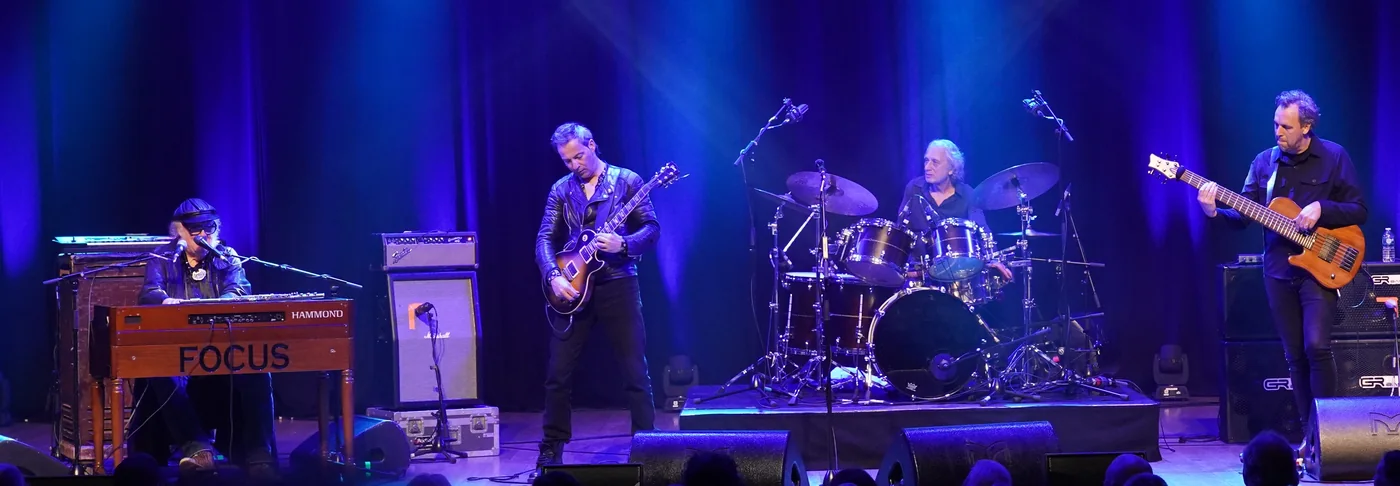
Van der Linden left after the 1973 touring period. Colin Allen played on Hamburger Concerto, recorded at Olympic Studios in early 1974. Later lineups made Mother Focus and Focus con Proby; Akkerman left in early 1976 and the 1970s band ended in 1978. Brief collaborations and reunions followed before van Leer re-established Focus in the early 2000s. Van der Linden returned in 2004. The current quartet—van Leer, van der Linden, guitarist Menno Gootjes and bassist Udo Pannekeet—recorded Focus 12 at Wisseloord Studios and released it in 2024.
Sound & Style
Van Leer alternates Hammond organ, piano, flute and voice instead of assigning each piece one fixed front-line instrument. “House of the King” is carried by flute; “Sylvia” by a concise organ-and-guitar arrangement; “Hocus Pocus” by the return of Akkerman’s riff between yodels, whistles, flute, organ and percussion. The voice functions rhythmically and theatrically there, while the title song “Moving Waves” uses conventional sung words and sparse piano.
Akkerman’s role also changes with the format. On the debut, electric and acoustic guitar sit inside compact vocal songs. Moving Waves places hard-edged riffing beside “Janis” for acoustic guitar and “Le Clochard” for lute. Focus 3 adds the clean melodic line of “Sylvia,” intimate lute-and-flute writing and the twenty-six-minute “Anonymus II,” where every member receives extended space. Hamburger Concerto combines Akkerman’s lute prelude with a six-part title suite jointly shaped by guitar and keyboards.
The arrangements are therefore not simply classical decoration placed on rock. “Eruption” draws on the Orpheus story and develops recurring sections across roughly twenty-three minutes; “Anonymus II” turns debut material into a long improvisational framework; and “Hamburger Concerto” uses linked movements with more explicit thematic control. Across those works, composition and group improvisation keep changing their balance.
Essential Albums
Moving Waves
1971Released at home as Focus II, the six-track second album introduces Cyril Havermans on bass and Pierre van der Linden on drums. Side one moves from the full album version of “Hocus Pocus” through the sparse piano-and-voice title song, Akkerman’s acoustic “Le Clochard” and lute piece “Janis.” The reverse is occupied by the roughly twenty-three-minute “Eruption,” a sequence built from recurring themes, named sections and passages linked to the Orpheus story.
Key tracks: Hocus Pocus · Moving Waves · Eruption
Open album guide → View on Amazon →Focus 3
1972Bert Ruiter’s first Focus album is a double LP recorded in four days at Olympic Studios. “Sylvia” compresses organ, guitar melody, bass movement and rhythmic lift into three and a half minutes; “Answers? Questions! Questions? Answers!” develops related ideas for almost fourteen; “Anonymus II” expands beyond twenty-six minutes and gives every member solo space. The original vinyl sequence splits that last work across sides three and four before “Elspeth” and “House of the King.”
Key tracks: Sylvia · Answers? Questions! Questions? Answers! · Anonymus II
Open album guide → View on Amazon →In and Out of Focus
1970The original Dutch Focus Plays Focus is a seven-track debut by van Leer, Akkerman, Martijn Dresden and Hans Cleuver. Recorded at Sound Techniques in January 1970, it mixes vocal songs, flute, trumpet, keyboards and electric or acoustic guitar. “Happy Nightmare (Mescaline)” includes guest cello, while the vocal and instrumental pieces both titled “Focus” frame two sides of the early band. “House of the King” was a separate 1970 single and entered many later international editions rather than the original Dutch LP.
Key tracks: Focus (vocal) · Happy Nightmare (Mescaline) · Focus (instrumental)
Open album guide → View on Amazon →Affiliate note: Amazon links on this page may earn RetroForge Records a small commission, at no extra cost to you.
Later Turns and Archive
Hamburger Concerto
1974Recorded with Colin Allen replacing Pierre van der Linden, the fourth studio album opens with Akkerman’s lute arrangement of music by Joachim van den Hove and closes with a six-part, roughly twenty-minute title suite. “Birth” joins flute, guitar and shifting ensemble passages; “Harem Scarem” provides the compact counterweight. Mike Vernon’s production keeps the large keyboard and percussion palette audible without turning the album into one continuous texture.
Open album guide → View on Amazon →Ship of Memories
1976Ship of Memories is an archival compilation, not a newly recorded 1976 studio album. Former producer Mike Vernon selected nine unreleased recordings spanning 1970–1975. Six pieces come from the abandoned May 1973 Chipping Norton sessions; “Spoke the Lord Creator” belongs to the debut lineup, while “Red Sky at Night” and “Crackers” feature David Kemper on drums. The personnel changes are part of what the collection documents.
Open album guide → View on Amazon →Why They Still Matter
The 1971–1974 sequence preserves three distinct ways of working at scale. Moving Waves places five concise pieces against the album-side architecture of “Eruption.” Focus 3 stretches one quartet from the brevity of “Sylvia” to “Anonymus II,” whose improvisational framework runs for more than twenty-six minutes. Hamburger Concerto returns to a controlled sequence of linked movements with a different drummer and a broader percussion palette.
The group’s chart history demonstrates that those contrasts reached beyond a specialist audience: in Britain, Moving Waves peaked at number two, Focus 3 at number six, “Hocus Pocus” at number twenty and “Sylvia” at number four. The modern band matters for a different reason. With van Leer and van der Linden joined by Gootjes and Pannekeet, Focus 12 records an active quartet at Wisseloord Studios rather than presenting a nostalgia-only touring unit.
Sources & Further Reading
Connected archive routes
Explore This Band
Continue through the RetroForge knowledge graph
Curated paths into the people, records, events and ideas that give this subject its wider musical context.
Genres and scenes
Sounds and instruments
- Hammond Organ