The Smoke emerged from Yorkshire R&B groups, moved to London as the five-piece Shots and became a four-piece before recording the song that defines them. “My Friend Jack” compressed fuzz guitar, close vocal harmony and psychedelic suggestion into a three-minute single. It reached only No. 45 in Britain but climbed to No. 2 in West Germany, where the group found the audience denied them at home.
That continental success produced an unusual discography. It’s Smoke Time, assembled from 1966 recordings and issued by Metronome in 1967, was released in Germany rather than Britain. The album shows that the Smoke were not merely the vehicle for one provocative chorus: their range extended from hard freakbeat to melodic pop, with concise arrangements holding the different styles together.
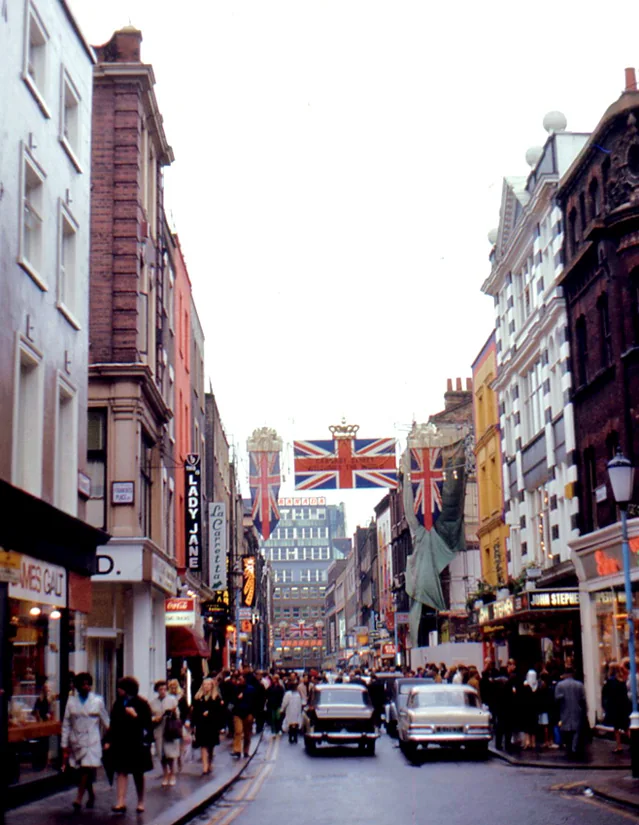
Carnaby Street in 1968, the mod and psychedelic London environment surrounding The Smoke.Photo: Roger W / Wikimedia Commons · Licensed under CC BY-SA 2.0. Converted to WebP for this page.
Formation & History
Bassist John “Zeke” Lund, guitarist Mal Luker and drummer Geoff Gill had played in Tony Adams and the Viceroys; singer Mick Rowley and rhythm guitarist Phil Peacock came from the Moonshots. Together they became the Shots. A contemporary Record Mirror profile from October 1965 lists all five members, identifies Alan Brush as their financial backer and promotes their Columbia debut “Keep a Hold of What You’ve Got.” Peacock later departed, leaving Rowley, Luker, Lund and Gill to rename the group the Smoke.
Working with independent producer Monty Babson, the quartet recorded the material that would become It’s Smoke Time during 1966. Columbia released “My Friend Jack” in Britain in early 1967. Its sugar-lump imagery prompted the BBC to stop playing it; the single spent three weeks on the UK chart and peaked at No. 45. Metronome’s German release had a very different trajectory, entering the chart in May and reaching No. 2. Demand there led to the Germany-only album and sustained television and touring work on the continent.
The follow-up records did not repeat that success, and the stable quartet gradually gave way to releases involving different combinations of its members and outside musicians. Lund, Luker and Gill became connected with Morgan Studios; Gill also joined Fickle Pickle. A 1976 remake of “My Friend Jack” and a re-recorded version of the album material further complicated later reissues, so the recording date matters when navigating the catalogue.
Sound & Style
The Smoke’s strongest recordings combine the forward snap of a mod R&B band with unusually vivid guitar treatment. Luker’s fuzz and tremolo supply texture without loosening the beat; Lund and Gill keep the rhythm compact, while Rowley’s lead is reinforced by bright group harmonies. “My Friend Jack” works because its strange subject remains enclosed within an economical pop structure.
The album broadens that design rather than repeating it twelve times. “Waterfall” foregrounds melody and harmony; “You Can’t Catch Me” and “High in a Room” restore a harder guitar attack; “If the Weather’s Sunny” and “I Wanna Make It with You” lean toward lighter British pop. The contrast reveals a band shaped before psychedelia became its label. Effects add colour, but the arrangements still depend on beat-group timing, short instrumental responses and choruses built to arrive quickly.
Essential Albums
1967
It’s Smoke Time
Metronome · Original 1967 release
The Smoke’s only original-period studio album gathers twelve compact performances recorded in 1966. “My Friend Jack” is the obvious centre, but the sequencing prevents it from swallowing the record: “Waterfall” opens the melodic side of the group, “You Can’t Catch Me” sharpens the guitar edge, and “High in a Room” turns another altered-state image into brisk pop. Side two moves through sunshine harmonies, R&B-derived rhythm and increasingly polished vocal arrangements. Because Metronome issued the LP only in Germany, it became both a document of a British band and an artefact of the continental market that sustained them.
Key tracks: My Friend Jack · Waterfall · You Can’t Catch Me
The prehistory begins with the Shots’ 1965 single “Keep a Hold of What You’ve Got” backed with “She’s a Liar.” It captures the five-piece as a tougher R&B act before Peacock’s departure. After It’s Smoke Time, “Have Some More Tea” pushes the guitar and drums toward a harder, Who-like attack, while the later “Utterly Simple” — written by Traffic’s Dave Mason — places the group inside a more spacious psychedelic arrangement. “Sydney Gill,” issued on the reverse, is one of drummer Geoff Gill’s more ambitious compositions.
Compilation track lists require care. Some add Shots recordings, later singles, material issued under the Chords Five alias, the 1976 remakes or unrelated groups with the same name. For the original quartet, the 1966 album masters and the sequence of 1967–68 singles provide the clearest route; later work is most useful when the personnel and recording date are identified.
The Smoke’s history resists a purely British account of British psychedelia. “My Friend Jack” was a minor three-week chart entry at home and a No. 2 hit in West Germany; the corresponding album existed because the German market wanted it. That split explains why a York-rooted, London-based group can seem both central to the freakbeat sound and strangely absent from the standard UK album narrative.
The recordings themselves justify the continued attention. The quartet did not abandon beat-group discipline when the lyrics and guitar tones became psychedelic. Their best work keeps hooks, harmonies and rhythmic pressure in the foreground, making “My Friend Jack” a bridge between mod R&B, freakbeat and concise psychedelic pop rather than an isolated novelty.
RetroForge Records publishes original music and independent editorial guides. This historical band guide is not affiliated with the artist, labels or rights holders. No unlicensed album artwork is reproduced.