
History Archive · 1979
The Wall, Unknown Pleasures and the End of the Seventies
The decade closed with two albums about distance: one monumental and theatrical, the other spare enough to make every empty space feel dangerous.
What Happened
Pink Floyd released the double album The Wall in November, turning Roger Waters’ idea of emotional barriers into songs, Gerald Scarfe imagery and an eventual stage production. Joy Division released Unknown Pleasures through Factory Records, produced by Martin Hannett after sessions at Strawberry Studios.
The albums occupied opposite positions in the industry. Pink Floyd commanded international resources; Joy Division emerged from a young independent network in Manchester. Both made alienation structural rather than decorative.
What the Music Sounded Like
Pink Floyd moved among hard rock, ballad, orchestration and recurring narrative motifs. Joy Division used Peter Hook’s high bass, Stephen Morris’s controlled drums, Bernard Sumner’s sparse guitar and Ian Curtis’s severe vocal, with Hannett opening large artificial spaces around them.
How It Was Made
The Wall involved producers Bob Ezrin, David Gilmour and Roger Waters, arranger Michael Kamen and multiple studios. Unknown Pleasures used studio processing and subtraction to make a small band sound psychologically enormous.
The Wider Musical Context
Disco, punk, reggae, electronic music and the first wave of post-punk had broken the idea of one central rock culture. Album-scale ambition survived, but its tools and institutions were changing.
What Followed
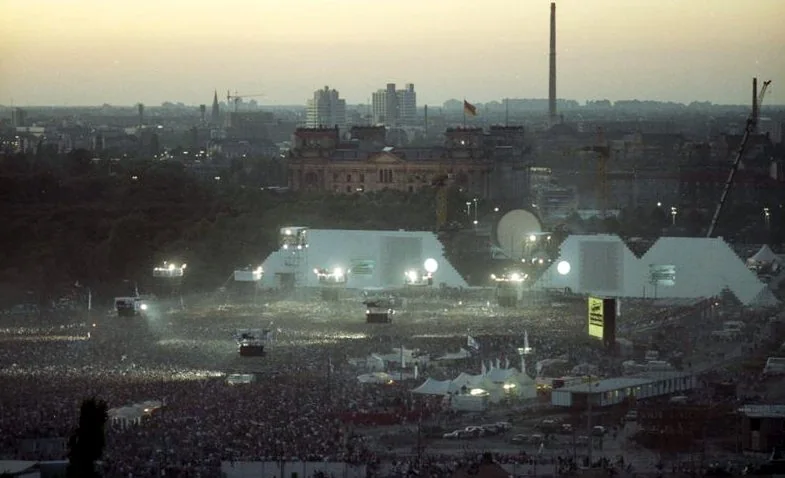
Pink Floyd staged The Wall as an intentionally limited spectacle. Joy Division recorded Closer; after Ian Curtis’s death, the remaining members formed New Order and moved toward electronic dance music.
Two Architectures of Alienation
The Wall and Unknown Pleasures appear to occupy opposite ends of 1979. Pink Floyd built a double album around a fictional rock star whose traumas become bricks in an emotional barrier. Joy Division’s debut arrived from an independent Manchester label with no printed band photograph on its famous sleeve and no explanatory narrative. One is maximal and theatrical; the other is compressed, anonymous and severe.
Yet both make isolation architectural. Pink’s wall is described through recurring characters, sound effects and musical themes. Joy Division’s rooms are created by distance between drums, bass, guitar, voice and studio ambience. Neither record treats alienation as a vague mood. It becomes a system that shapes where sounds can stand and how close another person is allowed to come.
The Wall Turned the Arena into Its Subject
Roger Waters developed the project after feeling increasing hostility toward stadium audiences. Producer Bob Ezrin helped organise the story and tighten its dramatic movement, while Gerald Scarfe’s artwork and animation gave its institutions—school, family, war, fame and fascist spectacle—a common visual language. The record uses short scenes, reprises and abrupt transitions to make a rock album behave like theatre.
Its scale is easy to mistake for uncomplicated grandeur. Much of the music is deliberately claustrophobic: voices heard through telephones, televisions and walls; domestic spaces invaded by memory; a crowd transformed into a threatening mass. The later concerts made the metaphor physical by constructing a wall across the stage. Spectacle was used to question spectacle, even as the production became one of rock’s most elaborate events.
Martin Hannett Made Empty Space Audible
Joy Division recorded Unknown Pleasures at Strawberry Studios in Stockport in April 1979 with producer Martin Hannett. The band’s live force was reorganised rather than merely documented. Stephen Morris’s drums could sound isolated and mechanical; Peter Hook’s bass carried melodies in a high register; Bernard Sumner’s guitar arrived as sharp texture; Ian Curtis’s voice occupied a stark emotional foreground. Studio space became a fifth member.
The production initially surprised musicians accustomed to a more aggressive live sound, but its separation gave the songs extraordinary durability. “Disorder” moves with nervous momentum, “She’s Lost Control” turns repetition into bodily unease and “I Remember Nothing” leaves immense gaps around impact. Peter Saville’s sleeve, built around an image of radio pulses, completes the record’s refusal of conventional rock portraiture. Information replaces personality, yet the result feels intensely human.
The Seventies Ended by Splitting the Centre
These albums did not mark a clean handover from old rock to new. The Wall became a vast commercial success while Unknown Pleasures established a different model of independent cultural power. Arena rock, post-punk, electronic music, disco and metal were all expanding at once. The important change was the loss of any single agreed route forward.
Later artists inherited both approaches. Concept albums and stadium productions learned from Pink Floyd’s integration of story, image and live design. Alternative rock and electronic music learned from Joy Division’s use of space, repetition and graphic identity. 1979 did not close the decade with one verdict. It left two doors open: make the spectacle reveal its own machinery, or reduce the room until every remaining sound becomes unavoidable.
Essential Listening
- Pink Floyd — Another Brick in the Wall, Part 2
- Pink Floyd — Comfortably Numb
- Joy Division — Disorder
- Joy Division — She’s Lost Control
- Joy Division — New Dawn Fades
Related Genres and Guides
Related RetroForge listening
Hear the Archive Connection
Research notes
Sources and Further Reading
- The Wall — Pink Floyd
- Joy Division: About — Joy Division
- Joy Division discography — Joy Division
- Pink Floyd 1979 timeline ? Pink Floyd
- Unknown Pleasures and its pulsar sleeve ? University of Manchester