
History Archive · 1977
Bowie, Kraftwerk and the Electronic Reinvention of Rock
In 1977, electronic sound no longer belonged outside the rock album. It could determine the drums, the form, the emotional distance and the image.
What Happened
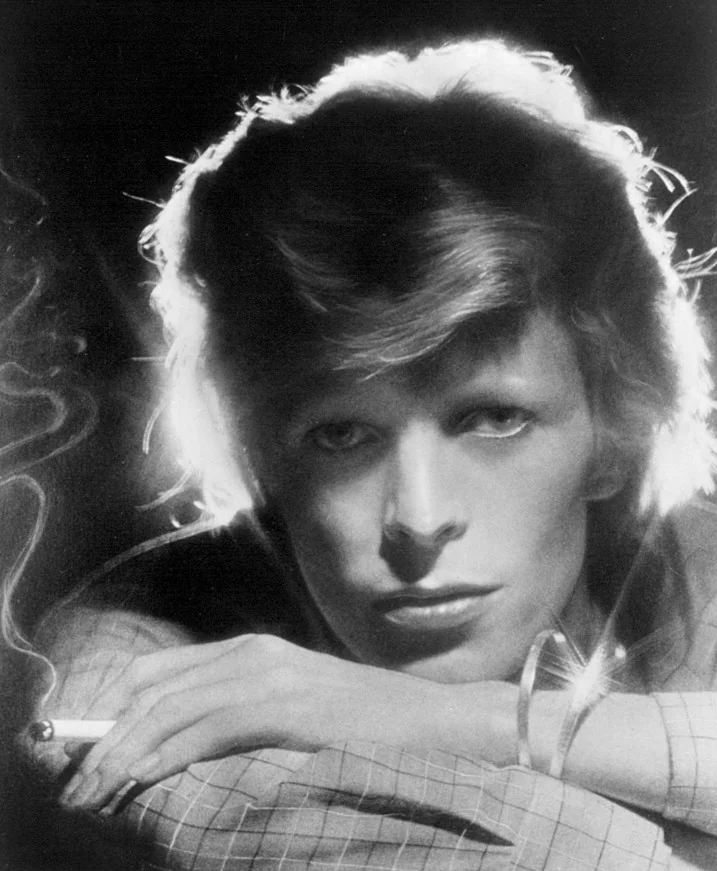
David Bowie released Low in January and “Heroes” in October, working with Tony Visconti and Brian Eno. Kraftwerk released Trans-Europe Express, turning continental rail travel, identity and technology into a controlled electronic suite.
Bowie’s records were connected to Berlin, although much of Low was recorded at the Château d’Hérouville in France and mixed at Hansa. The important connection was creative: German experimental music offered an alternative to American rock convention.
What the Music Sounded Like
Low paired compressed, sharply harmonizer-processed drums and clipped song fragments with broad instrumental pieces. Trans-Europe Express used sequenced repetition, electronic percussion and emotionally restrained voices to make travel feel mechanical and romantic at once.
How It Was Made
Tony Visconti’s Eventide Harmonizer transformed Dennis Davis’s drums on Low. Kraftwerk’s Kling Klang method integrated composition, custom electronics, performance and visual design into one system.
The Wider Musical Context
Punk was demanding rupture, disco was transforming rhythm and Jamaican dub was revealing the mix as composition. Bowie and Kraftwerk made those changing priorities legible to rock audiences.
What Followed
Joy Division, Ultravox, Gary Numan, Depeche Mode, New Order and many others inherited different pieces of the 1977 electronic turn. Hip-hop producers later found a separate future inside Kraftwerk’s exact pulse.
Low Broke the Rock Album into Unequal Rooms
David Bowie’s Low, released in January 1977, refuses the balanced architecture expected of a major rock album. Its first side contains brief, fractured songs whose vocals can feel interrupted or deliberately incomplete. The second opens into instrumentals shaped by synthesizers, treatments and large emotional spaces. Working with Tony Visconti and Brian Eno, Bowie did not simply add electronic colour to conventional songs. He allowed production, editing and sequence to determine what counted as a finished composition.
The record’s reputation as part of the “Berlin trilogy” can obscure its geography: much of Low was recorded in France, with further work in West Berlin. What mattered was less one city than a break from Bowie’s recent habits and public identity. The compressed drums, unstable fragments and instrumental landscapes made retreat audible without turning the record into confession. Its form became the biography.
“Heroes” Put the Experiment in a More Public Frame
Later in 1977, “Heroes” was recorded entirely in Berlin at Hansa Studios. Visconti’s production and Eno’s electronic systems surrounded a stronger band presence, with Robert Fripp’s sustained guitar cutting across the title track and appearing throughout the album. Where Low often withdraws, “Heroes” turns similar tools toward pressure, motion and defiant scale.
The title song’s enormous vocal arc can make the album seem more straightforward than it is. “Neuköln,” “Sense of Doubt” and “Moss Garden” occupy uncertain spaces between composition, atmosphere and sound design. Bowie’s achievement was not a permanent electronic style but a method of reinvention: use unfamiliar collaborators and systems to make habitual decisions impossible, then let the album preserve the struggle.
Kraftwerk Imagined a Different Europe
Trans-Europe Express treated rail travel, radio signals, rhythm and European identity as parts of one design. Kraftwerk’s repetition was not an attempt to imitate rock drumming with machines. It proposed a different relationship between body and technology: steady enough for dance, restrained enough for close listening and precise enough to make tiny changes consequential. The train is simultaneously subject, percussion instrument and organising metaphor.
The group’s visual discipline mattered as much as its equipment. Tailored presentation, controlled typography and emotionally ambiguous performance rejected both blues-rock authenticity and cosmic spectacle. Europe was not pictured as ancient heritage but as a network of cities, borders and machines. That outlook gave musicians far beyond Düsseldorf permission to sound modern without borrowing an American rock persona.
Influence Did Not Travel in One Direction
Bowie admired Kraftwerk, while Kraftwerk referred to Bowie and Iggy Pop in “Trans-Europe Express.” Brian Eno’s systems, German electronic music, American funk, studio dub and European art traditions circulated through the same period. Reducing the story to Bowie “discovering” Germany reproduces the celebrity hierarchy the music itself complicates. These artists were listening across borders and translating ideas into distinct bodies of work.
Post-punk, synth-pop, ambient music and electronic dance all found usable futures in 1977. Some inherited the clipped song fragments of Low; others took Kraftwerk’s pulse, serial imagery or machine-human ambiguity. The deeper inheritance was the understanding that reinvention could join sound, process, artwork and public character. Electronic music was no longer a specialist colour added to rock. It could redesign the artist who used it.
Essential Listening
- David Bowie — Sound and Vision
- David Bowie — Warszawa
- David Bowie — “Heroes”
- Kraftwerk — Trans-Europe Express
- Kraftwerk — Europe Endless
Related Genres and Guides
Related RetroForge listening
Hear the Archive Connection
Research notes
Sources and Further Reading
- Low — David Bowie
- David Bowie: About — David Bowie
- Low album focus — David Bowie
- Happy Birthday Low — David Bowie
- Album Focus: “Heroes” — David Bowie
- Kraftwerk – Retrospective 1 2 3 4 5 6 7 8 — Museum of Modern Art
- Kraftwerk digital catalogue and chronology — Rhino / Parlophone
- Lifetime Achievement Award: Kraftwerk — Recording Academy