

Overview
Amon Düül II occupy a distinctive place in the krautrock landscape. Their early records combine structured psychedelic rock with collective improvisation, dense percussion, violin, keyboards and electric guitar. That ensemble language distinguishes them from the motorik precision or studio-built electronics often used to summarise West German experimental music.
The band’s identity was never reducible to one instrument. Chris Karrer and John Weinzierl shared guitar duties, Karrer also brought violin and saxophone, Falk Rogner supplied organ and keyboards, and Renate Knaup’s voice could move from melody to theatrical intensity. The result was a particularly physical, dramatic form of psychedelia.
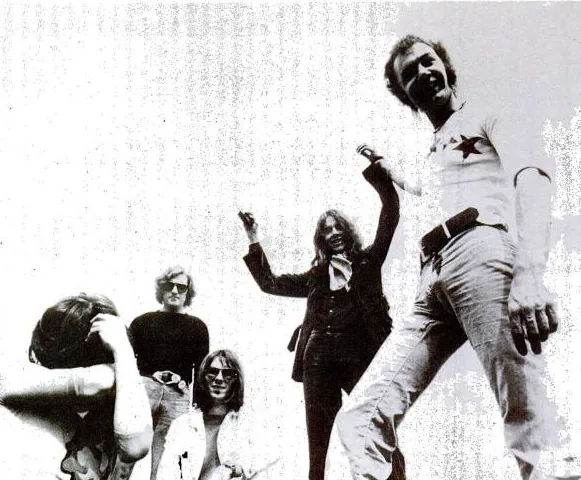
Formation & History
Amon Düül II emerged in 1968 from the wider Amon Düül art commune in Munich. When an opportunity to record divided the collective, members with stronger musical ambitions formed a separate group while retaining the shared name. Amon Düül and Amon Düül II both appeared at the Internationale Essener Songtage in September 1968, making the split public.
The early lineup developed around Chris Karrer, John Weinzierl, Falk Rogner, Renate Knaup, bassist Dave Anderson and drummers Peter Leopold and Dieter Serfas, with Christian “Shrat” Thierfeld among the additional early contributors. Liberty released Phallus Dei in 1969. Its four shorter pieces lead to the roughly twenty-one-minute title track that fills the second side. The 1970 double album Yeti then placed composed material on its first disc and group improvisations on its second, establishing the balance that defines their best-known period.
Sound & Style
Amon Düül II’s early sound depends on the friction between arrangement and improvisation. Karrer’s violin and guitar, Weinzierl’s guitar, Rogner’s keyboards and the layered percussion can move together in a composed passage, then loosen into an open ensemble texture. The rhythm is rarely the steady motorik pulse associated with Neu!; it accelerates, crowds the beat and changes weight as the players react to one another.
Knaup’s vocals add another source of contrast, moving between direct rock singing, chant and theatrical exclamation. On Yeti, the structured first LP and improvised second LP reveal how consistently the same instrumental character survives across both methods. Tanz der Lemminge extends that approach through longer multi-part compositions and one final collective improvisation.
Essential Albums
Yeti
1970The 1970 double album is the clearest starting point because it presents both sides of the early band. The first LP moves from the multi-part Soap Shop Rock through compact pieces such as Archangels Thunderbird and Eye-Shaking King; the second is devoted to three group improvisations, ending with Sandoz in the Rain.
Key tracks: Soap Shop Rock, A. Burning Sister, B. Halluzination Guillotine, C. Gulp a Sonata, D. Flesh-Coloured Anti-Aircraft Alarm · Eye-Shaking King · Sandoz in the Rain (Improvisation)
Open album guide → View on Amazon →Phallus Dei
1969The debut draws on the group’s live repertoire. Four shorter pieces occupy the first side; the roughly twenty-one-minute Phallus Dei fills the second. Two drummers, hand percussion, organ, violin and layered guitars make it the most densely ritualistic of the first three albums.
Key tracks: Kanaan · Phallus Dei · Luzifers Ghilom
Open album guide → View on Amazon →Tanz der Lemminge
1971The third album reorganises the band’s scale into long, multi-part suites. Syntelman’s March of the Roaring Seventies and Restless Skylight-Transistor-Child dominate the first LP, while Chamsin Soundtrack closes the second with the record’s principal collective improvisation.
Key tracks: Syntelman's March of the Roaring Seventies: In the Glassgarden · Race From Here to Your Ears: Overheated Tiara · Chamsin Soundtrack: Toxicological Whispering
Open album guide → View on Amazon →Affiliate note: Amazon links on this page may earn RetroForge Records a small commission, at no extra cost to you.
Deeper Cuts
Wolf City
1972A more concise 1972 album that retains the ensemble’s unusual textures inside shorter songs. Surrounded by the Stars and Green-Bubble-Raincoated-Man make its sharper melodic profile immediately clear.
Open album guide → View on Amazon →Vive la Trance
1973The 1973 album shifts toward compact songwriting without abandoning political or psychedelic detail. A Morning Excuse and the anti-imperialist Mozambique show two sides of that transition.
Open album guide → View on Amazon →Hijack
1974Released in 1974, Hijack is a polished and deliberately eclectic record, moving among hard rock, funk, theatrical vocals and electronic colour rather than extending the long improvisations of the early albums.
Open album guide → View on Amazon →Why They Still Matter
Phallus Dei, Yeti and Tanz der Lemminge document three distinct solutions to the same problem: how a commune-based ensemble could turn collective improvisation into durable album structures. Their rapid development from a live-derived debut to the divided composed/improvised design of Yeti and the extended suites of Tanz der Lemminge is the strongest case for their historical importance.
They also demonstrate why krautrock cannot be reduced to a single method. While Can often centred groove and Kraftwerk increasingly pursued electronic precision, Amon Düül II retained an acoustic and theatrical volatility: violin, hand percussion, multiple voices and unstable guitar textures remained central even as their writing became more concise.
Connected archive routes
Explore This Band
Continue through the RetroForge knowledge graph
Curated paths into the people, records, events and ideas that give this subject its wider musical context.
Festivals
- Internationale Essener Songtage 1968: Before Krautrock Had a Name