Gryphon’s early instruments and training shaped the compositions from within rather than decorating standard folk rock.
Gryphon began with crumhorns, bassoon, recorder and arrangements of early English music before allowing electric rock instrumentation to enter the room. That origin makes their progressive albums unusual: medieval and Renaissance timbres are not decorative colour pasted onto a conventional band, but the musicians' starting vocabulary. The later complexity grows from ensemble counterpoint, dance rhythm and acoustic articulation.
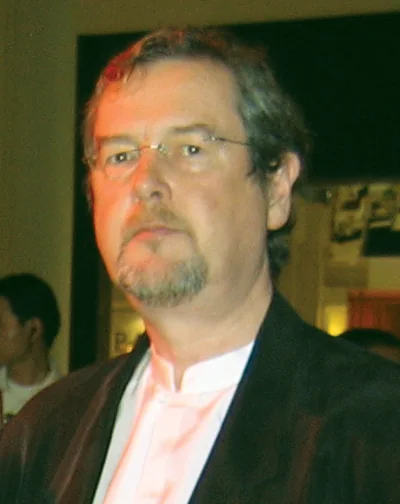
Gryphon co-founder Richard Harvey at the world premiere of King Naresuan in Bangkok in 2007.Photo: Curtis Winston / Wikimedia Commons · Licensed under CC BY 2.5. Converted to WebP for this page.
Formation & History
Richard Harvey and Brian Gulland met through early music and their studies at London's Royal College of Music. In 1972 they developed Gryphon with guitarist Graeme Taylor and drummer, percussionist and singer Dave Oberlé. Crumhorns, bassoon, recorders and mandolin were therefore present before the group became associated with progressive rock. Transatlantic released the self-titled debut in June 1973.
In 1974 Gryphon supplied music for Peter Hall's National Theatre production of The Tempest at the Old Vic; material from that commission contributed to Midnight Mushrumps. Bassist Philip Nestor joined for the two 1974 albums, and December's instrumental Red Queen to Gryphon Three pushed the ensemble further into long-form progressive writing. A support tour with Yes widened the audience. Raindance followed in 1975, while personnel changes preceded the more conventional rock approach of Treason in 1977 and the original band's end that year.
The four founders reunited for a Queen Elizabeth Hall concert in 2009. Regular activity resumed in 2015; Richard Harvey stepped down the following year, and the later ensemble brought in musicians including Andy Findon, Rob Levy and Clare Taylor. Gryphon released ReInvention in 2018, Get Out of My Father's Car! in 2020 and the live double album A Sonic Tonic in 2024.
Sound & Style
Crumhorn, bassoon, recorder, guitar and keyboards use dance forms, counterpoint and abrupt rhythmic changes.
Bassoon and crumhorn give Gryphon a dry, reedy low register unlike any standard keyboard orchestra. Harvey's keyboards, recorders and mandolin, Taylor's guitar and Gulland's winds interlock in written lines; Oberlé handles both rock pulse and older dance accents. The best arrangements can be playful without becoming parody, and technically complex without erasing the physical breath and attack of acoustic instruments.
Essential Albums
1974
Red Queen to Gryphon Three
Transatlantic · Original 1974 release
Released by Transatlantic in December 1974, Red Queen to Gryphon Three is an instrumental four-part composition loosely organised around a chess match. “Opening Move,” “Second Spasm,” “Lament” and “Checkmate” pass themes between guitar, keyboards, bassoon, recorder and rhythm section. Electric force has increased since the debut, but the reeds prevent the ensemble from becoming another symphonic keyboard band. The album rewards following motifs and changes of instrumental colour rather than waiting for isolated solos.
Midnight Mushrumps stands where Gryphon's early-music identity expands into long-form rock. Parts of the album grew from the group's music for the National Theatre's 1974 production of The Tempest. The eighteen-minute title piece uses repeated processional ideas, changing instrumental combinations and measured escalation; four shorter pieces retain more of the debut's acoustic wit. Philip Nestor's bass adds weight without displacing bassoon, crumhorn and recorder from the centre of the arrangements.
Key tracks: Midnight Mushrumps · The Ploughboys Dream · The Last Flash of Gaberdine Tailor
Released by Transatlantic in June 1973, the debut presents Gryphon before progressive rock became the main frame. Traditional material, original tunes and early instruments are performed with both scholarship and irreverence. “Kemp's Jig,” “The Unquiet Grave” and “Sir Gavin Grimbold” establish the contrast between nimble dance, dark ballad and comic invention. Rock drums and guitar appear, but they do not dominate the acoustic centre; the quartet's internal knowledge of counterpoint, breath and historical dance rhythm is already the source of its difference.
Key tracks: Kemp’s Jig · Sir Gavin Grimbold · The Unquiet Grave
Gryphon offer a genuine bridge between historical performance and progressive composition. Their relationship with European classical tradition reaches beyond the usual nineteenth-century orchestra and keyboard virtuoso: ensemble counterpoint, dance rhythm and the physical characteristics of early wind instruments determine how the pieces move.
The modern catalogue matters as well. ReInvention and Get Out of My Father's Car! did not simply recreate the 1973 acoustic sound; they applied the same mixed-instrument logic to new compositions and a changed lineup. Gryphon therefore remain an active example of how acoustic instrumentation can support large forms without imitating conventional symphonic rock.
RetroForge Records publishes original music and independent editorial guides. This historical band guide is not affiliated with the artist, labels or rights holders. No unlicensed album artwork is reproduced.