

Why this event matters
Bath 1970 captures a change in British live music more clearly than a genre label can. The previous year's Bath Festival of Blues belonged to a recognisable circuit of blues and rock gatherings. By 1970 the title had expanded to the Festival of Blues and Progressive Music, and the bill stretched across heavy rock, West Coast psychedelia, jazz-rock, folk-rock and music that was only beginning to acquire stable categories. The word “progressive” described an appetite before it described one tidy style.
The event also demonstrated a new physical scale. The Royal Bath and West Showground offered space and existing agricultural infrastructure, but a rock audience numbering well into six figures created demands beyond ordinary concert promotion. A huge stage, tall speaker arrays, overnight scheduling, traffic and basic welfare were not secondary matters. They shaped what could be heard, how long people waited and how the festival was remembered.

Before the gates opened
Promoter Freddie Bannister had already organised the 1969 Bath Festival at the city's Recreation Ground. Moving the 1970 event to the Showground near Shepton Mallet allowed a far larger production and audience. It also shifted “Bath” away from the city named in the title. That geographical shorthand survived because the festival identity had already formed, even though the actual site was in rural Somerset.
The expansion was ambitious in both programme and duration. Artists were drawn from Britain and North America, and the event was planned across a weekend rather than as a single day. Surviving programmes and advertisements show how promoters sold variety as abundance: listeners were not being offered one coherent scene but an encounter with several directions in contemporary rock. That breadth created prestige while increasing the chance of delays, equipment pressure and a timetable that could not remain exact.
The place and the people
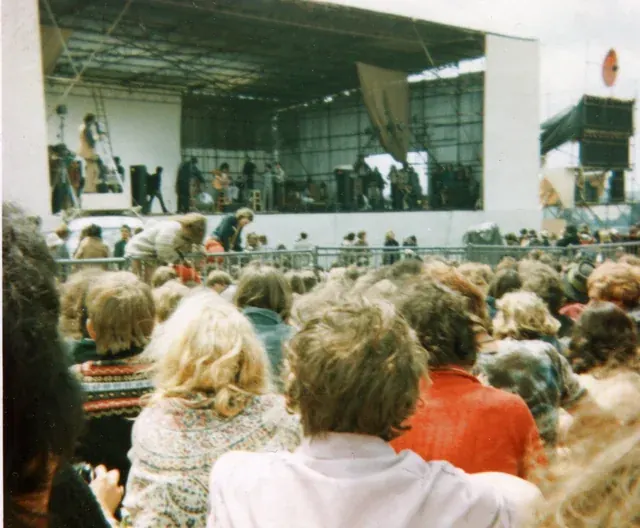
An agricultural showground is not empty countryside. It has roads, buildings, arenas and established uses, but those facilities were not designed for a continuous rock audience occupying the site through a long weekend. Photographs make the transformation visible. The stage rises at one edge of a dense field; the public-address towers are pieces of architecture; people settle into the ground as if the viewing area were a temporary town square.
Attendance figures should be handled with caution. Later accounts often repeat very large round numbers, and contemporary music papers could be equally eager to dramatise scale. The Royal Bath and West's own retrospective account says more than 150,000 festivalgoers attended. That is substantial enough without selecting the highest estimate. The historical point is secure: the crowd was far beyond theatre or ballroom scale and required promoters to think in terms of mass movement.

The musical programme
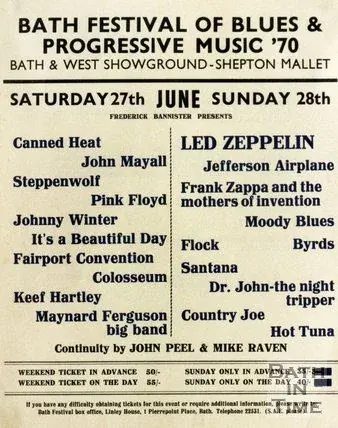
The bill now reads like an index to several futures. Led Zeppelin represented the new authority of heavy rock. Pink Floyd were moving beyond their psychedelic club origins toward long-form, large-space performance. Santana and Jefferson Airplane brought different forms of Californian rock; The Byrds connected the festival to folk-rock history; Canned Heat carried amplified blues boogie; Frank Zappa and the Mothers of Invention complicated any easy separation between rock, satire and composed experiment.
British progressive and jazz-rock currents were equally important. Colosseum placed brass, improvisation and blues-derived weight inside a rock-festival frame. Fairport Convention, It's a Beautiful Day, Steppenwolf, John Mayall and many others expanded the musical map further. Not every scheduled artist appeared as expected, and exact running orders vary between accounts. The programme should therefore be read as a promoted design rather than a perfect transcript of what every listener heard.
Defining performances
Led Zeppelin's Sunday appearance dominates many retrospective accounts. Their official archive preserves contemporary reviews, programme material and a set-list reconstruction, while also recording the troubled attempt to film them. The performance mattered within the band's rapidly growing British status, but reducing Bath to one headliner would flatten the event. The long waits and sequence of contrasting acts made each major appearance part of a collective test of endurance.
Pink Floyd's night performance has also accumulated legend, especially around their large-scale work and use of sound effects. Reliable descriptions should distinguish the documented presence of the band from details repeated without clear contemporary support. Bath's significance does not depend on reconstructing every minute. It rests on the fact that groups developing long, atmospheric or technically demanding music were now expected to project it across a field.

Stage, sound and production
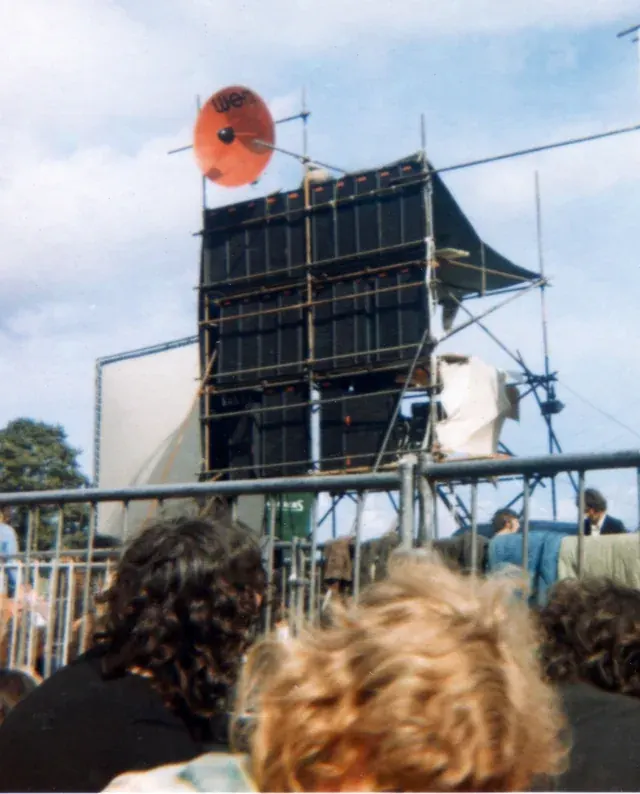
The photographs of the PA system are among the most valuable documents from Bath. They show sound reinforcement as physical engineering: stacked cabinets, scaffolding and cable runs built to carry music over distance. This was before standardised touring festival packages. Equipment could be assembled for one event, exposed to weather and pushed beyond familiar indoor practice.
A festival timetable places another kind of pressure on sound. Each group brings instruments, stage positions and volume expectations; every changeover risks delay. A late performance can push the entire sequence into different light and weather. The official Led Zeppelin archive records that an attempted filming suffered because the crew had prepared for daylight while the band preferred to play at dusk. Whatever the competing recollections around that episode, it illustrates how artistic decisions, documentation and production were inseparable.
Problems and surviving evidence
Bath is less completely documented than Monterey or Woodstock. There is no single widely distributed film that teaches later audiences how to remember the weekend. Photographs, programmes, press clippings, brief film fragments and personal recollections must be read together. That fragmented archive explains why line-up details and attendance are sometimes repeated with more certainty than the evidence allows.
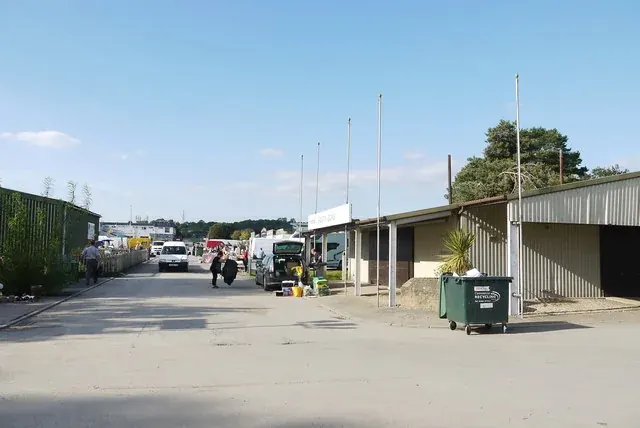
The absence of one definitive document is historically revealing. Most festivals did not receive the full machinery of preservation. A stage could be enormous in 1970 and leave only scattered visual traces. RetroForge's image set therefore includes a later photograph of the Showground, clearly identified as present-day context. It helps locate the event but does not pretend that the modern landscape is an untouched view of the festival.

Films, recordings and surviving documents
The Led Zeppelin archive is unusually rich in programme scans, press reviews, recollections and set-list information. It is indispensable for the band's part of the weekend, but a headliner's archive cannot stand in for the entire festival. Commons photographs of the stage and PA provide independent material evidence, while the printed programme documents the organisers' intended breadth.
Short film fragments associated with Peter Whitehead have renewed interest in Bath, but their survival should not encourage claims that a complete visual record exists. De Montfort University's account of Whitehead's archive shows how footage can reappear after decades and how institutional preservation changes what historians are able to ask. The gaps remain part of the evidence.
From Bath toward Glastonbury
The relationship between Bath and the first Worthy Farm festival is unusually direct because Michael Eavis later described attending Bath and being inspired to organise his own event. Influence did not mean imitation. Worthy Farm began on a much smaller scale, on different land and with a different social identity. What travelled was the realisation that a farm or showground could become a place where contemporary music and a temporary public met.
Bath therefore belongs in festival history not as a forgotten Glastonbury rehearsal but as a major event in its own right. Its programme, sound system and crowd were already the result of earlier British promoter experience. Later festivals learned from Bath while solving different problems.
Legacy
Michael Eavis has described seeing Led Zeppelin at Bath as an inspiration for the first festival at Worthy Farm later in 1970. That connection does not make Bath a prototype for every feature of Glastonbury, but it places the event inside a practical chain of influence. Promoters attended other festivals, observed crowds and production, then built new versions on different land.
Bath also marks the moment when “progressive music” could name a public large enough to fill a field without requiring musical uniformity. Heavy rock, extended improvisation, folk textures and experimental composition could share the same infrastructure. The festival's legacy lies in that expansion—and in the problems expansion made impossible to ignore.
Follow the festival beyond the field
Timeline
Related genres
Related band guides
Explore by sound
Essential listening
RetroForge Echo
Hear a Fictional Archive Response
These modern RetroForge releases echo part of the festival’s musical vocabulary; they are not historical festival recordings.
Sources and further reading
- Bath Festival – West Showground, 28 June 1970Led Zeppelin Official Website · accessed 23 July 2026
- 1970 Bath Festival ProgrammeLed Zeppelin Official Archive · accessed 23 July 2026
- Archive footage and the Peter Whitehead collectionDe Montfort University · accessed 23 July 2026
- Bath Festival retrospectiveRoyal Bath & West Society · accessed 23 July 2026
- Bath Festival image category and item-level rights recordsWikimedia Commons · accessed 23 July 2026
Image credits5 licensed images
The Bath Festival stage in 1970 — Aspro ( talk ) 11:40, 7 August 2008 (UTC) — Wikimedia Commons — CC BY-SA 2.0 uk · source record · CC BY-SA 2.0 uk
Converted to WebP and resized; no generative or compositional alterations.
The 1970 programme preserves the festival's own identity: blues remained in the title while progressive music announced a widening musical field — Rathfelder — Wikimedia Commons — CC0 · source record · CC0
Converted to WebP and resized; no generative or compositional alterations.
Part of Bath's public-address system — Aspro at English Wikipedia — Wikimedia Commons — CC BY-SA 2.0 uk · source record · CC BY-SA 2.0 uk
Converted to WebP and resized; no generative or compositional alterations.
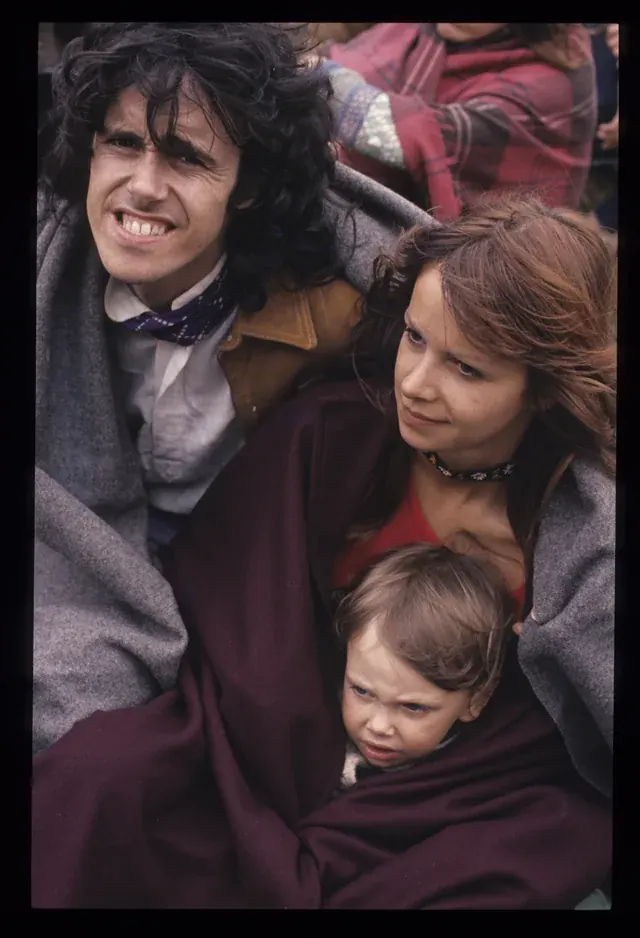
Donovan and family at Bath in 1970, photographed within the social world surrounding the performances — Dirk Herbert — Wikimedia Commons — CC BY-SA 4.0 · source record · CC BY-SA 4.0
Converted to WebP and resized; no generative or compositional alterations.
The Royal Bath and West Showground in a later photograph — Nigel Mykura — Wikimedia Commons — CC BY-SA 2.0 · source record · CC BY-SA 2.0
Converted to WebP and resized; no generative or compositional alterations.