

Edition timeline
The first Pop & Blues festival
A dense international programme overwhelms the comfortable capacity of the Grugahalle.
The sound grows heavier
Black Sabbath, Can and other performers shift the balance toward heavy and experimental rock.
Mallison supports Aachen
Essen’s organisational knowledge moves into an outdoor stadium context.
A third edition
The series returns for a final extended Grugahalle programme.
Why this series matters
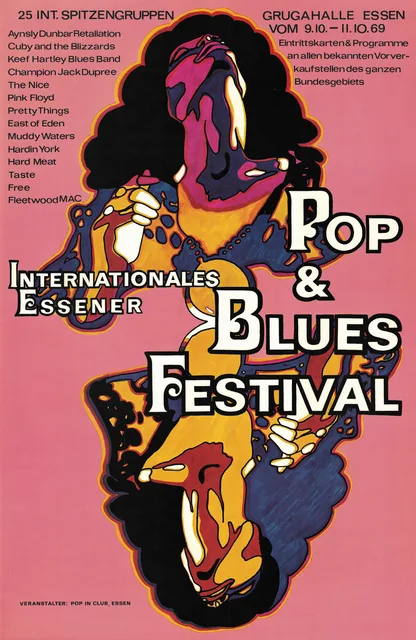
The Pop & Blues festivals followed the cultural momentum of the 1968 Essener Songtage but were a distinct project. Songtage dispersed political song, multimedia and underground performance across the city; Konrad Mallison concentrated international touring acts and German experimenters inside the Grugahalle. The series shows radical musical energy entering a repeatable production system without becoming stylistically tame. West German groups and British stars did not develop in isolation; they shared stages, audiences and television cameras. Mallison owned Essen’s Pop In discotheque and had attended the 1969 Bath festival. The Essener Songtage offered another local model, but he chose an indoor hall partly to escape autumn weather. Connections made through London’s Marquee Club helped secure performers. The plan combined nightclub knowledge, British festival ambition and municipal infrastructure, revealing how organisers professionalised through travel and networks rather than formal festival-management institutions. A civic hall created a very different ecology from Woodstock’s open land. Tens of thousands converged on a fixed-capacity building with entrances, seating and fire limits. Sources disagree on the October 1969 count: WDR retrospectives mention about 14,000 entering a hall associated with roughly 8,000 capacity, while specialist histories cite 11,000–12,000 inside and several thousand outside. The secure fact is demand far beyond comfortable absorption. Stages at opposite ends of the Grugahalle alternated so one group could prepare while another performed. The arrangement reduced conventional changeover silence and allowed exceptionally long bills to continue. It also created a relentless audience experience with little psychological separation between a blues veteran, British progressive group and German experimental act. Production design became an argument about musical equality: radically different performers entered the same continuous flow.

The 1969 programme
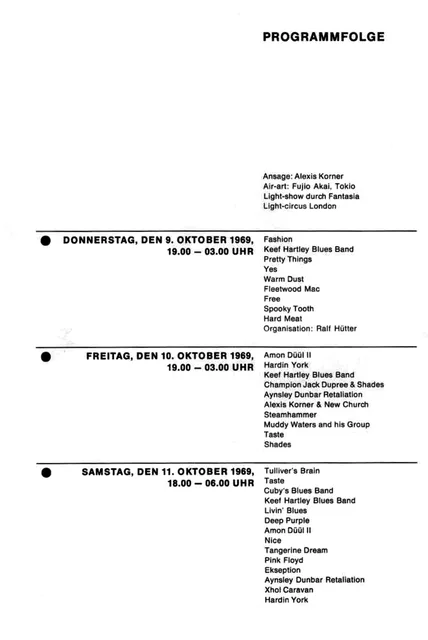
Muddy Waters, Champion Jack Dupree and Alexis Korner-associated currents supplied blues lineage. Pink Floyd, Yes, The Nice and The Pretty Things represented British psychedelic and progressive expansion. Deep Purple, Free, Taste and Spooky Tooth pushed toward heavier rock. Amon Düül II, Tangerine Dream and Organisation exposed West German experiments before international critics consolidated “krautrock.” Some acts repeated and some unprinted names played, making set lists and reports stronger than early posters. Thousands could not simply be admitted once the building reached its practical limit. Accounts say Alexis Korner and other musicians performed outside to calm excluded visitors; the episode should remain attributed rather than treated as universal memory. Inside, crowding intensified an already continuous programme. Essen demonstrates that indoor weather protection exchanged one set of risks for another: finite doors and hard capacity became the festival’s most consequential physical boundary. The second festival on 24–25 April brought Black Sabbath, Edgar Broughton Band, Can, Renaissance, Keef Hartley and Ekseption into another mixed bill, shifting weight toward heavier and more structurally adventurous music. A third edition ran 22–25 October and deserves separate recognition rather than becoming an appendix. Edition-specific research prevents all 1969–70 names from merging into one imaginary weekend and shows how rapidly the programme evolved. The dual-stage system made time visible as a production resource. WDR filming added another layer: camera positions, broadcast selection and surviving archive edits shaped what later audiences could see. Being filmed, being broadcast at the time and surviving in a modern archive are different claims. Essen’s television afterlife nevertheless helped teach European viewers what progressive and heavy rock looked like onstage before concert video became routine.

Problems and practical limits
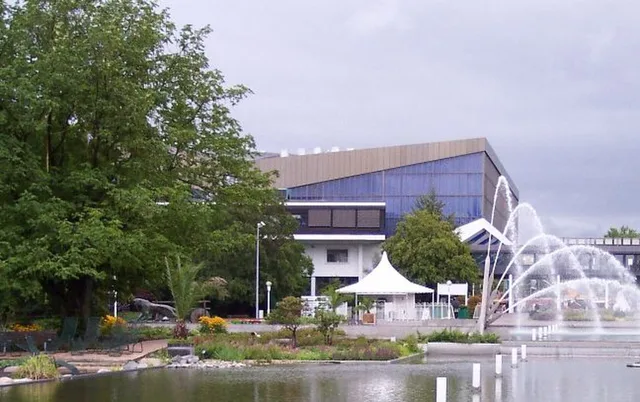
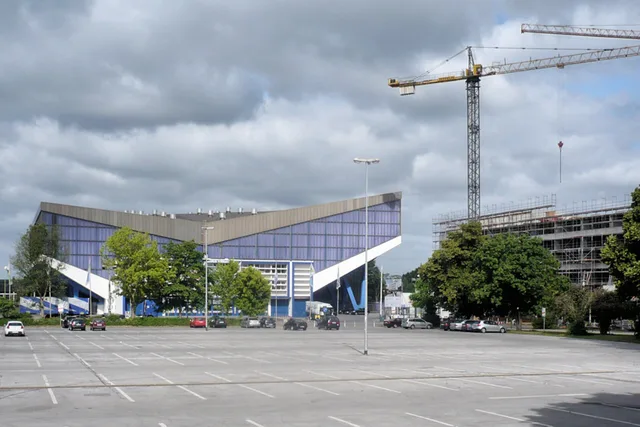
Overcrowding, ticket scarcity, entrances and relentless scheduling were the defining limits. Open-air concerns such as camping and storm exposure do not belong here simply because they recur in other festival histories. The Grugahalle offered reliable shelter and electricity, but it could not expand when demand exceeded prediction. Its walls made institutional youth culture possible and made the boundaries of that institution painfully concrete. WDR’s Rockpalast archive, local press, posters, the surviving set list and collector recordings make Essen unusually documentable. The poster and set-list images reproduced here have item-level reusable licences; their contrast also teaches the difference between promotion and performance. Modern and historical Grugahalle views document the building without pretending to show a specific festival interior. Every recording remains evidence first, not automatically distributable media. Amon Düül II, Tangerine Dream, Organisation and Can followed distinct aesthetic paths. Placing them beside Pink Floyd, Muddy Waters, Deep Purple and Black Sabbath shows shared infrastructure without forcing a single identity onto the German groups. “Krautrock” became useful later as international shorthand, but Essen’s programme captures an earlier reality: local experimental scenes were already participating in the same touring economy as British blues, progressive and heavy rock. Together with Songtage and Aachen, the Pop & Blues series makes Essen central to European underground history around 1968–70. The Grugahalle was less romantic than a field, yet more revealing of youth culture’s collision with civic capacity, television and repeat production. Mallison’s later work at Aachen carried organisational knowledge outdoors. The series did not continue indefinitely, but its stage system, broadcast record and cross-border programme made three editions historically durable.


Follow the festival beyond the field
Timeline
Related genres
Related band guides
Explore by sound
Essential listening
Sources and further reading
- Essener Pop & Blues Festival 1969 und 1970WDR Rockpalast · accessed 23 July 2026
- From the archives: Essen Pop & BluesWDR Rockpalast · accessed 23 July 2026
- Grugahalle historyGrugahalle Essen · accessed 23 July 2026
- Konrad Mallison interviewIt’s Psychedelic Baby Magazine · accessed 23 July 2026
- Festival poster and set-list recordsWikimedia Commons · accessed 23 July 2026
Image credits5 licensed images
The October 1969 festival poster, a primary visual source for the advertised programme — Konrad Mallison — Wikimedia Commons — CC BY-SA 4.0 · source record · CC BY-SA 4.0
Converted to WebP and resized; no generative or compositional alterations.
A surviving 1969 set list, useful evidence for distinguishing performed music from poster billing — Konrad Mallison — Wikimedia Commons — CC BY-SA 4.0 · source record · CC BY-SA 4.0
Converted to WebP and resized; no generative or compositional alterations.
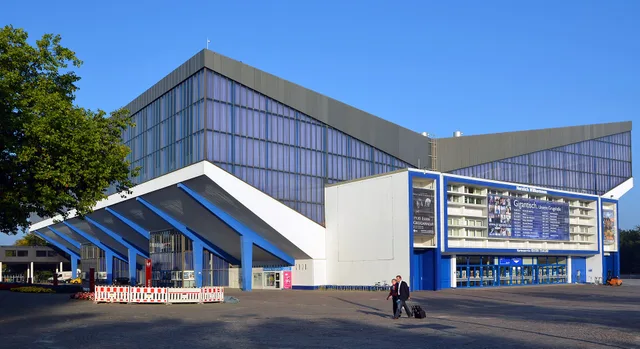
A later exterior view of the Grugahalle, the indoor arena that concentrated the festival’s sound, crowd and changeovers — Unknown creator — Wikimedia Commons — CC BY-SA 3.0 · source record · CC BY-SA 3.0
Converted to WebP and resized; no generative or compositional alterations.
The Grugahalle in its urban setting. This public-domain image provides venue context rather than festival documentation — Wiki05 — Wikimedia Commons — Public domain · source record · Public domain
Converted to WebP and resized; no generative or compositional alterations.
A modern view of the Grugahalle, included to connect the historical series with the surviving building — An-d — Wikimedia Commons — CC BY-SA 3.0 · source record · CC BY-SA 3.0
Converted to WebP and resized; no generative or compositional alterations.