

Why this event matters
Holland Pop Festival was not simply Woodstock copied onto Dutch soil. The comparison was present from the beginning and remains useful as shorthand, but Kralingen belonged to Rotterdam's own urban, political and cultural setting. The city was marking twenty-five years since liberation and reconstruction through the C70 programme, organised around communication. A mass pop event in the Kralingse Bos could be understood as youth culture, civic experiment and international spectacle at once.
Its importance to Dutch live culture is practical as well as symbolic. The festival proved that a multi-day international rock gathering could be mounted in the Netherlands and that tens of thousands would travel to it. It also exposed the same gap seen across 1970 festival culture: ticketed plans and official capacity were vulnerable once a much larger public arrived.

Before the gates opened
Rotterdam's municipal archive describes promoter Georges Knap bringing forward the plan after another proposed Dutch peace festival failed to secure official cooperation elsewhere. Knap worked with 22-year-old Mojo booker Berry Visser, who helped assemble the international line-up. Within Rotterdam, C70 created a more receptive climate. That support did not mean every difficulty had been solved. A wooded public landscape had to accommodate stages, camping, access, food, sanitation, medical assistance and a crowd whose final size no system could count precisely.
The event carried several names. Holland Pop Festival was the public identity; Kralingen or Kralingen 1970 became the location-based memory; Stamping Ground was the title under which film carried the weekend abroad. Those names emphasise different things: national ambition, local place and a moving-image interpretation. Keeping all three in view helps explain why accounts of the festival do not always look identical.
The place and the people
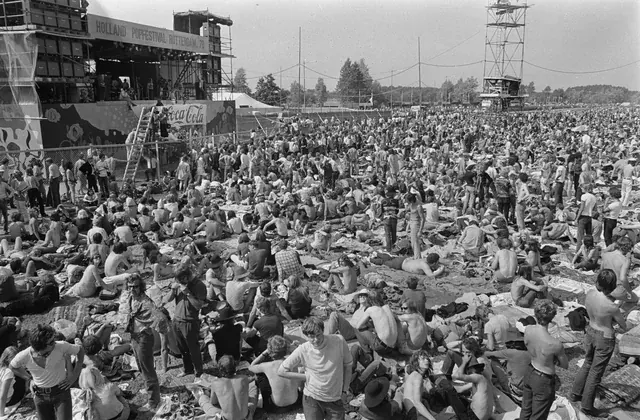
Kralingse Bos is a park landscape rather than a remote farm. That setting placed counterculture inside a modern city rebuilding its identity. Photographs from the Nationaal Archief and Dutch press agencies show grass packed with seated listeners, tents at the edge of the grounds, service workers in “We help you” shirts, bicycles, improvised shelter and the enormous residue left when the crowd departed.
The Stadsarchief Rotterdam notes that organisers expected around 30,000 people and that the actual crowd was certainly larger; some accounts rise to 100,000. The archive itself treats the exact number as disputed. That is the responsible position. Turnstile counts become unreliable when fences and admission cease to describe the whole site. The images establish scale without requiring a false exact total.

The musical programme
Kralingen's bill was international and stylistically unsettled. Jefferson Airplane and Canned Heat carried highly visible American festival culture. Santana connected Latin percussion, blues guitar and the breakthrough associated with Woodstock. The Byrds arrived with a changing version of folk rock and country rock. Dr. John brought New Orleans musical theatre; Fairport Convention represented British folk-rock; Soft Machine occupied the border between Canterbury, jazz and experimental rock.
Pink Floyd's appearance tied the festival to a more expansive British progressive language, although surviving records should be consulted before making exact claims about set order or every performed piece. Dutch groups and European artists were not merely support around American and British stars. Their presence located the event within a continental network whose festivals, clubs and films increasingly allowed music to circulate independently of Anglo-American radio.
What the audience experienced
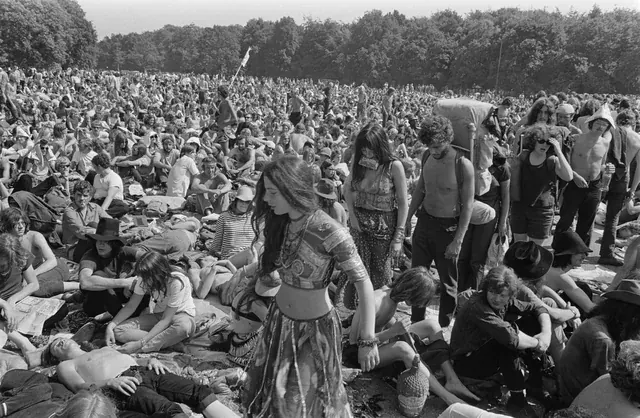
The archive records heat, rain, waiting and movement through the park, but no single visitor experienced “the crowd” as one thing. Some watched from near the stage; others camped, wandered or treated the grounds as a social world in their own right. The visibility of bare chests, flowers, improvised clothing and communal rest made the event easy for press photographers to frame as a Dutch version of hippie culture.
That visual language can become a stereotype if detached from practical detail. People still needed water, food, toilets, directions and protection from weather. The “We help you” service organisation visible in the photographs is a reminder that apparent informality required labour. Counterculture at scale did not remove administration; it forced administration to improvise in public.

Stage, sound and production
The broad stage and densely occupied field show a production built for distance. As at Bath and Isle of Wight, the challenge was not just making the music loud. Engineers had to preserve enough definition for groups built around vocal harmony, acoustic instruments, percussion or extended electric improvisation. A single festival system had to serve them in rapid succession.
Film added another production layer. Stamping Ground selected performances and audience images to create an international document. As with Monterey Pop and Woodstock, the film is evidence and interpretation at the same time. It preserves movement, sound and faces that still photography cannot, yet its edit is not the complete running order and should not be used as if every omitted artist were absent from the historical event.
Problems and the morning after
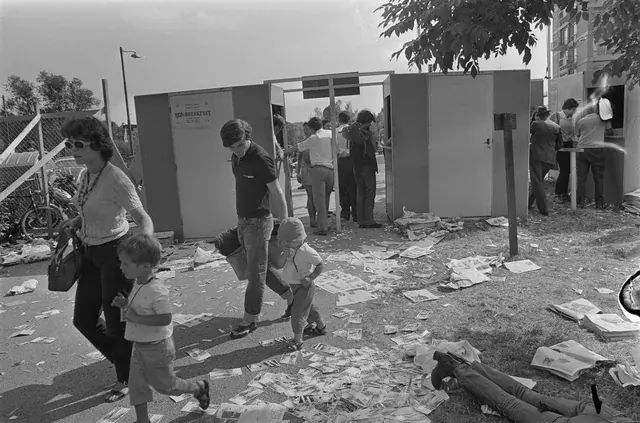
Rain, crowd pressure and access complicated the weekend. Admission control weakened, and a production designed around paying attendance could not recover costs in the way intended. The festival's aftermath is unusually well documented in Dutch photographs: tents being dismantled, visitors leaving, rubbish spread across the field and workers beginning the clean-up. These images resist the habit of ending festival history with the final encore.
The debris does not prove a simple moral about the audience. Any temporary city produces waste, especially when infrastructure is overwhelmed. It does show that the cultural promise of freedom transferred practical costs to organisers, workers and public space. The ideal and the clean-up belonged to the same event.

What happened afterward
Holland Pop Festival did not become an annual Kralingen institution. Its financial and organisational difficulties worked against repetition, while the wider festival economy was already changing. The documentary ensured that the event remained visible beyond those who had attended. Dutch archives, anniversary projects and a local monument later returned attention to the place itself.
The 2020 fiftieth-anniversary work is significant because it brought together organisers, images, recordings and public memory rather than leaving the festival as a borrowed “Dutch Woodstock” label. Kralingen can stand on its own historical ground: an event made possible by Rotterdam's particular openness, shaped by an international bill and preserved through an exceptionally strong Dutch photographic archive.
Films, recordings and surviving documents
Stamping Ground remains the best-known moving-image document, but Dutch public archives give Kralingen an unusually detailed still record. Nationaal Archief photographs identify dates, agencies and file numbers; Stadsarchief Rotterdam connects the festival to C70 and municipal history; Sound & Vision records broadcast and film material. Together they prevent the story from depending on one commercial documentary.
The image credits on this page are deliberately visible. Anefo and Fotoburo De Boer photographers documented crowds, artists, service workers and aftermath, and the later CC0 release of many files allows broad reuse. Public-domain access does not erase authorship. Naming the photographer or agency preserves the documentary chain that makes each image useful.
A Dutch event, not a borrowed myth
Calling Kralingen “the Dutch Woodstock” helps readers locate its scale and period, and the phrase appears in Dutch institutional accounts. It becomes misleading when it implies that the Rotterdam event had no identity beyond imitation. Kralingen was connected to municipal reconstruction culture, Dutch media, European touring routes and a park that residents still recognise.
The comparison should open the subject rather than close it. Woodstock supplied an international image of possibility; Rotterdam provided the political opportunity and physical place; Dutch organisers and workers built the event that actually occurred.
Legacy
Kralingen widened the imaginable scale of Dutch pop culture. Later festivals developed more durable organisations, recurring identities and professional infrastructures, but they inherited a question that Holland Pop had made visible: how can a temporary gathering remain open, adventurous and socially meaningful while still functioning as a safe and financially coherent event?
The answer was not solved in 1970. That is why the festival still matters. It is both a record of possibility and a case study in limits, captured with unusual clarity by photographers whose work now sits in public archives under reusable rights.
Follow the festival beyond the field
Timeline
Related genres
Related band guides
Explore by sound
Essential listening
RetroForge Echo
Hear a Fictional Archive Response
These modern RetroForge releases echo part of the festival’s musical vocabulary; they are not historical festival recordings.
Sources and further reading
- Holland PopfestivalStadsarchief Rotterdam · accessed 23 July 2026
- Kralingen 1970 photographic collectionNationaal Archief · accessed 23 July 2026
- Poptoday archive recordNetherlands Institute for Sound & Vision · accessed 23 July 2026
- Holland Pop Festival 1970–2020Holland Pop Festival foundation project · accessed 23 July 2026
- Holland Pop 1970 documentary programmeKINO Rotterdam · accessed 23 July 2026
Image credits5 licensed images
A wide view of audience and stage in the Kralingse Bos, showing the festival as both concert and temporary settlement — Anefo — Nationaal Archief / Wikimedia Commons — CC0 · source record · CC0
Converted to WebP and resized; no generative or compositional alterations.
Festivalgoers at Kralingen in June 1970 — Rob Mieremet (ANEFO) — Nationaal Archief / Wikimedia Commons — CC0 · source record · CC0
Converted to WebP and resized; no generative or compositional alterations.
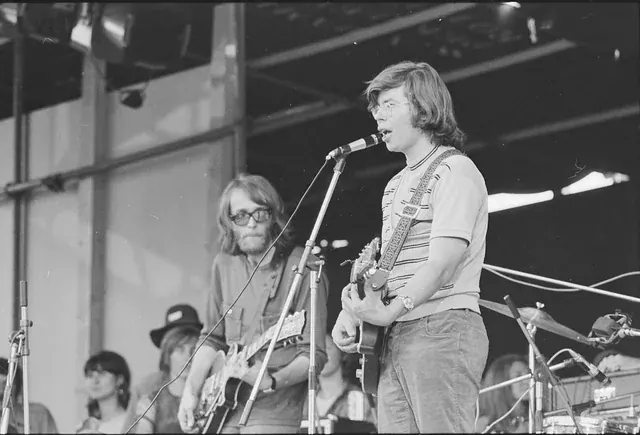
Canned Heat at Kralingen — Fotoburo De Boer — Nationaal Archief / Wikimedia Commons — CC0 · source record · CC0
Converted to WebP and resized; no generative or compositional alterations.
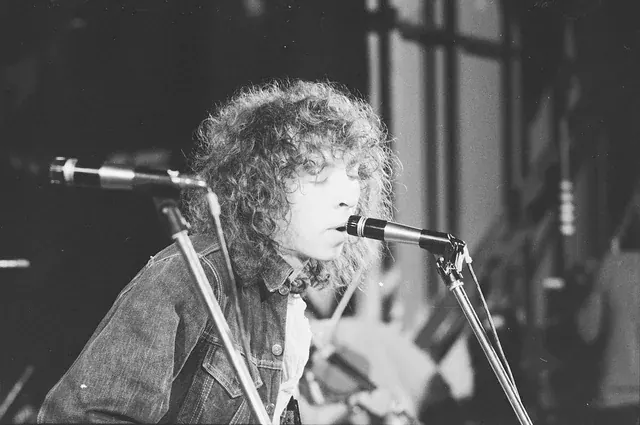
Fairport Convention at Kralingen, evidence of the festival's range beyond a single idea of psychedelic rock — Fotoburo De Boer — Nationaal Archief / Wikimedia Commons — CC0 · source record · CC0
Converted to WebP and resized; no generative or compositional alterations.
Tickets from Holland Pop Festival — Rob Mieremet (ANEFO) — Nationaal Archief / Wikimedia Commons — CC0 · source record · CC0
Converted to WebP and resized; no generative or compositional alterations.