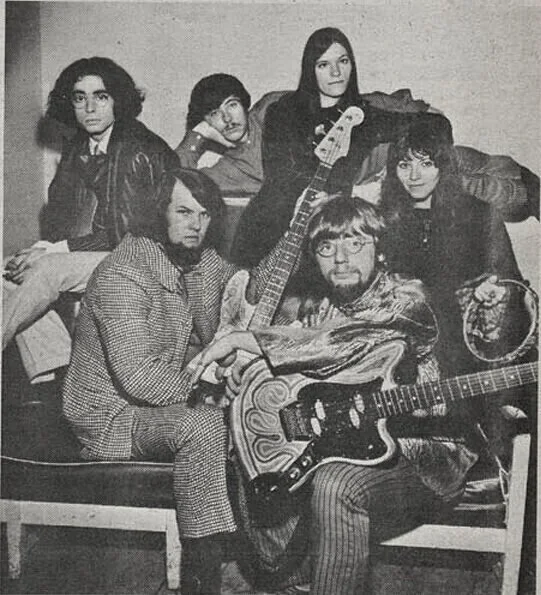
Ultimate Spinach began as the Underground Cinema, a Boston-area group led by singer, songwriter and multi-instrumentalist Ian Bruce-Douglas. After producer Alan Lorber renamed and signed them, MGM placed the band at the front of the “Bosstown Sound,” a coordinated attempt to market Boston as a counterpart to San Francisco. The campaign brought national attention and immediate suspicion in almost equal measure.
The music deserves to be separated from that slogan without pretending the slogan was irrelevant. Bruce-Douglas wrote every song on the first two albums and used organ, electric piano, vibraphone, flute, theremin, sitar and guitar to frame anti-war unease and disillusion. Barbara Hudson’s cooler voice and guitar provide an important counterweight. The third album belongs to another chapter: Bruce-Douglas was gone, and a rebuilt group led by Ted Myers and Tony Scheuren moved toward psychedelic pop, blues rock and concise song forms.
Ultimate Spinach in a 1968 KRLA Beat photograph.Photo: Unknown author This is a retouched picture , which means that it has been digitally altered from its original version. Modifications made by Dcameron814 . / Wikimedia Commons · Licensed under Public domain. Converted to WebP for this page.
Formation & History
Bruce-Douglas formed Underground Cinema with Hudson, drummer Keith Lahteinen, guitarist Geoff Winthrop and bassist Richard Nese. The group played the Boston Tea Party in July 1967 and signed with Lorber that September. Renamed Ultimate Spinach, they recorded nine Bruce-Douglas compositions at Bell Sound in New York. MGM released the debut in January 1968 alongside heavily promoted records by other Boston groups; it became the band’s strongest commercial release.
Lahteinen left after the debut sessions and Russell Levine took over drums. The strained second-album sessions lasted roughly ten days at Mayfair in New York, with Bruce-Douglas writing much of Behold & See under pressure. He departed after its August 1968 release. Lorber, who controlled the band name and still owed MGM a third album, assembled Hudson and Levine with former Chamaeleon Church writers Ted Myers and Tony Scheuren, bassist Mike Levine and guitarist Jeff “Skunk” Baxter. That line-up recorded Ultimate Spinach III in December 1968. It appeared in 1969, failed to continue the early momentum, and the project ended that year.
Sound & Style
The debut’s studio palette is unusually broad. Bruce-Douglas can move from the clipped organ of “Sacrifice of the Moon” to vibraphone, recorder, electric sitar or theremin colour, while fuzz guitar and sustained feedback darken the edges. “Ballad of the Hip Death Goddess” extends a minor-key procession over eight minutes; shorter pieces such as “Ego Trip” compress the same unease into garage-rock scale. Hudson’s restrained singing cuts through the more declamatory male vocals.
Behold & See is less dependent on electric keyboards and gives guitar, voices and long suites more space. “Mind Flowers” grows from a slow vocal design into dense fuzz, “Jazz Thing” uses modal movement and ensemble interplay, and the four-part “Genesis of Beauty” approaches the album as a continuous sequence. The third LP abandons that Bruce-Douglas language. Baxter’s guitar and Scheuren’s keyboards support a stylistically scattered mix of pop-soul cover, harmony pop, acoustic writing and harder blues rock.
Essential Albums
1968
Ultimate Spinach
MGM · Original 1968 release
All nine pieces on the debut were written by Ian Bruce-Douglas, and the sequence already separates the group from a simple garage-band model. “Ego Trip” drives on a compact riff, while the instrumental “Sacrifice of the Moon” opens the arrangement to organ, vibraphone and shifting studio colour. The eight-minute “Ballad of the Hip Death Goddess,” sung by Barbara Hudson, is the centrepiece: a slow, minor-key procession that turns the album’s anti-war anxiety and generational disillusion into atmosphere rather than slogan.
Key tracks: Ego Trip · Sacrifice of the Moon · Ballad of the Hip Death Goddess
The second album stretches fewer compositions across longer forms. After the brief entrance of “Gilded Lamp of the Cosmos,” “Mind Flowers” moves from measured vocal lines into a dense surge of fuzz guitar; “Jazz Thing” exchanges pop structure for modal ensemble playing. The nearly ten-minute, four-part “Genesis of Beauty” closes the record as a connected suite. Compared with the debut, keyboards recede and guitars, voices and extended transitions carry more of the architecture.
Key tracks: Gilded Lamp of the Cosmos · Jazz Thing · Mind Flowers
This is not a third Ian Bruce-Douglas album: he had left, and only Barbara Hudson and drummer Russell Levine carried over from the preceding line-up. Ted Myers and Tony Scheuren supplied most of the new writing, with Jeff Baxter on lead and steel guitar. The result moves between the pop-soul cover “(Just Like) Romeo and Juliet,” the concise “Daisy,” the extended guitar workout “Eddie’s Rush” and the harmony-rich “The World Has Just Begun.” Its stylistic fracture is the point—it documents what happened when a record contract and a band name outlasted the group that established them.
Key tracks: Romeo and Juliet · Happiness Child · The World Has Just Begun
The cleanest way to hear this catalogue is to respect its authorship boundary. Bruce-Douglas wrote and arranged the first two albums; their recurring keyboard colours, long modal sections and pessimistic lyrics form one body of work. Ultimate Spinach III retains the name, Hudson and Russell Levine, but its principal writers, instrumental centre and song forms belong to a reconstructed group. Treating all three records as one stable style obscures both phases.
“Bosstown Sound” also needs careful handling. Boston had an active club circuit and several ambitious groups, but the phrase was a producer-led promotional umbrella rather than a musical school with one shared method. Contemporary hostility toward the campaign helps explain the band’s reception; it does not, by itself, settle the value of the records underneath it.
Ultimate Spinach remain a sharp example of how an industry narrative can reach the audience before the music does. The Bosstown campaign secured visibility but also invited critics to treat the group as a manufactured claim. Returning to the first two LPs reveals something more specific: Bruce-Douglas’s unusual multi-instrumental arrangements, Hudson’s contrasting voice and an East Coast psychedelia that is darker and less celebratory than the advertising implied.
The third album adds a different kind of historical value. Its abrupt change of writers and sound shows how ownership of a name could preserve a commercial identity after its creative centre had disappeared. Heard with that break made explicit, the catalogue becomes both a musical record and a case study in late-1960s record-business packaging.
RetroForge Records publishes original music and independent editorial guides. This historical band guide is not affiliated with the artist, labels or rights holders. No unlicensed album artwork is reproduced.