Both belong to the progressive story. Then the year keeps going. Mike Oldfield releases Tubular Bells. Genesis releases Selling England by the Pound. Emerson, Lake & Palmer deliver Brain Salad Surgery. In Britain, Yes caps the year with Tales from Topographic Oceans, four compositions stretched across four sides of vinyl. In Italy, Le Orme releases Felona e Sorona and Banco del Mutuo Soccorso releases Io sono nato libero.
In Germany, Can releases Future Days, Faust releases Faust IV, Neu! releases Neu! 2 and Tangerine Dream moves deeper into electronic territory with Atem. Trying to reduce all of that to one definition of "progressive rock" is hopeless. That is exactly why 1973 is so interesting. The genre had become mature enough to possess an identity and still loose enough to escape it.
The Year Between Discovery and Formula
Progressive rock did not suddenly appear in 1973. Its ingredients had been developing for years. Psychedelia had expanded the sonic vocabulary of rock. The Beatles, the Beach Boys, Jimi Hendrix and countless studio experimenters had shown how dramatically recording technology could reshape a song. Bands such as King Crimson, Yes, Genesis, Van der Graaf Generator and Emerson, Lake & Palmer had already pushed long-form composition, unusual metre and non-rock influences deep into the mainstream album world.
By 1971 and 1972, progressive rock was already producing major statements. So what changes in 1973? Confidence. The early question had been: Can a rock band do this? By 1973, the answer was obviously yes. The new question was: How far can we take it? That shift produced very different answers.
One Genre, Five Records, Almost No Agreement
Five major releases from the year show just how little agreement there was about what progressive rock should sound like.
Pink Floyd – The Dark Side of the Moon
This is progressive rock as control. Songs flow into one another. Tape loops, synthesizers, spoken voices, studio effects and thematic repetition create a continuous psychological environment. Yet the album is remarkably concise by progressive standards. There are no twenty-minute demonstrations of instrumental gymnastics. Complexity serves atmosphere and theme. Its commercial success matters because it destroys the idea that ambitious album construction had to remain a specialist taste. A conceptual, technologically sophisticated record could become mass culture.
King Crimson – Larks' Tongues in Aspic
If Dark Side feels engineered to the millimetre, Larks' Tongues feels dangerous. Percussion clatters. Violin cuts through the band. Quiet passages create almost unbearable space. Then distorted guitar arrives with the delicacy of collapsing machinery. The album draws from rock, experimental composition and improvisation without smoothing the seams. This is progressive music not as polish, but as instability.
Mike Oldfield – Tubular Bells
Here the "band" itself almost disappears. Oldfield constructs a vast instrumental work through overdubbing, layering guitars, keyboards, percussion and other instruments into a piece that feels simultaneously composed and assembled. It belongs partly to progressive rock, partly to minimalism, partly to folk and partly to a category of its own invention. Its success proves another point: a long-form, largely instrumental studio construction could capture a huge audience without behaving anything like a conventional rock album.
Genesis – Selling England by the Pound
Genesis takes yet another route. English surrealism, pastoral acoustic passages, theatrical vocals, intricate ensemble playing and some of the band's most confident instrumental writing coexist without feeling like a demonstration exercise. The record is elaborate, but the elaboration increasingly serves character. By this stage, progressive rock's vocabulary is no longer the subject. Genesis can simply speak it.
Yes – Tales from Topographic Oceans
Then Yes closes the year by taking the LP format almost literally. Four sides. Four compositions. Each piece roughly occupies one side of vinyl. Whatever your opinion of the album, it represents a staggering level of cultural permission. A commercially successful rock band could ask listeners to buy a double LP containing no conventional short songs at all.
Progressive rock had reached the point where excess could itself become an artistic premise. Five records. Five completely different ideas about what ambition means. That is 1973.
The LP Was Not Packaging. It Was Architecture.
This period makes less sense if we imagine albums as playlists. A vinyl record divides listening into sides. That physical structure gave progressive composers a useful frame. A side could hold one extended work. It could contain several linked pieces. It could end on a unresolved moment that forced the listener to cross the room and turn the record over.
Running time became architectural. The limitation encouraged large shapes: openings, midpoints, side closers, reprises. Yes exploited the side-long form directly. Mike Oldfield used the two sides of Tubular Bells as enormous compositional spans. Pink Floyd created transitions that made individual tracks part of a continuous journey. The medium was helping write the music. For more on that relationship, see The Art of the Album Side.
Technology Had Reached a Productive Level of Inconvenience
There is a technical reason 1973 sounds like a threshold. Studios had become powerful. Multitrack recording supported elaborate overdubs. Synthesizers were becoming increasingly important. Tape editing allowed radical restructuring. Plate reverbs, tape echoes and sophisticated consoles gave engineers deep control over space. The Mellotron could provide orchestral textures inside a rock arrangement. At the same time, none of this was frictionless.
Track counts were finite. Tape wore. Edits required blades. Mix automation was limited. Synthesizers drifted. Complex recording decisions accumulated consequences. The technology was capable enough to encourage impossible ideas and difficult enough to force commitment. That is a potent combination. For a walk through the actual workflow, see How a 1970s Recording Studio Actually Worked.
Keyboards Had Escaped the Background
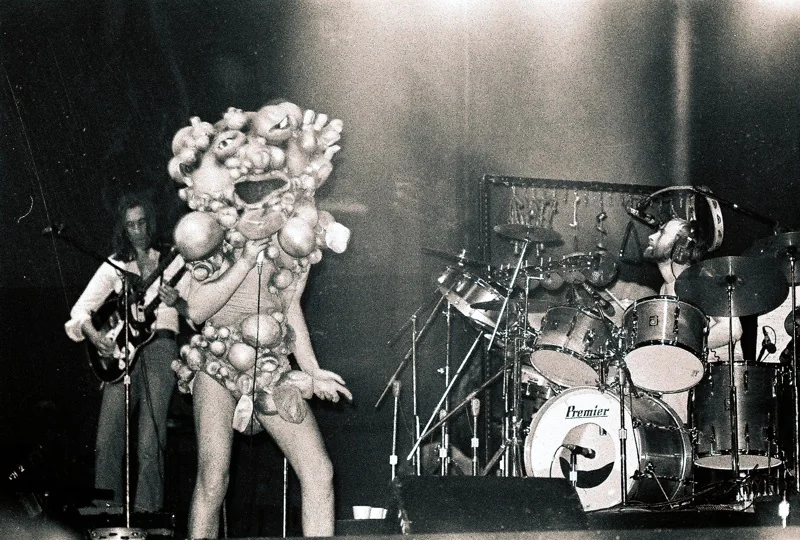
Rock music had already spent years expanding beyond guitar dominance, but progressive rock made keyboards structural. The Hammond organ could lead an arrangement rather than decorate it. The Mellotron could turn one sustained chord into orchestral scale. The Minimoog and other synthesizers allowed a keyboard player to carry melody with a timbre that had no acoustic equivalent.
Piano could provide classical articulation. Electric pianos introduced another colour entirely. A single keyboard player might move among several instruments during one composition because no one sound could satisfy the arrangement. That helped progressive music become more vertically complex. Guitar no longer had to fill every harmonic role. A band could distribute weight across organ, piano, Mellotron, synth and guitar and still remain recognisably rock.
The Mellotron's particular role in that sound is explored in Why Progressive Rock Loved the Mellotron.
Italy Was Not Waiting for Britain
Any account of 1973 that stays entirely in Britain misses one of the most vibrant progressive scenes of the period. Italian progressive rock had absorbed the broad possibilities of the genre and developed its own dramatic language. Le Orme's Felona e Sorona is one of the year's defining Italian releases, a compact concept album rich in organ, synthesizer and melodic development.
Banco del Mutuo Soccorso's Io sono nato libero takes a more expansive path, with extraordinary keyboard writing, theatrical vocals and long-form composition. Premiata Forneria Marconi was simultaneously reaching international listeners, helping demonstrate that progressive rock was not an English export with regional copies. The Italian scene often carried different musical instincts: opera, classical traditions, Mediterranean melody, theatrical vocal expression and a particular appetite for drama.
The point is not that Italy had its own version of British prog. It had its own prog. That difference matters.
Germany Was Asking a More Radical Question
Across Germany, another family of musicians was pulling rock apart from a different direction. Can's Future Days is spacious, fluid and almost aquatic. Rhythm becomes less a sequence of rock accents than a current carrying the music forward. Neu! 2 continues the radical reduction and repetition associated with the motorik approach. Faust IV remains difficult to place neatly anywhere, shifting between repetition, noise, song fragments and studio experiment.
Tangerine Dream's Atem pushes toward long electronic environments that anticipate the Berlin School direction soon to emerge more clearly. Calling all of this progressive rock can flatten important distinctions. "Krautrock" itself is an awkward umbrella over radically different artists. But historically these scenes belong in the same conversation. British prog often asked how much composition rock could absorb.
German experimental music often asked how much rock could be removed before something more interesting appeared. In 1973, both questions were producing extraordinary records.
Electronic Music Was Becoming a Parallel Future
Synthesizers had already entered rock, but their role was changing. The early novelty phase was fading. An electronic tone no longer had to represent outer space or serve as a strange decoration. It could form the basis of an arrangement. Musicians could build pieces from drones, sequenced patterns, filters, noise and gradual timbral change. The instrument did not need to imitate strings, brass or organ.
It could sound electronic on purpose. That distinction leads directly toward Berlin School, ambient and the wider progressive electronic tradition. The 1970s would soon produce entire albums in which the synthesizer was not an addition to the band. It was the environment. See Progressive Electronic Music Before the Digital Age for that broader story.
Virtuosity Became a Spectator Sport

A progressive audience in 1973 was increasingly prepared to admire musicianship as part of the event. Complex metre. Long instrumental development. Keyboard parts requiring independent hands moving across multiple manuals. Bass lines that refused to behave like support. Drummers carrying shifting structures without losing momentum. Guitarists moving from delicate acoustic textures into violent electric passages.
This could become indulgent, and later criticism of progressive rock would attack exactly that tendency. But virtuosity was not only speed. It was control over form. A band had to remember where it was inside a twelve-minute composition. A drummer had to make an odd metre feel physical instead of mathematical. A keyboardist had to change instruments and timbres while the piece continued.
Technical skill became part of storytelling. At its best, you forgot how difficult the music was because the musicians made the architecture move.
Why Listeners Allowed It
None of this happens without an audience. That is easy to overlook when discussing the records themselves. Listeners bought albums as primary objects. Freeform and progressive FM radio, alongside emerging album-oriented formats, could accommodate longer album cuts that Top 40 radio often would not. Music magazines discussed LPs as substantial works. Record shops rewarded curiosity. Gatefold sleeves, lyric sheets and artwork gave listeners more material to investigate while the record played.
Most importantly, repeated listening was normal. A difficult album did not have to reveal itself in the first thirty seconds before the listener swiped away. You owned it. It sat in the room. You played it again. Progressive rock benefited enormously from that relationship. Some music needs time to teach you how to hear it. In 1973, a commercially meaningful audience was willing to learn.
Why 1973 and Not 1971?
There is a strong argument for 1971 as progressive rock's greatest year. It produced an astonishing concentration of classics and caught several major bands during explosive periods of invention. So why single out 1973? Because 1973 shows the breadth of what the progressive impulse had become. By then:
- symphonic prog was mature
- concept albums could be mass-market events
- side-long compositions were commercially viable
- studio construction could replace the conventional band
- Italian prog had a powerful identity
- German experimental rock was flourishing
- synthesizer-based music was moving toward its own future
- virtuosity had become part of rock spectacle
- production technology could support extreme ambition
1971 feels like a breakthrough. 1973 feels like an ecosystem. That is a different kind of greatness.
The Sound of 1973
The recordings themselves also occupy a particular sonic moment. They can be dense without being flattened. Bass is powerful without always reaching modern sub frequencies. Drums retain rooms and air. Keyboards occupy enormous amounts of midrange without automatically burying guitar. Tape adds cohesion. Stereo can be bold. Reverb feels like a place. Quiet passages are genuinely quiet.
The records are sophisticated enough to feel meticulously produced, but the machinery still leaves audible fingerprints. For the technical side of that character, see Why Did 1970s Records Sound So Different?.
And Then the Door Began to Narrow
Part of what makes peaks visible is knowing they do not last. Progressive rock did not collapse in 1974. Major records continued to appear. New subgenres and regional scenes continued developing. Some artists made their strongest work later. But the conditions around the music were beginning to change. The scale of tours grew. Budgets grew.
Expectations grew. Certain stylistic habits became easier to imitate. What had once been a refusal of formula could itself become a formula. Later in the decade, punk's rhetoric often defined itself against the perceived virtuosity, scale and excess of established rock, progressive rock included, while changing economics and popular taste shifted the centre of rock culture. None of that invalidates the music. It simply makes 1973 feel unusually open. The genre had accumulated power without yet becoming trapped by its own image.
Put Five Records on the Table
If you want to understand the year, do not begin with a definition. Begin with records. Put The Dark Side of the Moon, Larks' Tongues in Aspic, Tubular Bells, Selling England by the Pound and Future Days beside one another. Do they sound like one genre? Not really. Good. Listen for what they share instead.
Confidence in the album format. Willingness to let pieces unfold. Trust in the listener. Interest in timbre. A refusal to treat rock instrumentation as fixed. A studio used creatively rather than invisibly. The belief that a record could create its own rules and spend forty minutes teaching them to you. That is what made 1973 extraordinary.
Not that progressive rock had finally discovered one perfect sound. It was that, for a while, nobody seemed especially interested in agreeing what that sound should be.